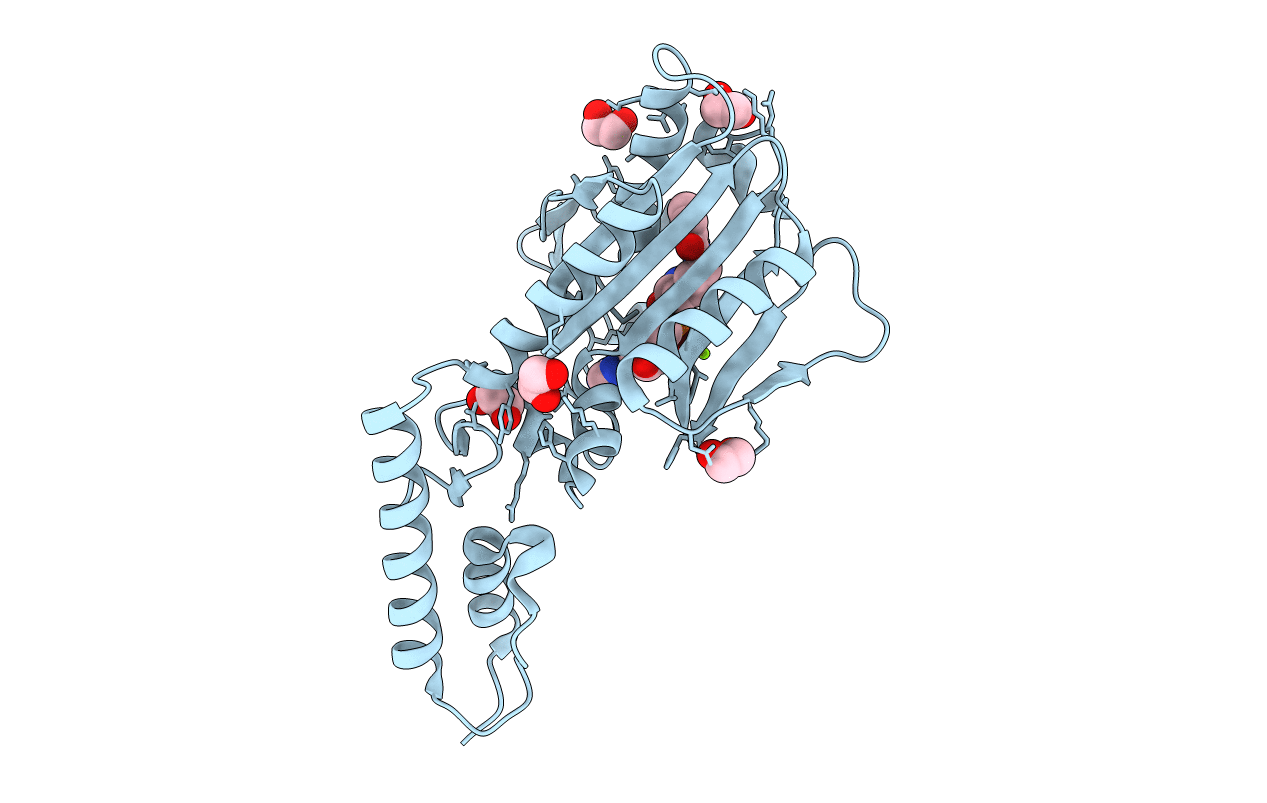
4CH3 image
Deposition Date 2013-11-28
Release Date 2014-03-19
Last Version Date 2023-12-20
Entry Detail
PDB ID:
4CH3
Keywords:
Title:
Structure of pyrrolysyl-tRNA synthetase in complex with adenylated butyryl lysine
Biological Source:
Source Organism:
Host Organism:
Method Details:
Experimental Method:
Resolution:
2.28 Å
R-Value Free:
0.19
R-Value Work:
0.17
R-Value Observed:
0.17
Space Group:
P 64

Macromolecular Entities
Structures with similar UniProt ID
Protein Blast
Polymer Type:polypeptide(L)
Molecule:PYRROLYSINE--TRNA LIGASE
Gene (Uniprot):pylS
Chain IDs:A
Chain Length:291
Number of Molecules:1
Biological Source:METHANOSARCINA MAZEI
Primary Citation
Structural Basis for the Site-Specific Incorporation of Lysine Derivatives Into Proteins.
Plos One 9 96198 ? (2014)
PMID: 24760130 DOI: 10.1371/JOURNAL.PONE.0096198

Abstact

Posttranslational modifications (PTMs) of proteins determine their structure-function relationships, interaction partners, as well as their fate in the cell and are crucial for many cellular key processes. For instance chromatin structure and hence gene expression is epigenetically regulated by acetylation or methylation of lysine residues in histones, a phenomenon known as the 'histone code'. Recently it was shown that these lysine residues can furthermore be malonylated, succinylated, butyrylated, propionylated and crotonylated, resulting in significant alteration of gene expression patterns. However the functional implications of these PTMs, which only differ marginally in their chemical structure, is not yet understood. Therefore generation of proteins containing these modified amino acids site specifically is an important tool. In the last decade methods for the translational incorporation of non-natural amino acids using orthogonal aminoacyl-tRNA synthetase (aaRS):tRNAaaCUA pairs were developed. A number of studies show that aaRS can be evolved to use non-natural amino acids and expand the genetic code. Nevertheless the wild type pyrrolysyl-tRNA synthetase (PylRS) from Methanosarcina mazei readily accepts a number of lysine derivatives as substrates. This enzyme can further be engineered by mutagenesis to utilize a range of non-natural amino acids. Here we present structural data on the wild type enzyme in complex with adenylated ε-N-alkynyl-, ε-N-butyryl-, ε-N-crotonyl- and ε-N-propionyl-lysine providing insights into the plasticity of the PylRS active site. This shows that given certain key features in the non-natural amino acid to be incorporated, directed evolution of this enzyme is not necessary for substrate tolerance.

Legend

Protein

Chemical

Disease

Primary Citation of related structures
Feedback Form
Name
Email
Institute
Feedback