4CCA image
Deposition Date 2013-10-21
Release Date 2013-10-30
Last Version Date 2023-12-20
Entry Detail
PDB ID:
4CCA
Title:
Structure of human Munc18-2
Biological Source:
Source Organism:
HOMO SAPIENS (Taxon ID: 9606)
Host Organism:
Method Details:
Experimental Method:
Resolution:
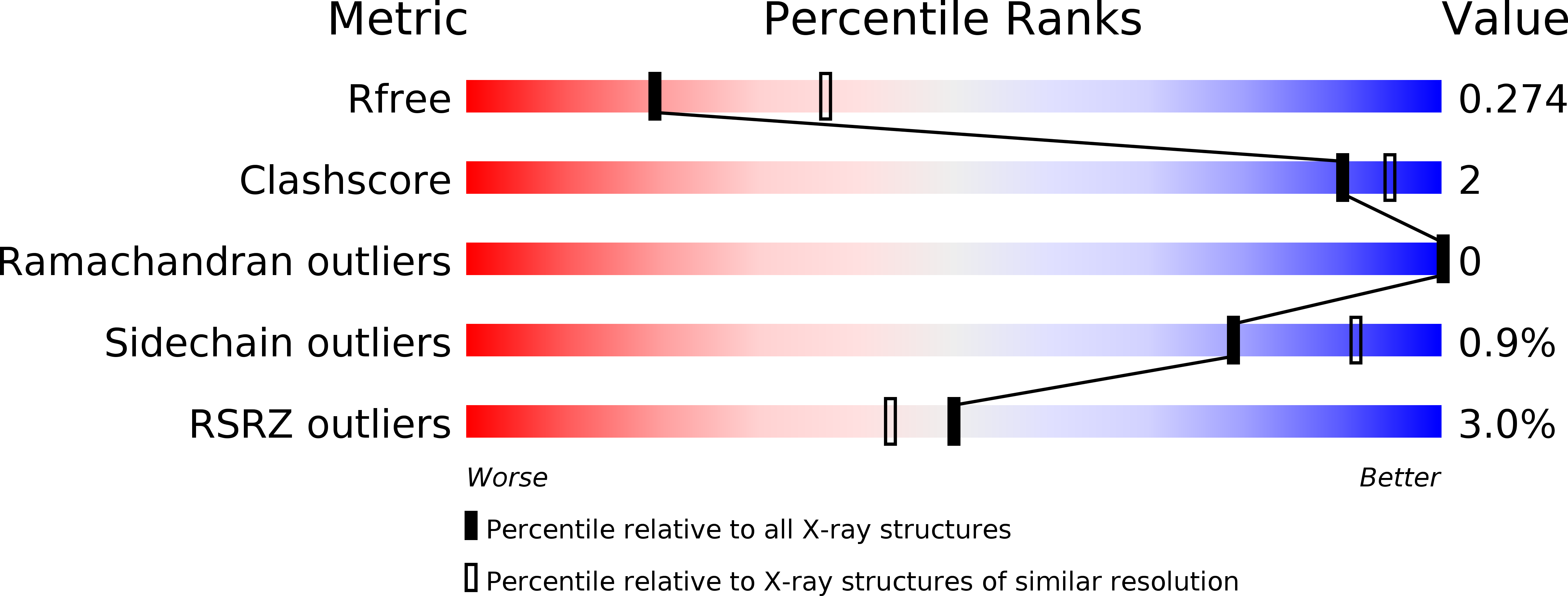
2.60 Å
R-Value Free:
0.27
R-Value Work:
0.24
R-Value Observed:
0.24
Space Group:
P 41 21 2
Macromolecular Entities
Structures with similar UniProt ID
Protein Blast
Polymer Type:polypeptide(L)
Molecule:SYNTAXIN-BINDING PROTEIN 2
Gene (Uniprot):STXBP2
Chain IDs:A
Chain Length:598
Number of Molecules:1
Biological Source:HOMO SAPIENS
Ligand Molecules
Primary Citation
Syntaxin Binding Mechanism and Disease-Causing Mutations in Munc18-2
Proc.Natl.Acad.Sci.USA 110 E4482 ? (2013)
PMID: 24194549 DOI: 10.1073/PNAS.1313474110

Abstact

Mutations in either syntaxin 11 (Stx11) or Munc18-2 abolish cytotoxic T lymphocytes (CTL) and natural killer cell (NK) cytotoxicity, and give rise to familial hemophagocytic lymphohistiocytosis (FHL4 or FHL5, respectively). Although Munc18-2 is known to interact with Stx11, little is known about the molecular mechanisms governing the specificity of this interaction or how in vitro IL-2 activation leads to compensation of CTL and NK cytotoxicity. To understand how mutations in Munc18-2 give rise to disease, we have solved the structure of human Munc18-2 at 2.6 Å resolution and mapped 18 point mutations. The four surface mutations identified (R39P, L130S, E132A, P334L) map exclusively to the predicted syntaxin and soluble N-ethylmaleimide-sensitive factor accessory protein receptor binding sites of Munc18-2. We find that Munc18-2 binds the N-terminal peptide of Stx11 with a ~20-fold higher affinity than Stx3, suggesting a potential role in selective binding. Upon IL-2 activation, levels of Stx3 are increased, favoring Munc18-2 binding when Stx11 is absent. Similarly, Munc18-1, expressed in IL-2-activated CTL, is capable of binding Stx11. These findings provide potential explanations for restoration of Munc18-Stx function and cytotoxicity in IL-2-activated cells.

Legend

Protein

Chemical

Disease

Primary Citation of related structures
Feedback Form
Name
Email
Institute
Feedback