4CAO image
Deposition Date 2013-10-08
Release Date 2014-02-19
Last Version Date 2024-05-08
Entry Detail
PDB ID:
4CAO
Keywords:
Title:
Structure of rat neuronal nitric oxide synthase heme domain in complex with 7-(2-(3-(3-Fluorophenyl(propylamino)ethyl))quinolin-2- amine
Biological Source:
Source Organism:
Host Organism:
Method Details:
Experimental Method:
Resolution:
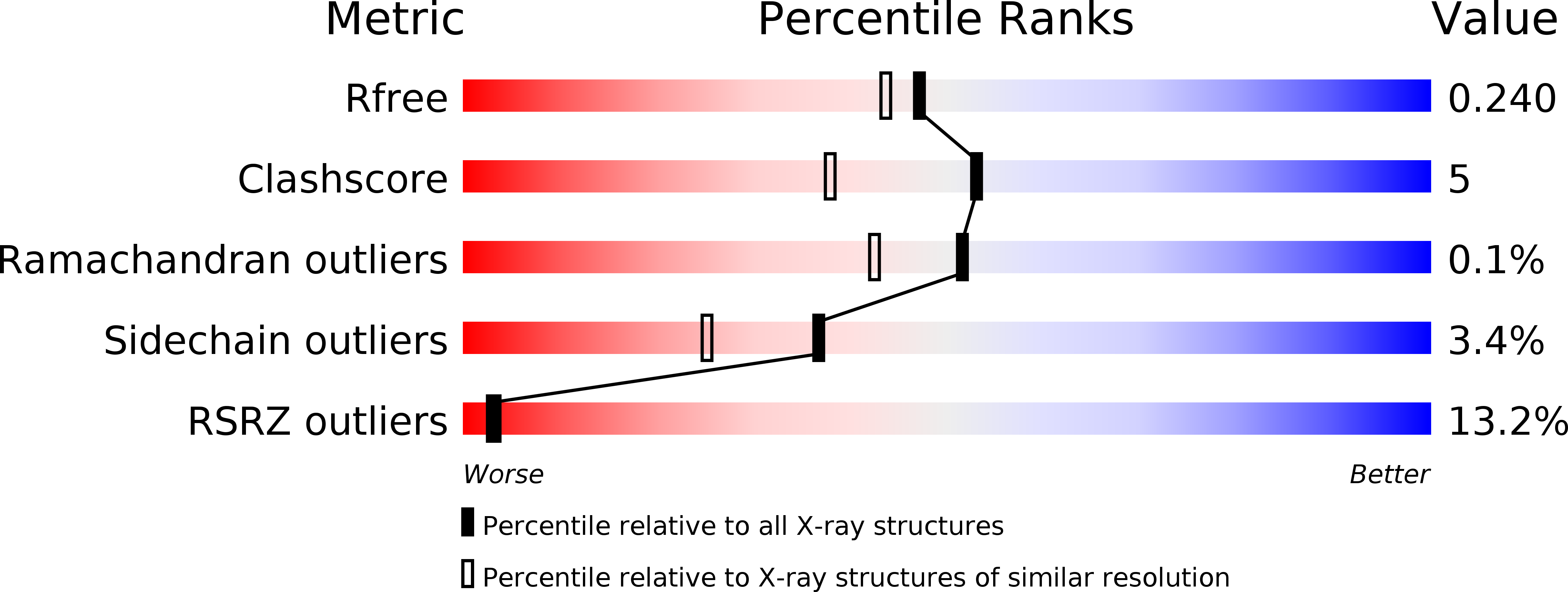
1.98 Å
R-Value Free:
0.23
R-Value Work:
0.19
R-Value Observed:
0.19
Space Group:
P 21 21 21
Macromolecular Entities
Structures with similar UniProt ID
Protein Blast
Polymer Type:polypeptide(L)
Molecule:NITRIC OXIDE SYNTHASE, BRAIN
Gene (Uniprot):Nos1
Chain IDs:A, B
Chain Length:422
Number of Molecules:2
Biological Source:RATTUS NORVEGICUS
Primary Citation
Simplified 2-Aminoquinoline-Based Scaffold for Potent and Selective Neuronal Nitric Oxide Synthase Inhibition.
J.Med.Chem. 57 1513 ? (2014)
PMID: 24472039 DOI: 10.1021/JM401838X

Abstact

Since high levels of nitric oxide (NO) are implicated in neurodegenerative disorders, inhibition of the neuronal isoform of nitric oxide synthase (nNOS) and reduction of NO levels are therapeutically desirable. Nonetheless, many nNOS inhibitors mimic l-arginine and are poorly bioavailable. 2-Aminoquinoline-based scaffolds were designed with the hope that they could (a) mimic aminopyridines as potent, isoform-selective arginine isosteres and (b) possess chemical properties more conducive to oral bioavailability and CNS penetration. A series of these compounds was synthesized and assayed against purified nNOS enzymes, endothelial NOS (eNOS), and inducible NOS (iNOS). Several compounds built on a 7-substituted 2-aminoquinoline core are potent and isoform-selective; X-ray crystallography indicates that aminoquinolines exert inhibitory effects by mimicking substrate interactions with the conserved active site glutamate residue. The most potent and selective compounds, 7 and 15, were tested in a Caco-2 assay and showed good permeability and low efflux, suggesting high potential for oral bioavailability.

Legend

Protein

Chemical

Disease

Primary Citation of related structures
Feedback Form
Name
Email
Institute
Feedback