4C0T image
Deposition Date 2013-08-07
Release Date 2013-10-23
Last Version Date 2024-11-20
Entry Detail
PDB ID:
4C0T
Keywords:
Title:
Candida albicans PKh Kinase Domain
Biological Source:
Source Organism:
Host Organism:
Method Details:
Experimental Method:
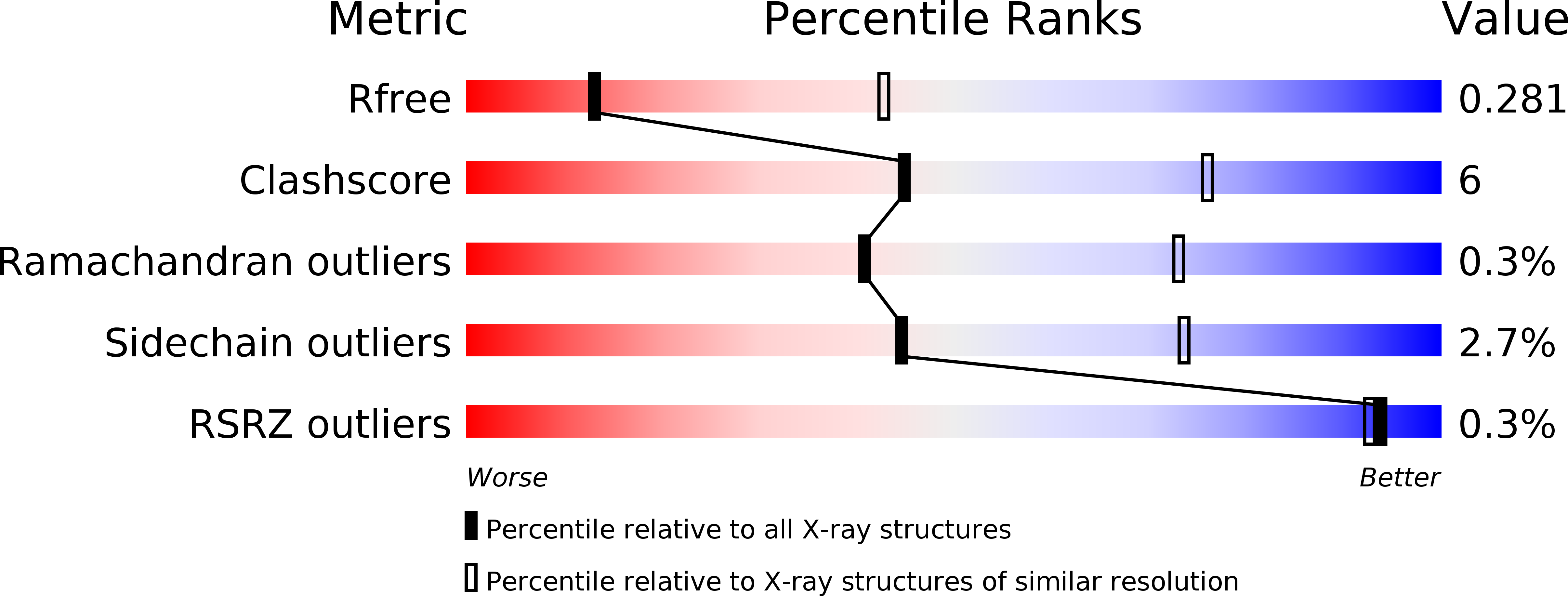
Resolution:
3.16 Å
R-Value Free:
0.27
R-Value Work:
0.22
R-Value Observed:
0.23
Space Group:
P 42 21 2
Macromolecular Entities
Structures with similar UniProt ID
Protein Blast
Polymer Type:polypeptide(L)
Molecule:LIKELY PROTEIN KINASE
Gene (Uniprot):PKH2
Chain IDs:A
Chain Length:974
Number of Molecules:1
Biological Source:CANDIDA ALBICANS
Modified Residue
Compound ID Chain ID Parent Comp ID Details 2D Image
SEP A SER PHOSPHOSERINE
Ligand Molecules
Primary Citation
The Pif-Pocket as a Target for C. Albicans Pkh Selective Inhibitors.
Acs Chem.Biol. 8 2283 ? (2013)
PMID: 23911092 DOI: 10.1021/CB400452Z

Abstact

The phosphoinositide-dependent protein kinase 1, PDK1, is a master kinase that phosphorylates the activation loop of up to 23 AGC kinases. S. cerevisiae has three PDK1 orthologues, Pkh1-3, which also phosphorylate AGC kinases (e.g., Ypk, Tpk, Pkc1, and Sch9). Pkh1 and 2 are redundant proteins involved in multiple essential cellular functions, including endocytosis and cell wall integrity. Based on similarities with the budding yeast, the Pkh of fungal infectious species was postulated as a novel target for antifungals. Here, we found that depletion of Pkh eventually induces oxidative stress and DNA double-strand breaks, leading to programmed cell death. This finding supports Pkh as an antifungal target since pharmacological inhibition of Pkh would lead to the death of yeast cells, the ultimate goal of antifungals. It was therefore of interest to further investigate the possibility to develop Pkh inhibitors with selectivity for Candida Pkh that would not inhibit the human ortholog. Here, we describe C. albicans Pkh2 biochemically, structurally and by using chemical probes in comparison to human PDK1. We found that a regulatory site on the C. albicans Pkh2 catalytic domain, the PIF-pocket, diverges from human PDK1. Indeed, we identified and characterized PS77, a new small allosteric inhibitor directed to the PIF-pocket, which has increased selectivity for C. albicans Pkh2. Together, our results describe novel features of the biology of Pkh and chemical biology approaches that support the validation of Pkh as a drug target for selective antifungals.

Legend

Protein

Chemical

Disease

Primary Citation of related structures
Feedback Form
Name
Email
Institute
Feedback