4BXD image
Deposition Date 2013-07-10
Release Date 2013-10-09
Last Version Date 2024-10-16
Entry Detail
PDB ID:
4BXD
Title:
CRYSTAL STRUCTURE OF AMPDH3 FROM PSEUDOMONAS AERUGINOSA IN COMPLEX WITH TETRASACCHARIDE PENTAPEPTIDE
Biological Source:
Source Organism:
Host Organism:
Method Details:
Experimental Method:
Resolution:
3.10 Å
R-Value Free:
0.27
R-Value Work:
0.22
R-Value Observed:
0.22
Space Group:
P 41 21 2
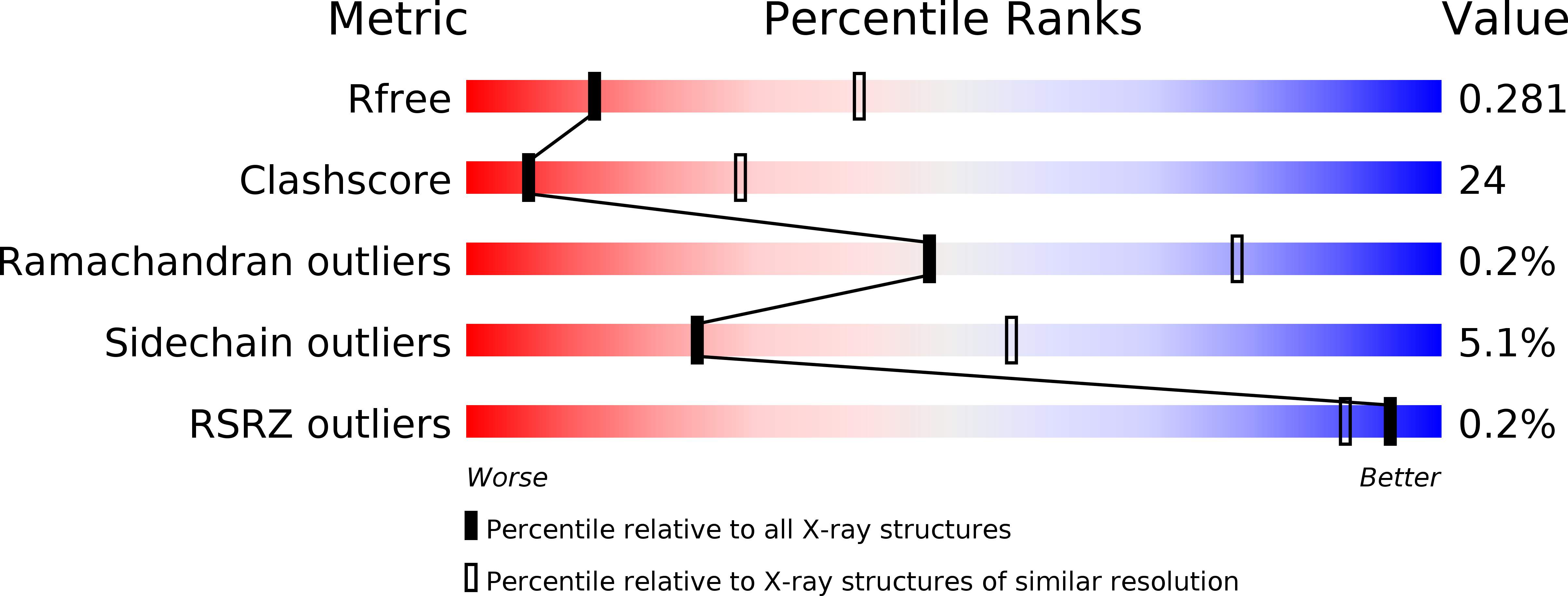
Macromolecular Entities
Structures with similar UniProt ID
Protein Blast
Polymer Type:polypeptide(L)
Molecule:AMPDH3
Gene (Uniprot):ampDh3
Chain IDs:A, B
Chain Length:255
Number of Molecules:2
Biological Source:PSEUDOMONAS AERUGINOSA PAO1
Polymer Type:polypeptide(L)
Molecule:PEPTIDE
Chain IDs:C, D
Chain Length:4
Number of Molecules:2
Biological Source:SYNTHETIC CONSTRUCT
Modified Residue
Compound ID Chain ID Parent Comp ID Details 2D Image
6CL C LYS 6-CARBOXYLYSINE
Ligand Molecules
Primary Citation
Cell-Wall Remodeling by the Zinc-Protease Ampdh3 from Pseudomonas Aeruginosa.
J.Am.Chem.Soc. 135 12604 ? (2013)
PMID: 23931161 DOI: 10.1021/JA407445X

Abstact

Bacterial cell wall is a polymer of considerable complexity that is in constant equilibrium between synthesis and recycling. AmpDh3 is a periplasmic zinc protease of Pseudomonas aeruginosa , which is intimately involved in cell-wall remodeling. We document the hydrolytic reactions that this enzyme performs on the cell wall. The process removes the peptide stems from the peptidoglycan, the major constituent of the cell wall. We document that the majority of the reactions of this enzyme takes place on the polymeric insoluble portion of the cell wall, as opposed to the fraction that is released from it. We show that AmpDh3 is tetrameric both in crystals and in solution. Based on the X-ray structures of the enzyme in complex with two synthetic cell-wall-based ligands, we present for the first time a model for a multivalent anchoring of AmpDh3 onto the cell wall, which lends itself to its processive remodeling.

Legend

Protein

Chemical

Disease

Primary Citation of related structures
Feedback Form
Name
Email
Institute
Feedback