4BWL image
Deposition Date 2013-07-03
Release Date 2014-02-19
Last Version Date 2023-12-20
Entry Detail
PDB ID:
4BWL
Keywords:
Title:
Structure of the Y137A mutant of E. coli N-acetylneuraminic acid lyase in complex with pyruvate, N-acetyl-D-mannosamine and N- acetylneuraminic acid
Biological Source:
Source Organism:
ESCHERICHIA COLI (Taxon ID: 562)
Host Organism:
Method Details:
Experimental Method:
Resolution:
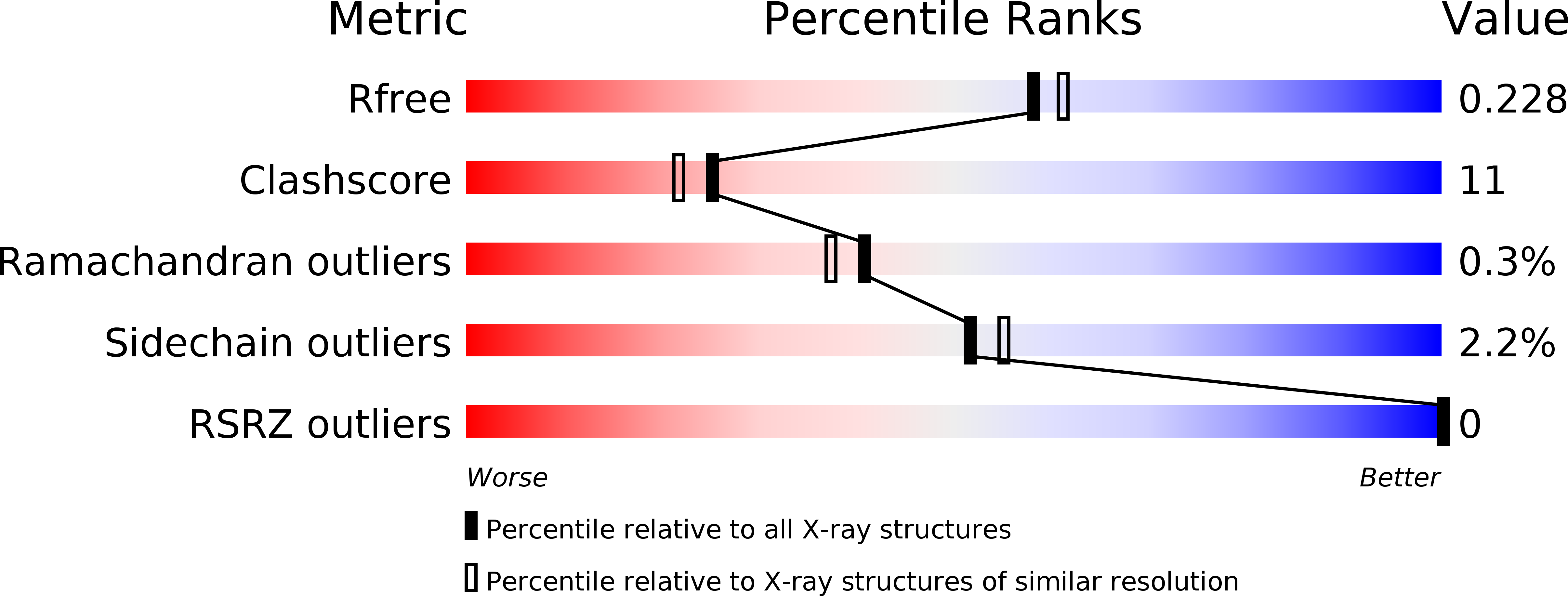
2.00 Å
R-Value Free:
0.23
R-Value Work:
0.17
R-Value Observed:
0.18
Space Group:
P 1 21 1
Macromolecular Entities
Structures with similar UniProt ID
Protein Blast
Polymer Type:polypeptide(L)
Molecule:N-ACETYLNEURAMINATE LYASE
Gene (Uniprot):nanA
Mutagens:YES
Chain IDs:A, B, D
Chain Length:304
Number of Molecules:3
Biological Source:ESCHERICHIA COLI
Structures with similar UniProt ID
Protein Blast
Polymer Type:polypeptide(L)
Molecule:N-ACETYLNEURAMINATE LYASE
Gene (Uniprot):nanA
Mutagens:YES
Chain IDs:C
Chain Length:304
Number of Molecules:1
Biological Source:ESCHERICHIA COLI
Modified Residue
Compound ID Chain ID Parent Comp ID Details 2D Image
KPI C LYS ?
Primary Citation
The Reaction Mechanism of N-Acetylneuraminic Acid Lyase Revealed by a Combination of Crystallography, Qm/Mm Simulation and Mutagenesis.
Acs Chem.Biol. 9 1025 ? (2014)
PMID: 24521460 DOI: 10.1021/CB500067Z

Abstact

N-Acetylneuraminic acid lyase (NAL) is a Class I aldolase that catalyzes the reversible condensation of pyruvate with N-acetyl-d-mannosamine (ManNAc) to yield the sialic acid N-acetylneuraminic acid (Neu5Ac). Aldolases are finding increasing use as biocatalysts for the stereospecific synthesis of complex molecules. Incomplete understanding of the mechanism of catalysis in aldolases, however, can hamper development of new enzyme activities and specificities, including control over newly generated stereocenters. In the case of NAL, it is clear that the enzyme catalyzes a Bi-Uni ordered condensation reaction in which pyruvate binds first to the enzyme to form a catalytically important Schiff base. The identity of the residues required for catalysis of the condensation step and the nature of the transition state for this reaction, however, have been a matter of conjecture. In order to address, this we crystallized a Y137A variant of the E. coli NAL in the presence of Neu5Ac. The three-dimensional structure shows a full length sialic acid bound in the active site of subunits A, B, and D, while in subunit C, discontinuous electron density reveals the positions of enzyme-bound pyruvate and ManNAc. These 'snapshot' structures, representative of intermediates in the enzyme catalytic cycle, provided an ideal starting point for QM/MM modeling of the enzymic reaction of carbon-carbon bond formation. This revealed that Tyr137 acts as the proton donor to the aldehyde oxygen of ManNAc during the reaction, the activation barrier is dominated by carbon-carbon bond formation, and proton transfer from Tyr137 is required to obtain a stable Neu5Ac-Lys165 Schiff base complex. The results also suggested that a triad of residues, Tyr137, Ser47, and Tyr110 from a neighboring subunit, are required to correctly position Tyr137 for its function, and this was confirmed by site-directed mutagenesis. This understanding of the mechanism and geometry of the transition states along the C-C bond-forming pathway will allow further development of these enzymes for stereospecific synthesis of new enzyme products.

Legend

Protein

Chemical

Disease

Primary Citation of related structures
Feedback Form
Name
Email
Institute
Feedback