4BV6 image
Deposition Date 2013-06-25
Release Date 2014-09-17
Last Version Date 2024-05-08
Entry Detail
PDB ID:
4BV6
Keywords:
Title:
Refined crystal structure of the human Apoptosis inducing factor
Biological Source:
Source Organism:
HOMO SAPIENS (Taxon ID: 9606)
Host Organism:
Method Details:
Experimental Method:
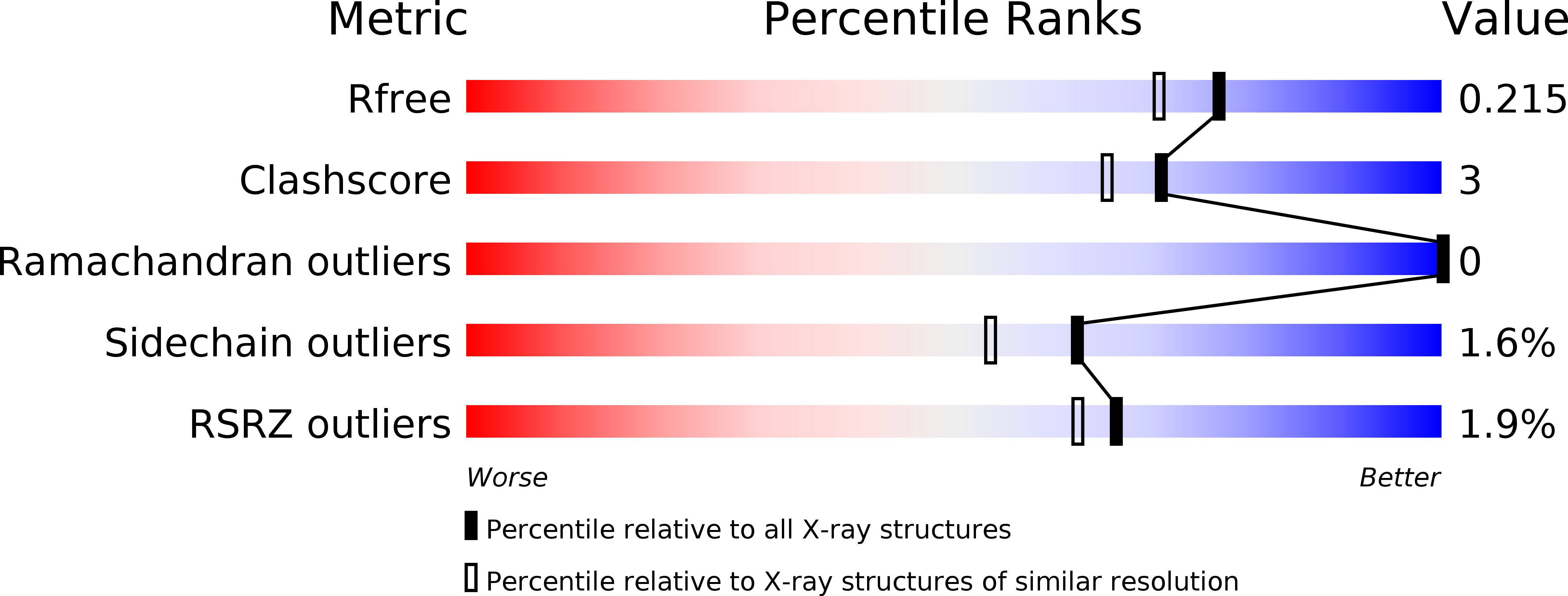
Resolution:
1.80 Å
R-Value Free:
0.21
R-Value Work:
0.19
R-Value Observed:
0.19
Space Group:
P 1 21 1
Macromolecular Entities
Structures with similar UniProt ID
Protein Blast
Polymer Type:polypeptide(L)
Molecule:APOPTOSIS-INDUCING FACTOR 1, MITOCHONDRIAL
Gene (Uniprot):AIFM1
Chain IDs:A
Chain Length:493
Number of Molecules:1
Biological Source:HOMO SAPIENS
Primary Citation
Structural Insights Into the Coenzyme Mediated Monomer-Dimer Transition of the Pro-Apoptotic Apoptosis Inducing Factor.
Biochemistry 53 4204 ? (2014)
PMID: 24914854 DOI: 10.1021/BI500343R

Abstact

The apoptosis-inducing factor (AIF) is a mitochondrial-flavoprotein that, after cell death induction, is distributed to the nucleus to mediate chromatinolysis. In mitochondria, AIF is present in a monomer-dimer equilibrium that after reduction by NADH gets displaced toward the dimer. The crystal structure of the human AIF (hAIF):NAD(H)-bound dimer revealed one FAD and, unexpectedly, two NAD(H) molecules per protomer. A 1:2 hAIF:NAD(H) binding stoichiometry was additionally confirmed in solution by using surface plasmon resonance. The here newly discovered NAD(H)-binding site includes residues mutated in human disorders, and accommodation of the coenzyme in it requires restructuring of a hAIF portion within the 509-560 apoptogenic segment. Disruption of interactions at the dimerization surface by production of the hAIF E413A/R422A/R430A mutant resulted in a nondimerizable variant considerably less efficiently stabilizing charge-transfer complexes upon coenzyme reduction than WT hAIF. These data reveal that the coenzyme-mediated monomer-dimer transition of hAIF modulates the conformation of its C-terminal proapoptotic domain, as well as its mechanism as reductase. These observations suggest that both the mitochondrial and apoptotic functions of hAIF are interconnected and coenzyme controlled: a key information in the understanding of the physiological role of AIF in the cellular life and death cycle.

Legend

Protein

Chemical

Disease

Primary Citation of related structures
Feedback Form
Name
Email
Institute
Feedback