4BJL image
Deposition Date 1995-05-26
Release Date 1995-12-07
Last Version Date 2024-10-09
Entry Detail
PDB ID:
4BJL
Keywords:
Title:
LOCW, A LAMBDA 1 TYPE LIGHT-CHAIN DIMER (BENCE-JONES PROTEIN) CRYSTALLIZED IN DISTILLED WATER
Biological Source:
Source Organism:
Homo sapiens (Taxon ID: 9606)
Method Details:
Experimental Method:
Resolution:
2.40 Å
R-Value Observed:
0.15
Space Group:
P 21 21 21
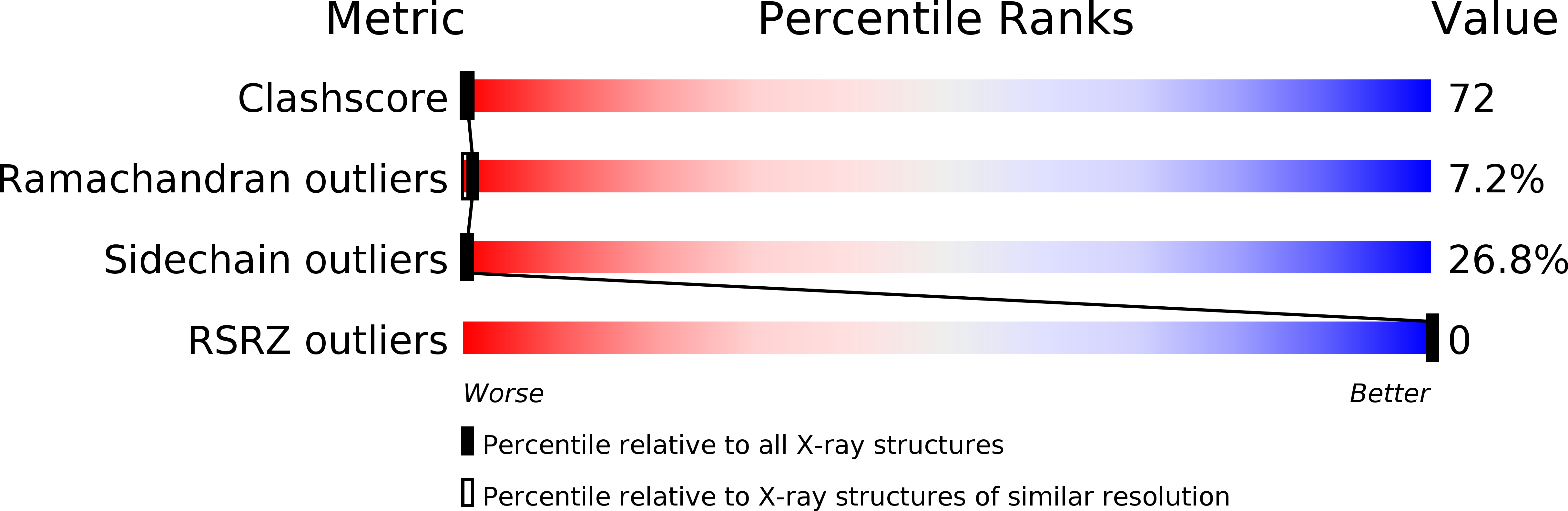
Macromolecular Entities
Polymer Type:polypeptide(L)
Molecule:LOC - LAMBDA 1 TYPE LIGHT-CHAIN DIMER
Chain IDs:A, B
Chain Length:216
Number of Molecules:2
Biological Source:Homo sapiens
Modified Residue
Compound ID Chain ID Parent Comp ID Details 2D Image
PCA A GLN PYROGLUTAMIC ACID
Primary Citation
Three quaternary structures for a single protein.
Proc.Natl.Acad.Sci.USA 93 7017 7021 (1996)
PMID: 8692936 DOI: 10.1073/pnas.93.14.7017

Abstact

The structure of a multisubunit protein (immunoglobulin light chain) was solved in three crystal forms, differing only in the solvent of crystallization. The three structures were obtained at high ionic strength and low pH, high ionic strength and high pH, and low ionic strength and neutral pH. The three resulting "snapshots" of possible structures show that their variable-domain interactions differ, reflecting their stabilities under specific solvent conditions. In the three crystal forms, the variable domains had different rotational and translational relationships, whereas no alteration of the constant domains was found. The critical residues involved in the observed effect of the solvent are tryptophans and histidines located between the two variable domains in the dimeric structure. Tryptophan residues are commonly found in interfaces between proteins and their subunits, and histidines have been implicated in pH-dependent conformation changes. The quaternary structure observed for a multisubunit protein or protein complex in a crystal may be influenced by the interactions of the constituents within the molecule or complex and/or by crystal packing interactions. The comparison of buried surface areas and hydrogen bonds between the domains forming the molecule and between the molecules forming the crystals suggest that, for this system, the interactions within the molecule are most likely the determining factors.

Legend

Protein

Chemical

Disease

Primary Citation of related structures
Feedback Form
Name
Email
Institute
Feedback