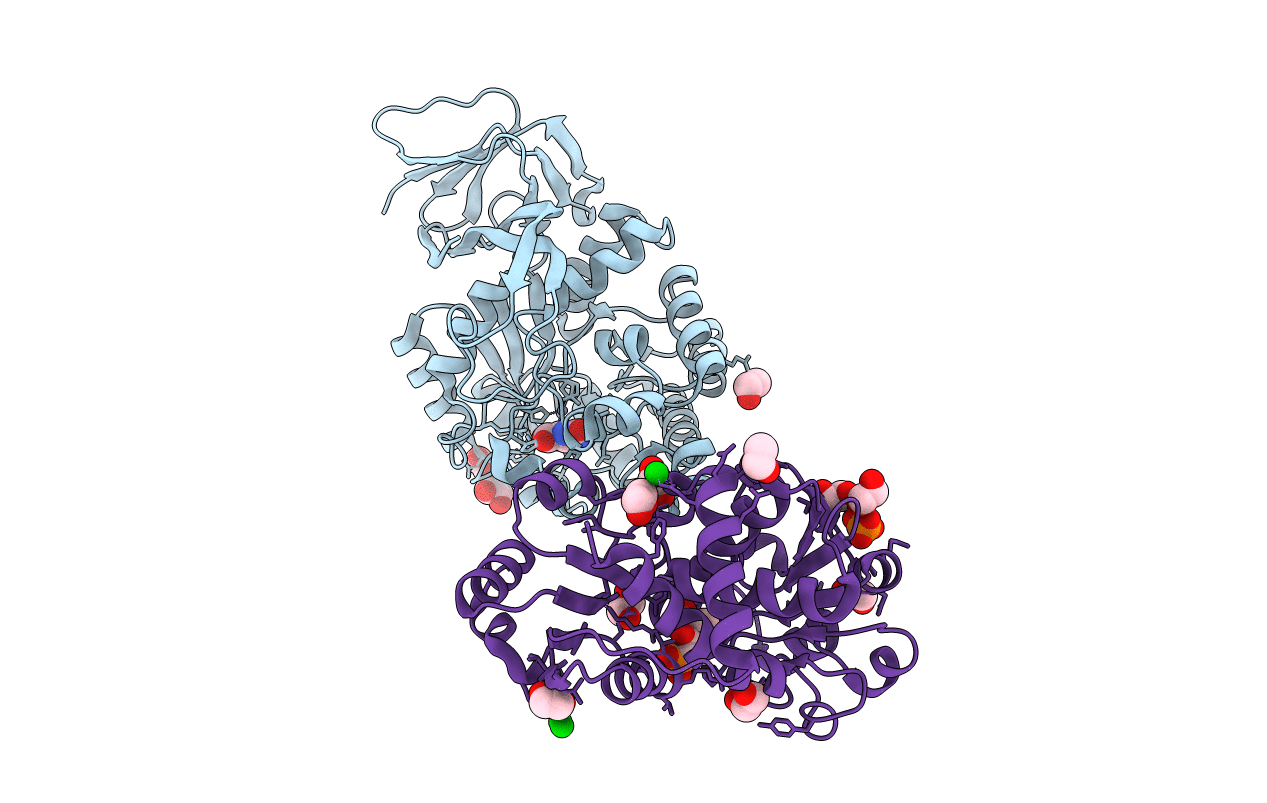
4BJH image
Deposition Date 2013-04-18
Release Date 2013-12-18
Last Version Date 2023-12-20
Entry Detail
PDB ID:
4BJH
Title:
Crystal Structure of the Aquifex Reactor Complex Formed by Dihydroorotase (H180A, H232A) with Dihydroorotate and Aspartate Transcarbamoylase with N-(phosphonacetyl)-L-aspartate (PALA)
Biological Source:
Source Organism:
Host Organism:
Method Details:
Experimental Method:
Resolution:
2.20 Å
R-Value Free:
0.20
R-Value Work:
0.16
R-Value Observed:
0.16
Space Group:
H 3 2
Macromolecular Entities
Structures with similar UniProt ID
Protein Blast
Polymer Type:polypeptide(L)
Molecule:DIHYDROOROTASE
Gene (Uniprot):pyrC
Mutagens:YES
Chain IDs:A
Chain Length:456
Number of Molecules:1
Biological Source:AQUIFEX AEOLICUS
Structures with similar UniProt ID
Protein Blast
Polymer Type:polypeptide(L)
Molecule:ASPARTATE CARBAMOYLTRANSFERASE
Gene (Uniprot):pyrB
Chain IDs:B
Chain Length:322
Number of Molecules:1
Biological Source:AQUIFEX AEOLICUS
Primary Citation
The Mononuclear Metal Center of Type-I Dihydroorotase from Aquifex Aeolicus.
Bmc Biochem. 14 36 ? (2013)
PMID: 24314009 DOI: 10.1186/1471-2091-14-36

Abstact

BACKGROUND Dihydroorotase (DHO) is a zinc metalloenzyme, although the number of active site zinc ions has been controversial. E. coli DHO was initially thought to have a mononuclear metal center, but the subsequent X-ray structure clearly showed two zinc ions, α and β, at the catalytic site. Aquifex aeolicus DHO, is a dodecamer comprised of six DHO and six aspartate transcarbamoylase (ATC) subunits. The isolated DHO monomer, which lacks catalytic activity, has an intact α-site and conserved β-site ligands, but the geometry of the second metal binding site is completely disrupted. However, the putative β-site is restored when the complex with ATC is formed and DHO activity is regained. Nevertheless, the X-ray structure of the complex revealed a single zinc ion at the active site. The structure of DHO from the pathogenic organism, S. aureus showed that it also has a single active site metal ion. RESULTS Zinc analysis showed that the enzyme has one zinc/DHO subunit and the addition of excess metal ion did not stimulate catalytic activity, nor alter the kinetic parameters. The metal free apoenzyme was inactive, but the full activity was restored upon the addition of one equivalent of Zn2+ or Co2+. Moreover, deletion of the β-site by replacing the His180 and His232 with alanine had no effect on catalysis in the presence or absence of excess zinc. The 2.2 Å structure of the double mutant confirmed that the β-site was eliminated but that the active site remained otherwise intact. CONCLUSIONS Thus, kinetically competent A. aeolicus DHO has a mononuclear metal center. In contrast, elimination of the putative second metal binding site in amidohydrolyases with a binuclear metal center, resulted in the abolition of catalytic activity. The number of active site metal ions may be a consideration in the design of inhibitors that selectively target either the mononuclear or binuclear enzymes.

Legend

Protein

Chemical

Disease

Primary Citation of related structures
Feedback Form
Name
Email
Institute
Feedback