4BF8 image
Deposition Date 2013-03-15
Release Date 2013-07-31
Last Version Date 2024-06-19
Entry Detail
PDB ID:
4BF8
Keywords:
Title:
Fpr4 PPI domain
Biological Source:
Source Organism:
Host Organism:
Method Details:
Experimental Method:
Conformers Calculated:
50
Conformers Submitted:
12
Selection Criteria:
LOWEST ENERGY
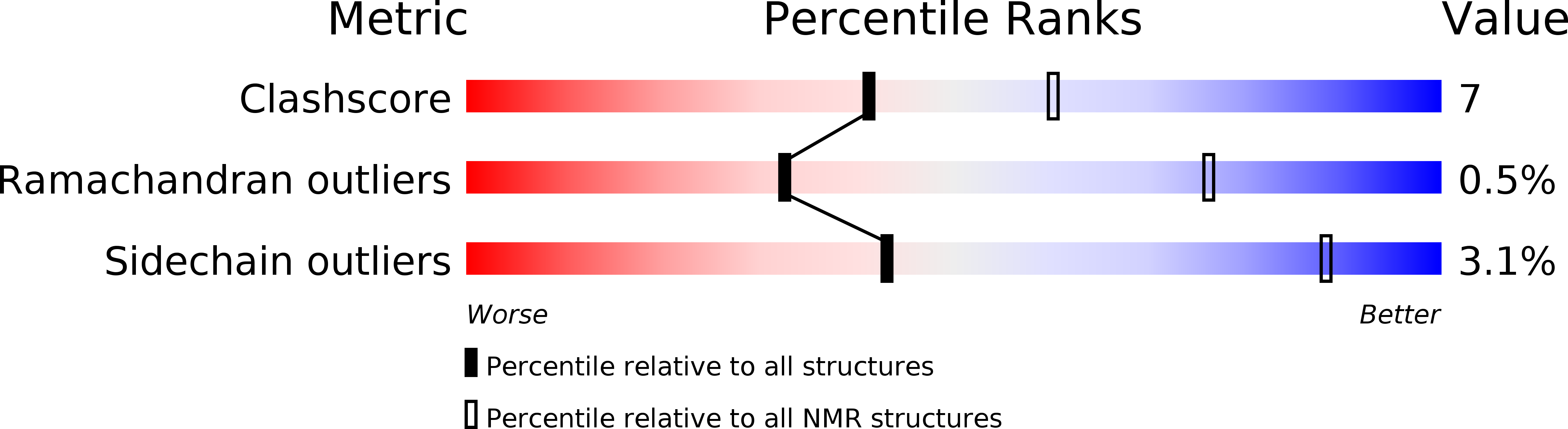
Macromolecular Entities
Structures with similar UniProt ID
Protein Blast
Polymer Type:polypeptide(L)
Molecule:FPR4
Gene (Uniprot):FPR4
Chain IDs:A
Chain Length:117
Number of Molecules:1
Biological Source:SACCHAROMYCES CEREVISIAE
Ligand Molecules
Primary Citation
Structure and Activity of the Peptidyl-Prolyl Isomerase Domain from the Histone Chaperone Fpr4 Towards Histone H3 Proline Isomerization
J.Biol.Chem. 288 25826 ? (2013)
PMID: 23888048 DOI: 10.1074/JBC.M113.479964

Abstact

The FK506-binding protein (FKBP) family of peptidyl-prolyl isomerases (PPIases) is characterized by a common catalytic domain that binds to the inhibitors FK506 and rapamycin. As one of four FKBPs within the yeast Saccharomyces cerevisiae, Fpr4 has been described as a histone chaperone, and is in addition implicated in epigenetic function in part due to its mediation of cis-trans conversion of proline residues within histone tails. To better understand the molecular details of this activity, we have determined the solution structure of the Fpr4 C-terminal PPIase domain by using NMR spectroscopy. This canonical FKBP domain actively increases the rate of isomerization of three decapeptides derived from the N terminus of yeast histone H3, whereas maintaining intrinsic cis and trans populations. Observation of the uncatalyzed and Fpr4-catalyzed isomerization rates at equilibrium demonstrate Pro(16) and Pro(30) of histone H3 as the major proline targets of Fpr4, with little activity shown against Pro(38). This alternate ranking of the three target prolines, as compared with affinity determination or the classical chymotrypsin-based fluorescent assay, reveals the mechanistic importance of substrate residues C-terminal to the peptidyl-prolyl bond.

Legend

Protein

Chemical

Disease

Primary Citation of related structures
Feedback Form
Name
Email
Institute
Feedback