4AV1 image
Deposition Date 2012-05-23
Release Date 2012-06-13
Last Version Date 2024-05-01
Entry Detail
PDB ID:
4AV1
Keywords:
Title:
Crystal structure of the human PARP-1 DNA binding domain in complex with DNA
Biological Source:
Source Organism:
Host Organism:
Method Details:
Experimental Method:
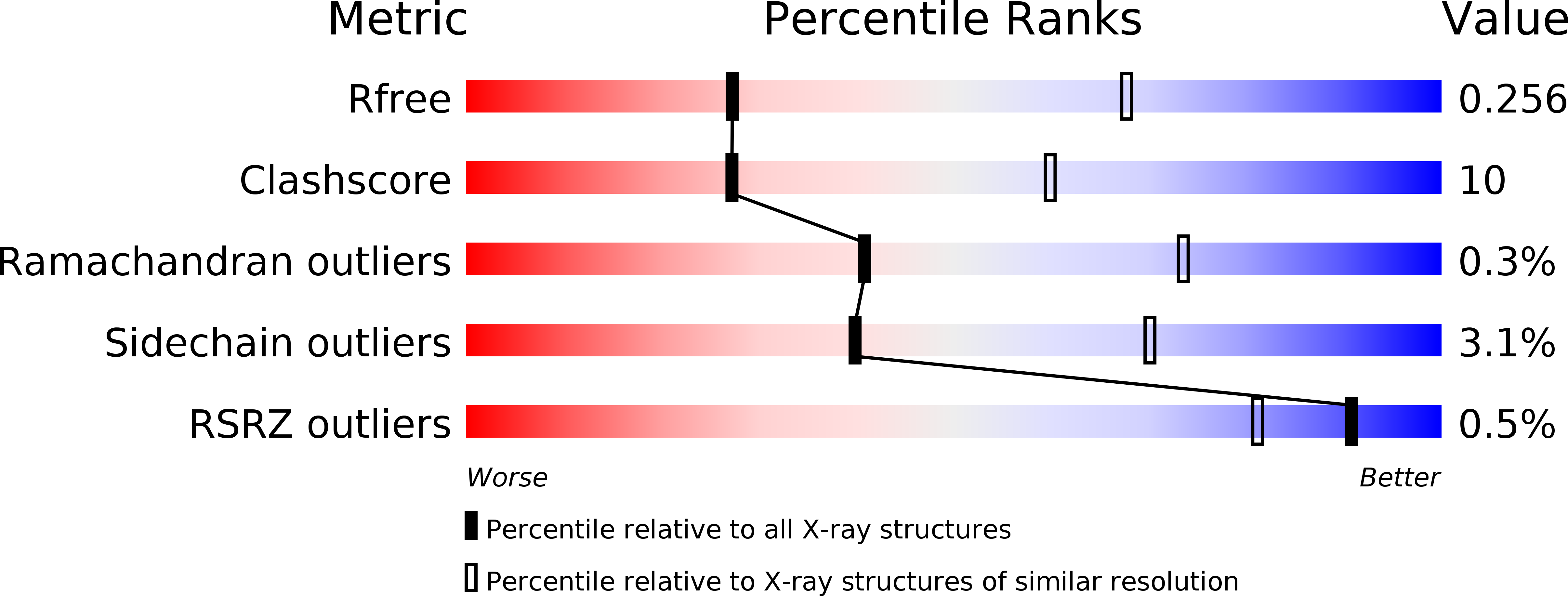
Resolution:
3.10 Å
R-Value Free:
0.24
R-Value Work:
0.22
R-Value Observed:
0.23
Space Group:
C 1 2 1
Macromolecular Entities
Structures with similar UniProt ID
Protein Blast
Polymer Type:polypeptide(L)
Molecule:POLY [ADP-RIBOSE] POLYMERASE 1
Gene (Uniprot):PARP1
Chain IDs:A, B, C, D
Chain Length:223
Number of Molecules:4
Biological Source:HOMO SAPIENS
Polymer Type:polydeoxyribonucleotide
Molecule:5'-D(*AP*AP*GP*TP*GP*TP*TP*GP*CP*AP*TP*TP)-3'
Chain IDs:E (auth: X)
Chain Length:12
Number of Molecules:1
Biological Source:SYNTHETIC CONSTRUCT
Polymer Type:polydeoxyribonucleotide
Molecule:5'-D(*TP*AP*AP*TP*GP*CP*AP*AP*CP*AP*CP*TP)-3'
Chain IDs:F (auth: Y)
Chain Length:12
Number of Molecules:1
Biological Source:SYNTHETIC CONSTRUCT
Ligand Molecules
Primary Citation
The Zinc-Finger Domains of Parp1 Cooperate to Recognise DNA Strand-Breaks
Nat.Struct.Mol.Biol. 19 685 ? (2012)
PMID: 22683995 DOI: 10.1038/NSMB.2335

Abstact

Poly(ADP-ribose) polymerase 1 (PARP1) is a primary DNA damage sensor whose (ADP-ribose) polymerase activity is acutely regulated by interaction with DNA breaks. Upon activation at sites of DNA damage, PARP1 modifies itself and other proteins by covalent addition of long, branched polymers of ADP-ribose, which in turn recruit downstream DNA repair and chromatin remodeling factors. PARP1 recognizes DNA damage through its N-terminal DNA-binding domain (DBD), which consists of a tandem repeat of an unusual zinc-finger (ZnF) domain. We have determined the crystal structure of the human PARP1-DBD bound to a DNA break. Along with functional analysis of PARP1 recruitment to sites of DNA damage in vivo, the structure reveals a dimeric assembly whereby ZnF1 and ZnF2 domains from separate PARP1 molecules form a strand-break recognition module that helps activate PARP1 by facilitating its dimerization and consequent trans-automodification.

Legend

Protein

Chemical

Disease

Primary Citation of related structures
Feedback Form
Name
Email
Institute
Feedback