4ARZ image
Deposition Date 2012-04-27
Release Date 2012-07-25
Last Version Date 2024-05-08
Entry Detail
PDB ID:
4ARZ
Keywords:
Title:
The crystal structure of Gtr1p-Gtr2p complexed with GTP-GDP
Biological Source:
Source Organism(s):
Expression System(s):
Method Details:
Experimental Method:
Resolution:
3.10 Å
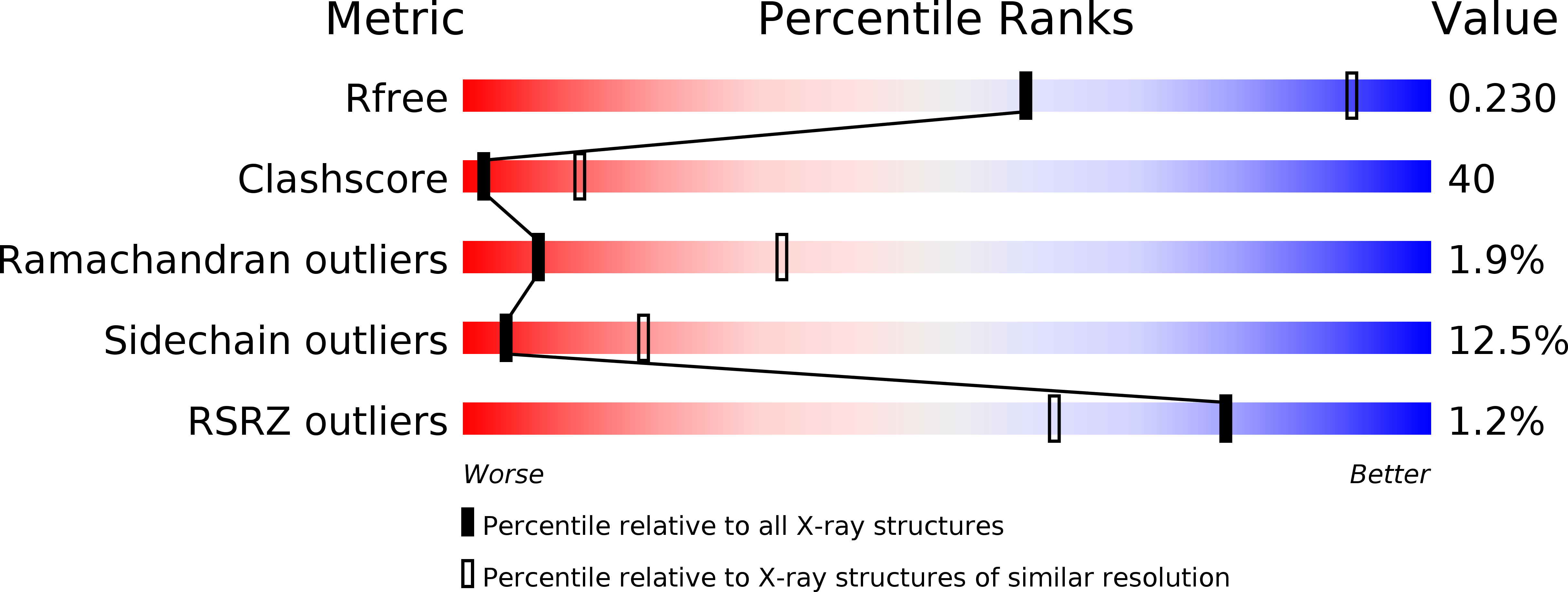
R-Value Free:
0.27
R-Value Work:
0.22
R-Value Observed:
0.22
Space Group:
C 2 2 21
Macromolecular Entities
Structures with similar UniProt ID
Protein Blast
Polymer Type:polypeptide(L)
Molecule:GTP-BINDING PROTEIN GTR1
Gene (Uniprot):GTR1
Chain IDs:A
Chain Length:310
Number of Molecules:1
Biological Source:SACCHAROMYCES CEREVISIAE
Structures with similar UniProt ID
Protein Blast
Polymer Type:polypeptide(L)
Molecule:GTP-BINDING PROTEIN GTR2
Gene (Uniprot):GTR2
Chain IDs:B
Chain Length:341
Number of Molecules:1
Biological Source:SACCHAROMYCES CEREVISIAE
Primary Citation
Crystal Structure of the Gtr1Pgtp-Gtr2Pgdp Complex Reveals Large Structural Rearrangements Triggered by GTP-to-Gdp Conversion
J.Biol.Chem. 287 29648 ? (2012)
PMID: 22807443 DOI: 10.1074/JBC.C112.384420

Abstact

The heterodimeric Rag GTPases consisting of RagA (or RagB) and RagC (or RagD) are the key regulator activating the target of rapamycin complex 1 (TORC1) in response to the level of amino acids. The heterodimer between GTP-loaded RagA/B and GDP-loaded RagC/D is the most active form that binds Raptor and leads to the activation of TORC1. Here, we present the crystal structure of Gtr1p(GTP)-Gtr2p(GDP), the active yeast Rag GTPase heterodimer. The structure reveals that GTP-to-GDP conversion on Gtr2p results in a large conformational transition of this subunit, including a large scale rearrangement of a long segment whose corresponding region in RagA is involved in binding to Raptor. In addition, the two GTPase domains of the heterodimer are brought to contact with each other, but without causing any conformational change of the Gtr1p subunit. These features explain how the nucleotide-bound statuses of the two GTPases subunits switch the Raptor binding affinity on and off.

Legend

Protein

Chemical

Disease

Primary Citation of related structures
Feedback Form
Name
Email
Institute
Feedback