4AGH image
Deposition Date 2012-01-27
Release Date 2012-08-29
Last Version Date 2024-05-08
Entry Detail
PDB ID:
4AGH
Keywords:
Title:
Structural features of ssDNA binding protein MoSub1 from Magnaporthe oryzae
Biological Source:
Source Organism:
Host Organism:
Method Details:
Experimental Method:
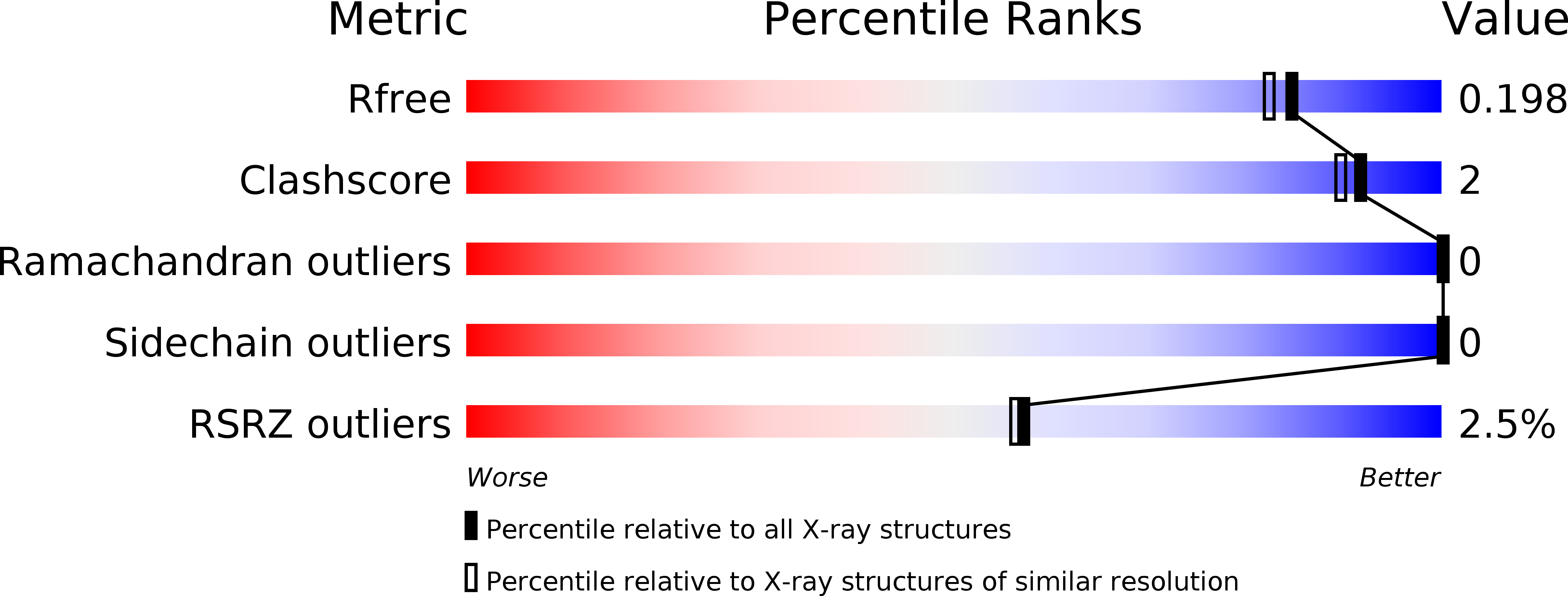
Resolution:
1.79 Å
R-Value Free:
0.20
R-Value Work:
0.17
R-Value Observed:
0.17
Space Group:
P 61 2 2
Macromolecular Entities
Structures with similar UniProt ID
Protein Blast
Polymer Type:polypeptide(L)
Molecule:MOSUB1, TRANSCRIPTION COFACTOR
Gene (Uniprot):MGG_00780
Chain IDs:A
Chain Length:158
Number of Molecules:1
Biological Source:MAGNAPORTHE ORYZAE
Primary Citation
Structural Features of the Single-Stranded DNA-Binding Protein Mosub1 from Magnaporthe Oryzae.
Acta Crystallogr.,Sect.D 68 1071 ? (2012)
PMID: 22948907 DOI: 10.1107/S0907444912019932

Abstact

The well studied general transcription cofactor Sub1/PC4 has multiple functions in transcription. It plays both a negative and a positive role in transcription initiation and is involved in elongation and downstream transcription processes and as a transcription reinitiation factor. MoSub1, a Sub1/PC4 orthologue from rice blast fungus, binds the single-stranded DNA dT(12) tightly with an affinity of 186 nM. The crystal structure of MoSub1 has been solved to 1.79 Å resolution. The structure of the protein shows high similiarity to the structure of PC4 and it has a similar dimer interface and DNA-binding region to PC4, indicating that MoSub1 could bind DNA using the same motif as other proteins of the Sub1/PC4 family. There are two novel features in the MoSub1 structure: a region N-terminal to the DNA-binding domain and a C-terminal extension. The region N-terminal to the DNA-binding domain of MoSub1 turns back towards the DNA-binding site and may interact directly with DNA or the DNA-binding site. The C-terminal extension region, which is absent in PC4, may not be capable of interacting with DNA and is one possible reason for the differences between Sub1 and PC4.

Legend

Protein

Chemical

Disease

Primary Citation of related structures
Feedback Form
Name
Email
Institute
Feedback