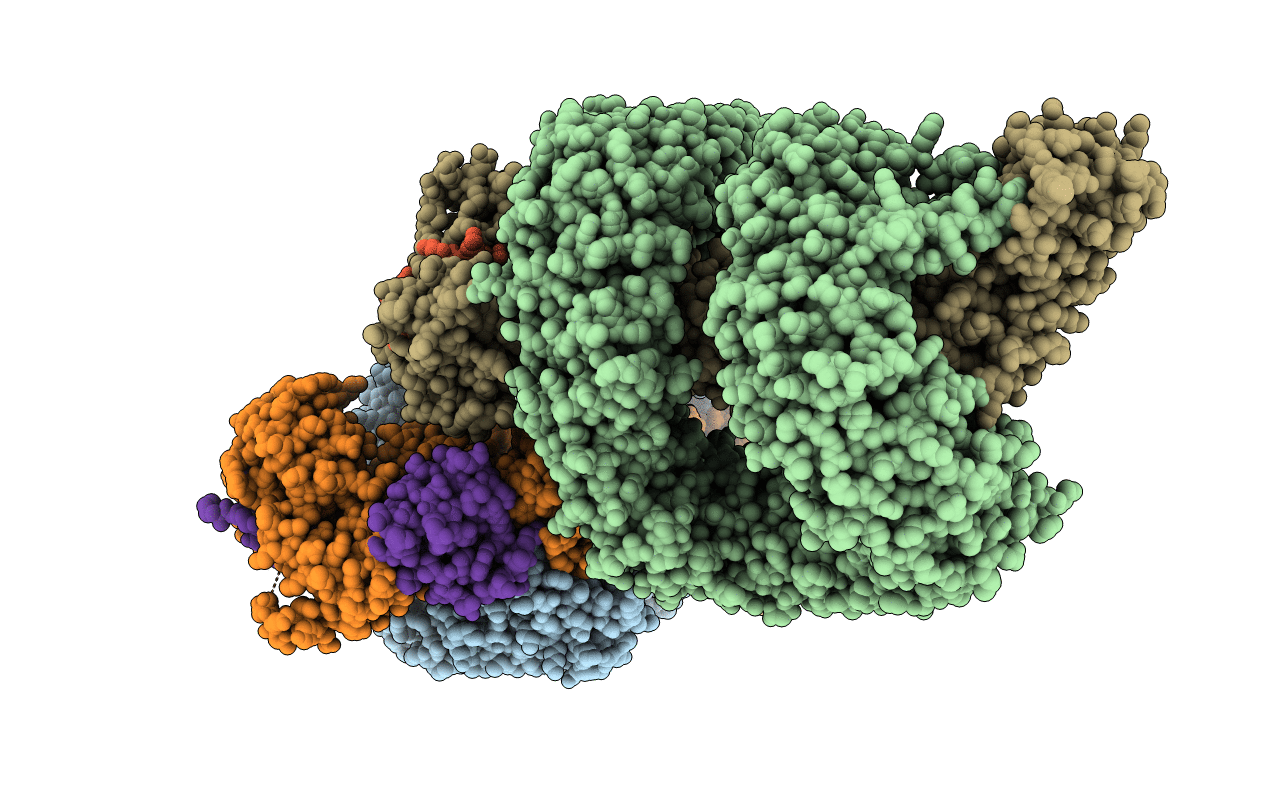
4A0C image
Deposition Date 2011-09-08
Release Date 2011-11-30
Last Version Date 2023-12-20
Entry Detail
PDB ID:
4A0C
Keywords:
Title:
Structure of the CAND1-CUL4B-RBX1 complex
Biological Source:
Source Organism:
HOMO SAPIENS (Taxon ID: 9606)
MUS MUSCULUS (Taxon ID: 10090)
Host Organism:
Method Details:
Experimental Method:
Resolution:
3.80 Å
R-Value Free:
0.31
R-Value Work:
0.23
R-Value Observed:
0.24
Space Group:
P 1 21 1
Macromolecular Entities
Structures with similar UniProt ID
Protein Blast
Polymer Type:polypeptide(L)
Molecule:CULLIN-ASSOCIATED NEDD8-DISSOCIATED PROTEIN 1
Gene (Uniprot):CAND1
Chain IDs:A, B
Chain Length:1253
Number of Molecules:2
Biological Source:HOMO SAPIENS
Structures with similar UniProt ID
Protein Blast
Polymer Type:polypeptide(L)
Molecule:CULLIN-4B
Gene (Uniprot):CUL4B
Chain IDs:C, E
Chain Length:741
Number of Molecules:2
Biological Source:HOMO SAPIENS
Structures with similar UniProt ID
Protein Blast
Polymer Type:polypeptide(L)
Molecule:E3 UBIQUITIN-PROTEIN LIGASE RBX1
Gene (Uniprot):Rbx1
Chain IDs:D, F
Chain Length:98
Number of Molecules:2
Biological Source:MUS MUSCULUS
Ligand Molecules
Primary Citation
The Molecular Basis of Crl4(Ddb2/Csa) Ubiquitin Ligase Architecture, Targeting, and Activation
Cell(Cambridge,Mass.) 147 1024 ? (2011)
PMID: 22118460 DOI: 10.1016/J.CELL.2011.10.035

Abstact

The DDB1-CUL4-RBX1 (CRL4) ubiquitin ligase family regulates a diverse set of cellular pathways through dedicated substrate receptors (DCAFs). The DCAF DDB2 detects UV-induced pyrimidine dimers in the genome and facilitates nucleotide excision repair. We provide the molecular basis for DDB2 receptor-mediated cyclobutane pyrimidine dimer recognition in chromatin. The structures of the fully assembled DDB1-DDB2-CUL4A/B-RBX1 (CRL4(DDB2)) ligases reveal that the mobility of the ligase arm creates a defined ubiquitination zone around the damage, which precludes direct ligase activation by DNA lesions. Instead, the COP9 signalosome (CSN) mediates the CRL4(DDB2) inhibition in a CSN5 independent, nonenzymatic, fashion. In turn, CSN inhibition is relieved upon DNA damage binding to the DDB2 module within CSN-CRL4(DDB2). The Cockayne syndrome A DCAF complex crystal structure shows that CRL4(DCAF(WD40)) ligases share common architectural features. Our data support a general mechanism of ligase activation, which is induced by CSN displacement from CRL4(DCAF) on substrate binding to the DCAF.

Legend

Protein

Chemical

Disease

Primary Citation of related structures
Feedback Form
Name
Email
Institute
Feedback