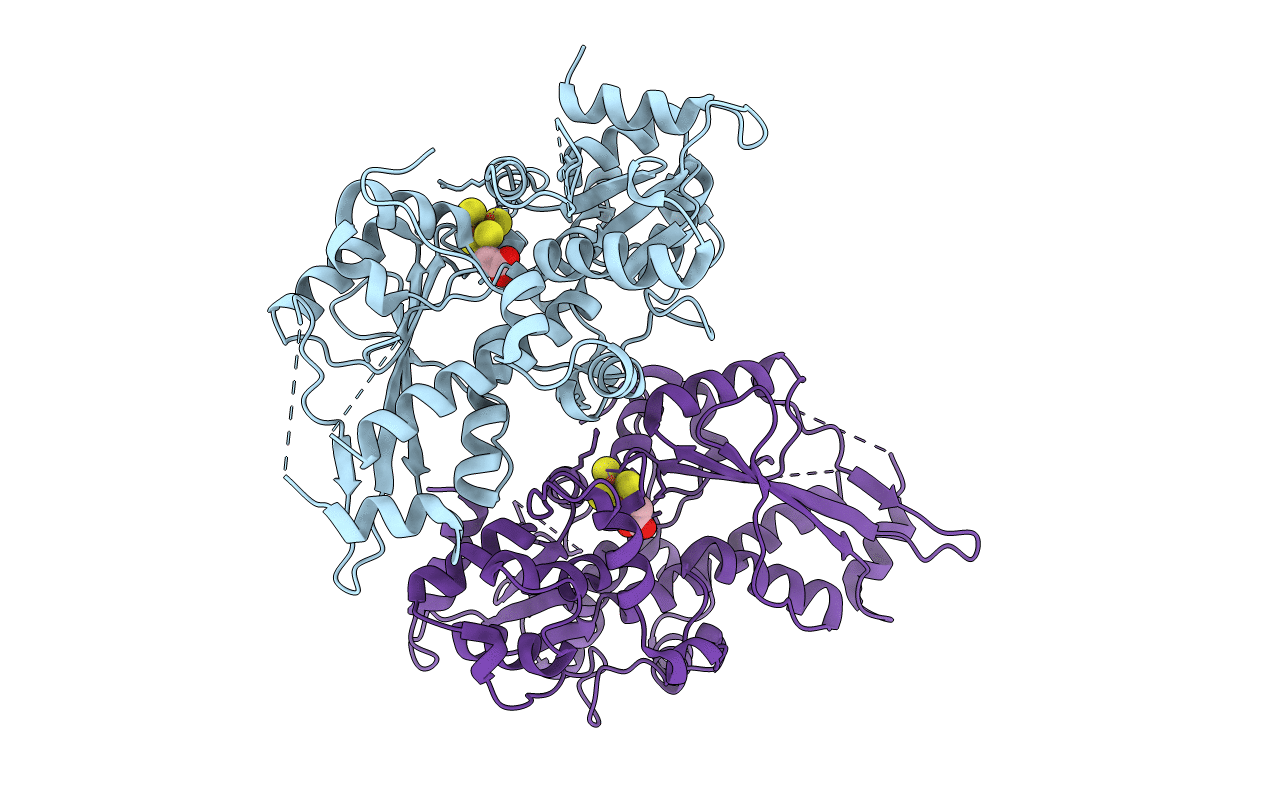
3lx4 image
Deposition Date 2010-02-24
Release Date 2010-04-28
Last Version Date 2023-09-06
Entry Detail
PDB ID:
3LX4
Keywords:
Title:
Stepwise [FeFe]-hydrogenase H-cluster assembly revealed in the structure of HydA(deltaEFG)
Biological Source:
Source Organism:
Host Organism:
Method Details:
Experimental Method:
Resolution:
1.97 Å
R-Value Free:
0.21
R-Value Work:
0.17
R-Value Observed:
0.17
Space Group:
P 32
Macromolecular Entities
Structures with similar UniProt ID
Protein Blast
Polymer Type:polypeptide(L)
Molecule:Fe-hydrogenase
Gene (Uniprot):hyd1
Chain IDs:A, B
Chain Length:457
Number of Molecules:2
Biological Source:Chlamydomonas reinhardtii
Primary Citation
Stepwise [FeFe]-hydrogenase H-cluster assembly revealed in the structure of HydA(DeltaEFG).
Nature 465 248 251 (2010)
PMID: 20418861 DOI: 10.1038/nature08993

Abstact

Complex enzymes containing Fe-S clusters are ubiquitous in nature, where they are involved in a number of fundamental processes including carbon dioxide fixation, nitrogen fixation and hydrogen metabolism. Hydrogen metabolism is facilitated by the activity of three evolutionarily and structurally unrelated enzymes: the [NiFe]-hydrogenases, [FeFe]-hydrogenases and [Fe]-hydrogenases (Hmd). The catalytic core of the [FeFe]-hydrogenase (HydA), termed the H-cluster, exists as a [4Fe-4S] subcluster linked by a cysteine thiolate to a modified 2Fe subcluster with unique non-protein ligands. The 2Fe subcluster and non-protein ligands are synthesized by the hydrogenase maturation enzymes HydE, HydF and HydG; however, the mechanism, synthesis and means of insertion of H-cluster components remain unclear. Here we show the structure of HydA(DeltaEFG) (HydA expressed in a genetic background devoid of the active site H-cluster biosynthetic genes hydE, hydF and hydG) revealing the presence of a [4Fe-4S] cluster and an open pocket for the 2Fe subcluster. The structure indicates that H-cluster synthesis occurs in a stepwise manner, first with synthesis and insertion of the [4Fe-4S] subcluster by generalized host-cell machinery and then with synthesis and insertion of the 2Fe subcluster by specialized hydE-, hydF- and hydG-encoded maturation machinery. Insertion of the 2Fe subcluster presumably occurs through a cationically charged channel that collapses following incorporation, as a result of conformational changes in two conserved loop regions. The structure, together with phylogenetic analysis, indicates that HydA emerged within bacteria most likely from a Nar1-like ancestor lacking the 2Fe subcluster, and that this was followed by acquisition in several unicellular eukaryotes.

Legend

Protein

Chemical

Disease

Primary Citation of related structures
Feedback Form
Name
Email
Institute
Feedback