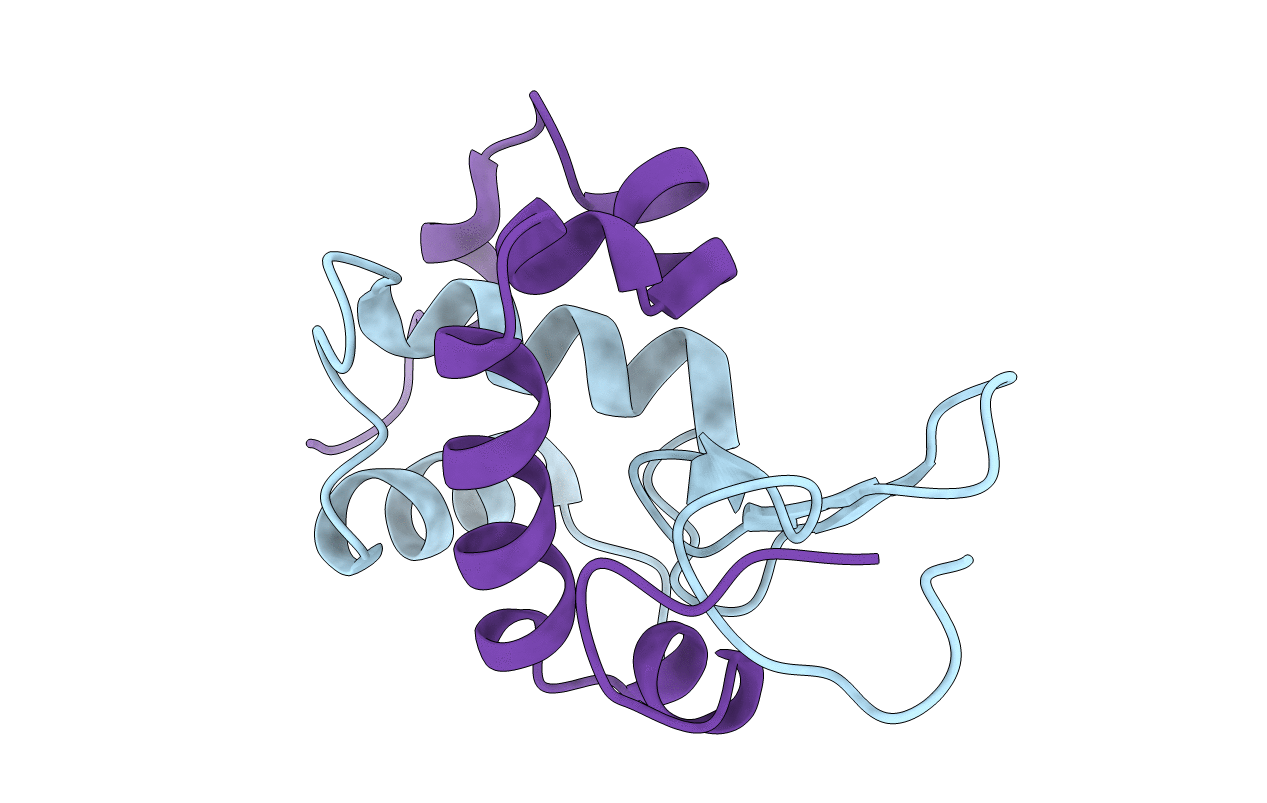
3ZVQ image
Deposition Date 2011-07-26
Release Date 2011-10-19
Last Version Date 2024-11-06
Entry Detail
PDB ID:
3ZVQ
Keywords:
Title:
Crystal Structure of proteolyzed lysozyme
Biological Source:
Source Organism:
GALLUS GALLUS (Taxon ID: 9031)
Method Details:
Experimental Method:
Resolution:
2.00 Å
R-Value Free:
0.23
R-Value Work:
0.21
R-Value Observed:
0.21
Space Group:
P 43 21 2

Macromolecular Entities
Structures with similar UniProt ID
Protein Blast
Polymer Type:polypeptide(L)
Molecule:LYSOZYME C
Gene (Uniprot):LYZ
Chain IDs:A
Chain Length:70
Number of Molecules:1
Biological Source:GALLUS GALLUS
Structures with similar UniProt ID
Protein Blast
Polymer Type:polypeptide(L)
Molecule:LYSOZYME C
Gene (Uniprot):LYZ
Chain IDs:B
Chain Length:58
Number of Molecules:1
Biological Source:GALLUS GALLUS
Primary Citation
Salt-assisted religation of proteolyzed Glutathione-S-transferase follows Hofmeister series.
Protein Pept.Lett. 17 54 63 (2010)
PMID: 19508200 DOI: 10.2174/092986610789909395

Abstact

Proteases have been used not only for proteolysis but also in organic solvent-assisted religation processes. Here, we demonstrated the effect of salts on peptide bond resynthesis in Glutathione-S-transferase (GST) and have found it to be in the purview of the Hofmeister phenomena. Our results show that the efficiency and ease of religation increases with an increase in the surface charge densities of the cations used in the study. Thus, the yield of religated GST follows the order: Mg2(+)>Li(+)>Na(+)>K(+). Characteristics of the salt-religated GST were studied using size exclusion chromatography, CD spectroscopy, mass spectrometry and CDNB activity assay. Results show that the properties of salt-religated GST are in close agreement with those of the native GST. Additionally, we also assessed the specific activity of the protease, Subtilisin Carlsberg, used in this study. Contrary, to aqueous-organic systems, wherein there is a remarkable decrease in the proteolytic activity, the activity in the presence of salts is only minimally changed. Our studies suggest that salt-assisted peptide bond formation is favoured primarily due to changes in the ionic environment of the nicked termini of GST, and that there is no role played by the protease.

Legend

Protein

Chemical

Disease

Feedback Form
Name
Email
Institute
Feedback