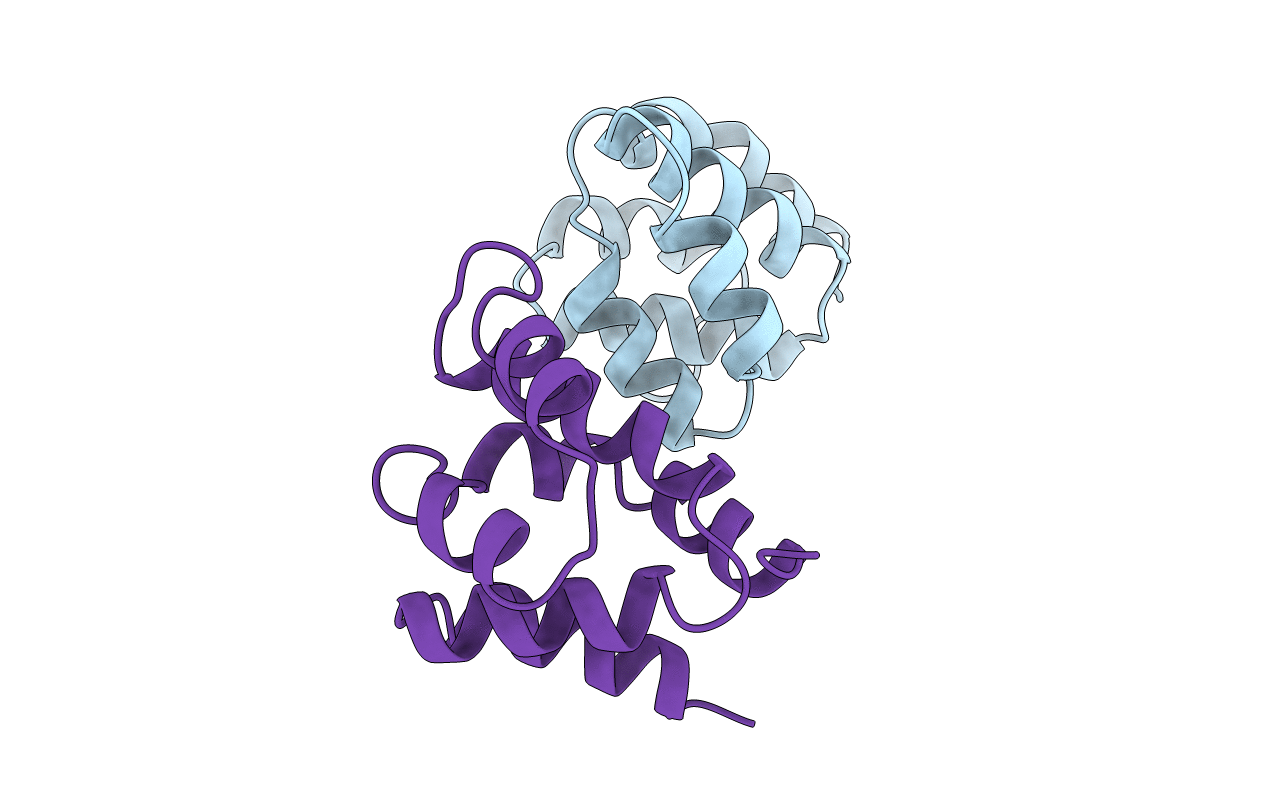
3YGS image
Deposition Date 1999-05-08
Release Date 2000-04-19
Last Version Date 2023-12-27
Entry Detail
PDB ID:
3YGS
Keywords:
Title:
APAF-1 CARD IN COMPLEX WITH PRODOMAIN OF PROCASPASE-9
Biological Source:
Source Organism:
Homo sapiens (Taxon ID: 9606)
Method Details:
Experimental Method:
Resolution:
2.50 Å
R-Value Free:
0.29
R-Value Work:
0.22
Space Group:
P 62 2 2

Macromolecular Entities
Structures with similar UniProt ID
Protein Blast
Polymer Type:polypeptide(L)
Molecule:APOPTOTIC PROTEASE ACTIVATING FACTOR 1
Gene (Uniprot):APAF1
Chain IDs:A (auth: C)
Chain Length:95
Number of Molecules:1
Biological Source:Homo sapiens
Structures with similar UniProt ID
Protein Blast
Polymer Type:polypeptide(L)
Molecule:PROCASPASE 9
Gene (Uniprot):CASP9
Chain IDs:B (auth: P)
Chain Length:97
Number of Molecules:1
Biological Source:Homo sapiens
Primary Citation
Structural basis of procaspase-9 recruitment by the apoptotic protease-activating factor 1.
Nature 399 549 557 (1999)
PMID: 10376594 DOI: 10.1038/21124

Abstact

Caspase-9-mediated apoptosis (programmed cell death) plays a central role in the development and homeostasis of all multicellular organisms. Mature caspase-9 is derived from its procaspase precursor as a result of recruitment by the activating factor Apaf-1. The crystal structures of the caspase-recruitment domain of Apaf-1 by itself and in complex with the prodomain of procaspase-9 have been determined at 1.6 and 2.5 A resolution, respectively. These structures and other evidence reveal that each molecule of Apaf-1 interacts with a molecule of procaspase-9 through two highly charged and complementary surfaces formed by non-conserved residues; these surfaces determine recognition specificity through networks of intermolecular hydrogen bonds and van der Waals interactions. Mutation of the important interface residues in procaspase-9 or Apaf-1 prevents or reduces activation of procaspase-9 in a cell-free system. Wild-type, but not mutant, prodomains of caspase-9 completely inhibit catalytic processing of procaspase-9. Furthermore, analysis of homologues from Caenorhabditis elegans indicates that recruitment of CED-3 by CED-4 is probably mediated by the same set of conserved structural motifs, with a corresponding change in the specificity-determining residues.

Legend

Protein

Chemical

Disease

Primary Citation of related structures
Feedback Form
Name
Email
Institute
Feedback