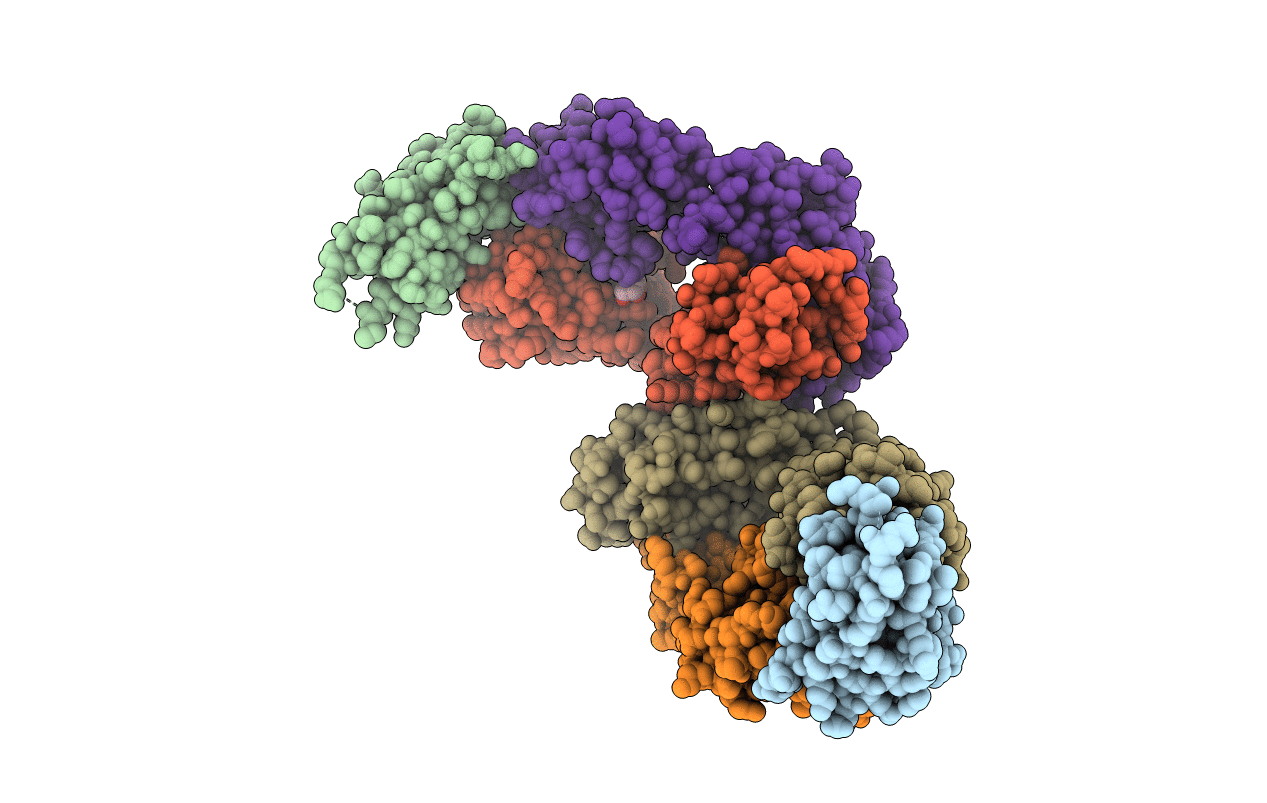
3WIH image
Deposition Date 2013-09-12
Release Date 2015-01-21
Last Version Date 2024-10-30
Entry Detail
PDB ID:
3WIH
Keywords:
Title:
Crystal structure of the third fibronectin domain (Fn3) of human ROBO1 in complex with the Fab fragment of murine monoclonal antibody B2212A.
Biological Source:
Source Organism:
Homo sapiens (Taxon ID: 9606)
Mus musculus (Taxon ID: 10090)
Host Organism:
Method Details:
Experimental Method:
Resolution:
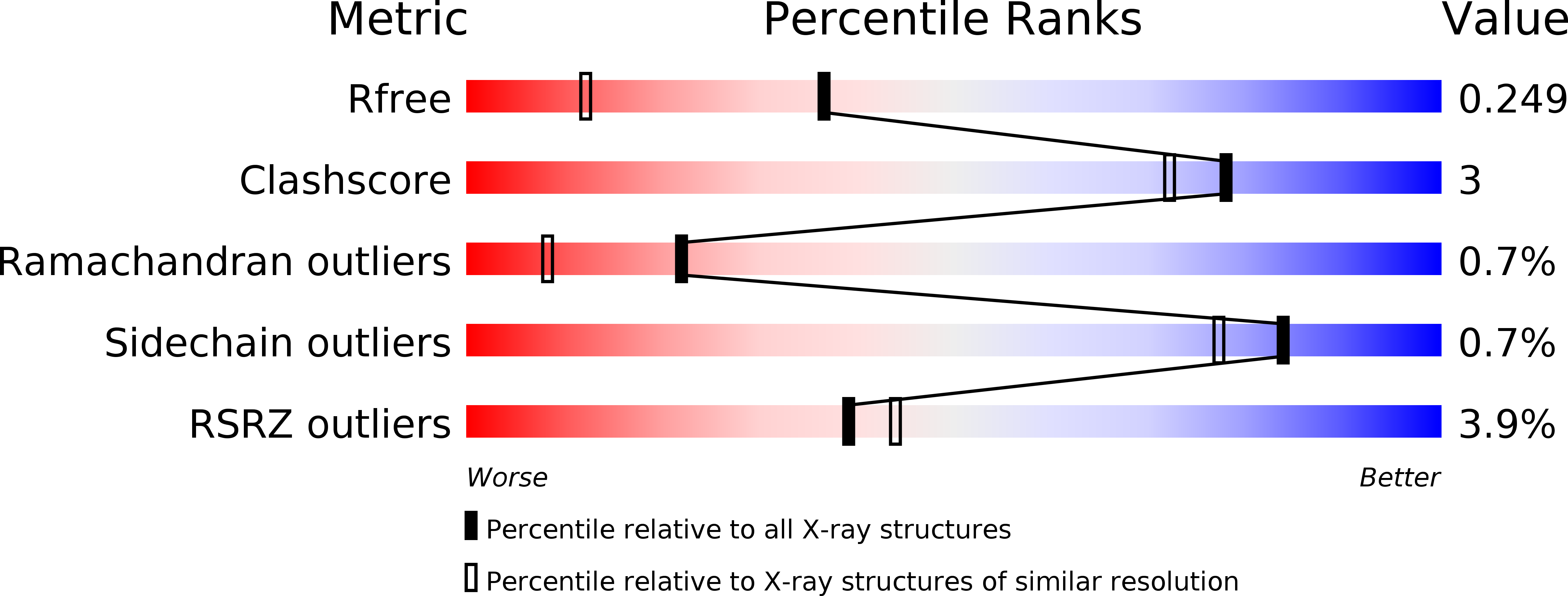
1.70 Å
R-Value Free:
0.23
R-Value Work:
0.18
R-Value Observed:
0.19
Space Group:
C 1 2 1
Macromolecular Entities
Structures with similar UniProt ID
Protein Blast
Polymer Type:polypeptide(L)
Molecule:Roundabout homolog 1
Gene (Uniprot):ROBO1
Chain IDs:A, D (auth: B)
Chain Length:97
Number of Molecules:2
Biological Source:Homo sapiens
Polymer Type:polypeptide(L)
Molecule:anti-human ROBO1 antibody B2212A Fab heavy chain
Chain IDs:C (auth: H), F (auth: I)
Chain Length:219
Number of Molecules:2
Biological Source:Mus musculus
Polymer Type:polypeptide(L)
Molecule:anti-human ROBO1 antibody B2212A Fab light chain
Chain IDs:B (auth: L), E (auth: M)
Chain Length:213
Number of Molecules:2
Biological Source:Mus musculus
Ligand Molecules
Primary Citation
Structural features of interfacial tyrosine residue in ROBO1 fibronectin domain-antibody complex: Crystallographic, thermodynamic, and molecular dynamic analyses
Protein Sci. 24 328 340 (2015)
PMID: 25492858 DOI: 10.1002/pro.2619

Abstact

ROBO1, fibronectin Type-III domain (Fn)-containing protein, is a novel immunotherapeutic target for hepatocellular carcinoma in humans. The crystal structure of the antigen-binding fragment (Fab) of B2212A, the monoclonal antibody against the third Fn domain (Fn3) of ROBO1, was determined in pursuit of antibody drug for hepatocellular carcinoma. This effort was conducted in the presence or absence of the antigen, with the chemical features being investigated by determining the affinity of the antibody using molecular dynamics (MD) and thermodynamics. The structural comparison of B2212A Fab between the complex and the free form revealed that the interfacial Tyr(L) 50 (superscripts L, H, and F stand for the residues in the light chain, heavy chain, and Fn3, respectively) played important roles in Fn3 recognition. That is, the aromatic ring of Tyr(L) 50 pivoted toward Phe(F) 68, forming a CH/π interaction and a new hydrogen bond with the carbonyl O atom of Phe(F) 68. MD simulations predicted that the Tyr(L) 50-Phe(F) 68 interaction almost entirely dominated Fab-Fn3 binding, and Ala-substitution of Tyr(L) 50 led to a reduced binding of the resultant complex. On the contrary, isothermal titration calorimetry experiments underscored that Ala-substitution of Tyr(L) 50 caused an increase of the binding enthalpy between B2212A and Fn3, but importantly, it induced an increase of the binding entropy, resulting in a suppression of loss in the Gibbs free energy in total. These results suggest that mutation analysis considering the binding entropy as well as the binding enthalpy will aid in the development of novel antibody drugs for hepatocellular carcinoma.

Legend

Protein

Chemical

Disease

Primary Citation of related structures
Feedback Form
Name
Email
Institute
Feedback