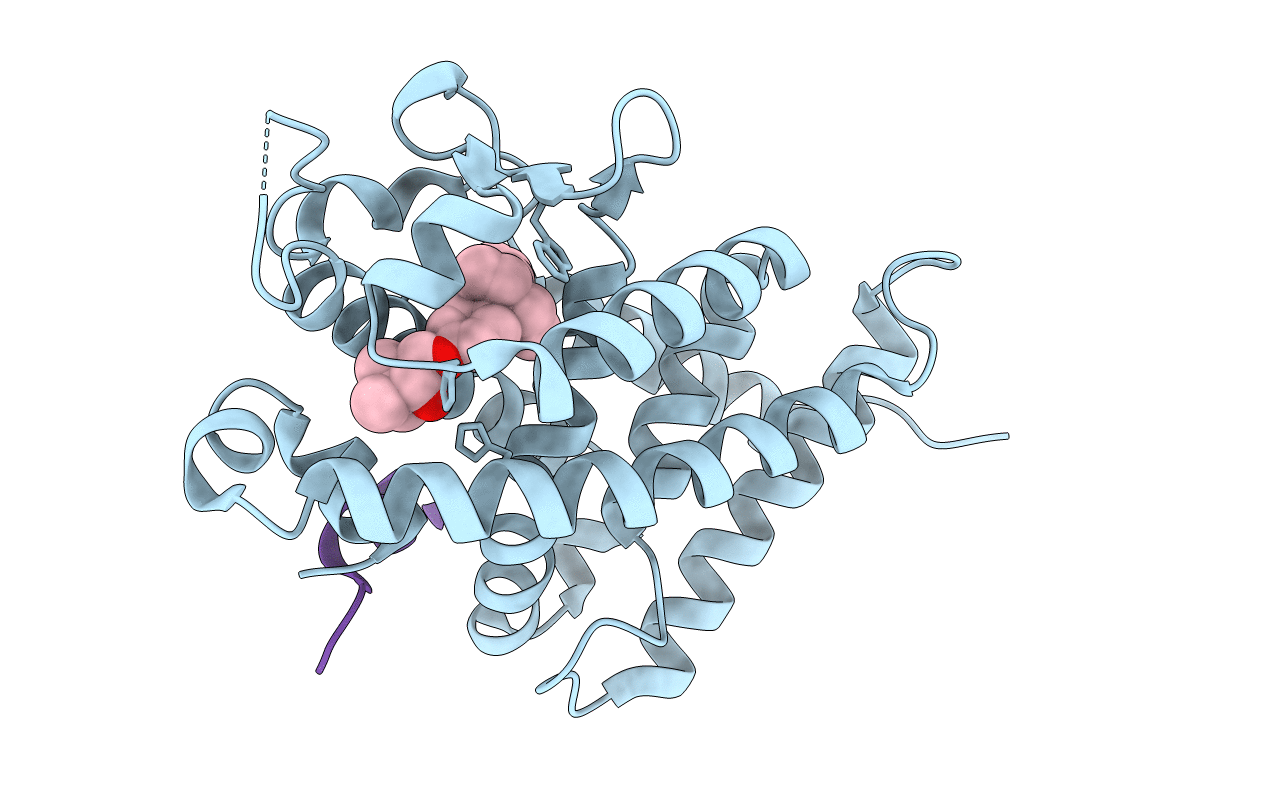
3W0I image
Deposition Date 2012-10-30
Release Date 2013-10-09
Last Version Date 2023-11-08
Entry Detail
PDB ID:
3W0I
Keywords:
Title:
Crystal Structure of Rat VDR Ligand Binding Domain in Complex with Novel Nonsecosteroidal Ligands
Biological Source:
Source Organism:
Rattus norvegicus (Taxon ID: 10116)
Homo sapiens (Taxon ID: 9606)
Host Organism:
Method Details:
Experimental Method:
Resolution:
1.90 Å
R-Value Free:
0.27
R-Value Work:
0.19
R-Value Observed:
0.20
Space Group:
C 1 2 1
Macromolecular Entities
Structures with similar UniProt ID
Protein Blast
Polymer Type:polypeptide(L)
Molecule:Vitamin D3 Receptor
Gene (Uniprot):Vdr
Chain IDs:A
Chain Length:253
Number of Molecules:1
Biological Source:Rattus norvegicus
Structures with similar UniProt ID
Protein Blast
Polymer Type:polypeptide(L)
Molecule:Mediator of RNA polymerase II transcription subunit 1
Gene (Uniprot):MED1
Chain IDs:B (auth: C)
Chain Length:13
Number of Molecules:1
Biological Source:Homo sapiens
Ligand Molecules
Primary Citation
Structural basis for vitamin D receptor agonism by novel non-secosteroidal ligands.
Febs Lett. 587 957 963 (2013)
PMID: 23462137 DOI: 10.1016/j.febslet.2013.02.028

Abstact

Non-secosteroidal ligands for vitamin D receptor (VDR) have been developed for the agonist with non-calcemic profiles. Here, we provide the structural mechanism of VDR agonism by novel non-secosteroidal ligands. All ligands had the similar efficacy, while two had the higher potency. Crystallographic analyses revealed that all ligands interacted with helix H10 and the loop between helices H6 and H7 in a similar manner, but also that the two ligands with higher potency had different interaction modes. This study suggests that distinct ligand potency depend upon differences in the formation and rearrangement of hydrogen-bond networks induced by each ligand.

Legend

Protein

Chemical

Disease

Primary Citation of related structures
Feedback Form
Name
Email
Institute
Feedback