3VYC image
Deposition Date 2012-09-22
Release Date 2012-11-28
Last Version Date 2024-03-20
Entry Detail
PDB ID:
3VYC
Title:
Crystal structure of unliganded Saccharomyces cerevisiae CRM1 (Xpo1p)
Biological Source:
Source Organism:
Host Organism:
Method Details:
Experimental Method:
Resolution:
2.10 Å
R-Value Free:
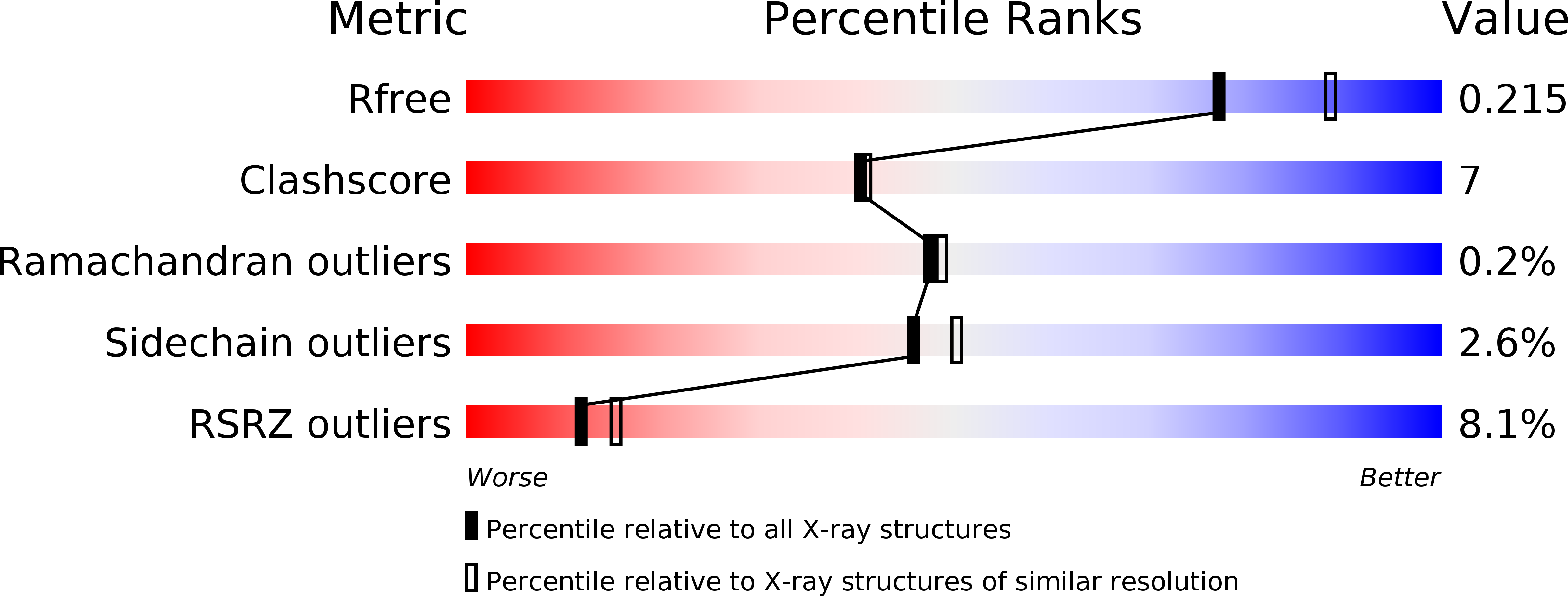
0.21
R-Value Work:
0.18
R-Value Observed:
0.18
Space Group:
P 41
Macromolecular Entities
Structures with similar UniProt ID
Protein Blast
Polymer Type:polypeptide(L)
Molecule:Exportin-1
Gene (Uniprot):CRM1
Mutagens:a deletion mutant in which residues 377-413 and 971-984 are deleted
Chain IDs:A
Chain Length:1033
Number of Molecules:1
Biological Source:Saccharomyces cerevisiae
Primary Citation
A 2.1- angstrom -resolution crystal structure of unliganded CRM1 reveals the mechanism of autoinhibition
J.Mol.Biol. 425 350 364 (2013)
PMID: 23164569 DOI: 10.1016/j.jmb.2012.11.014

Abstact

CRM1 mediates nuclear export of numerous proteins and ribonucleoproteins containing a leucine-rich nuclear export signal (NES). Binding of RanGTP to CRM1 in the nucleus stabilizes cargo association with CRM1, and vice versa, but the mechanism underlying the positive cooperativity in RanGTP and NES binding to CRM1 remains incompletely understood. Herein we report a 2.1-Å-resolution crystal structure of unliganded Saccharomyces cerevisiae CRM1 (Xpo1p) that demonstrates that an internal loop of CRM1 (referred to as HEAT9 loop) is primarily responsible for maintaining the NES-binding cleft in a closed conformation, rendering CRM1 incapable of NES binding in the absence of RanGTP. The structure also shows that the C-terminal tail of CRM1 stabilizes the autoinhibitory conformation of the HEAT9 loop and thereby reinforces autoinhibition. Comparison with the structures of CRM1-NES-RanGTP complexes reveals how binding of RanGTP is associated with a series of allosteric conformational changes in CRM1 that lead to opening of the NES-binding cleft, allowing for stable binding of NES cargoes.

Legend

Protein

Chemical

Disease

Primary Citation of related structures
Feedback Form
Name
Email
Institute
Feedback