3VVI image
Deposition Date 2012-07-25
Release Date 2013-04-10
Last Version Date 2024-03-20
Entry Detail
PDB ID:
3VVI
Title:
Crystal structure of the coiled-coil domain of the transient receptor potential channel from Gibberella zeae (TRPGz)
Biological Source:
Source Organism:
Method Details:
Experimental Method:
Resolution:
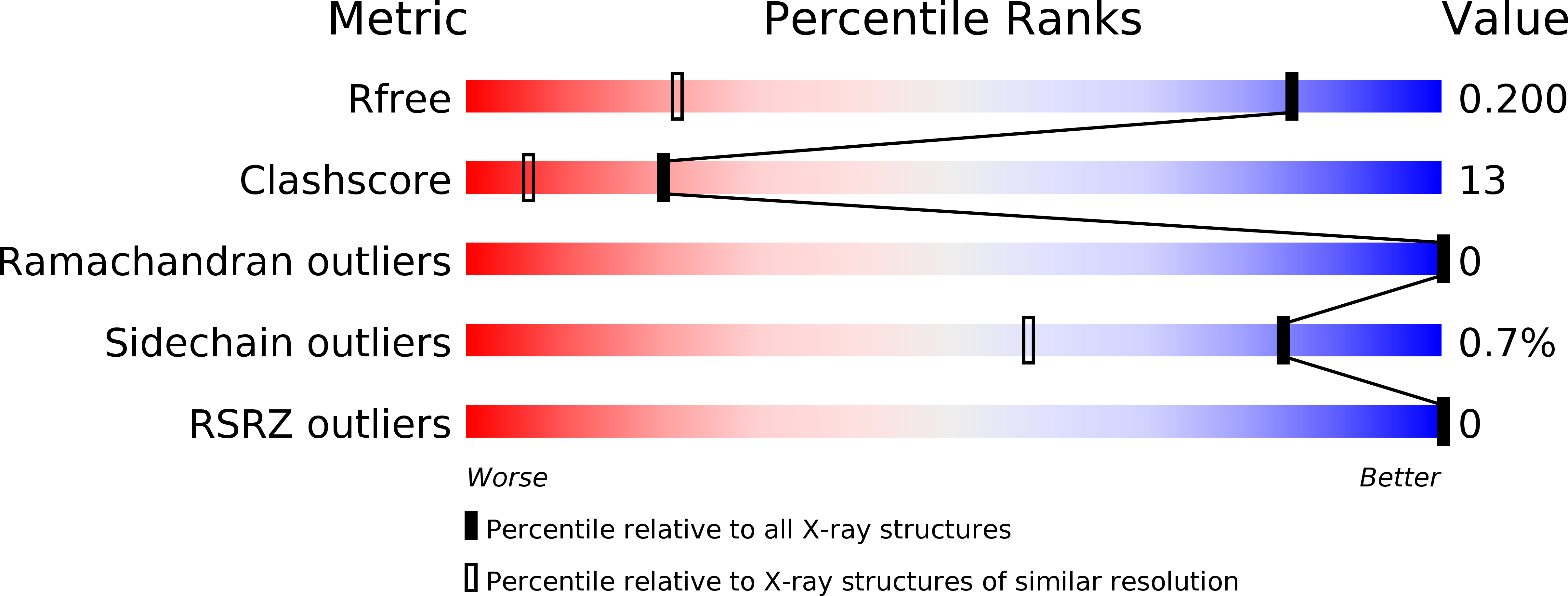
1.25 Å
R-Value Free:
0.19
R-Value Work:
0.14
R-Value Observed:
0.14
Space Group:
P 43
Macromolecular Entities
Structures with similar UniProt ID
Protein Blast
Polymer Type:polypeptide(L)
Molecule:Non selective cation channel homologous to TRP channel
Gene (Uniprot):FG04178.1
Chain IDs:A, B, C, D, E, F, G, H
Chain Length:21
Number of Molecules:8
Biological Source:Gibberella zeae PH-1
Ligand Molecules
Primary Citation
Molecular bases of multimodal regulation of a fungal transient receptor potential (TRP) channel
J.Biol.Chem. 288 15303 15317 (2013)
PMID: 23553631 DOI: 10.1074/jbc.M112.434795

Abstact

Multimodal activation by various stimuli is a fundamental characteristic of TRP channels. We identified a fungal TRP channel, TRPGz, exhibiting activation by hyperosmolarity, temperature increase, cytosolic Ca(2+) elevation, membrane potential, and H2O2 application, and thus it is expected to represent a prototypic multimodal TRP channel. TRPGz possesses a cytosolic C-terminal domain (CTD), primarily composed of intrinsically disordered regions with some regulatory modules, a putative coiled-coil region and a basic residue cluster. The CTD oligomerization mediated by the coiled-coil region is required for the hyperosmotic and temperature increase activations but not for the tetrameric channel formation or other activation modalities. In contrast, the basic cluster is responsible for general channel inhibition, by binding to phosphatidylinositol phosphates. The crystal structure of the presumed coiled-coil region revealed a tetrameric assembly in an offset spiral rather than a canonical coiled-coil. This structure underlies the observed moderate oligomerization affinity enabling the dynamic assembly and disassembly of the CTD during channel functions, which are compatible with the multimodal regulation mediated by each functional module.

Legend

Protein

Chemical

Disease

Primary Citation of related structures
Feedback Form
Name
Email
Institute
Feedback