3VQ2 image
Deposition Date 2012-03-17
Release Date 2012-05-09
Last Version Date 2024-10-30
Entry Detail
PDB ID:
3VQ2
Keywords:
Title:
Crystal structure of mouse TLR4/MD-2/LPS complex
Biological Source:
Source Organism:
Mus musculus (Taxon ID: 10090)
Host Organism:
Method Details:
Experimental Method:
Resolution:
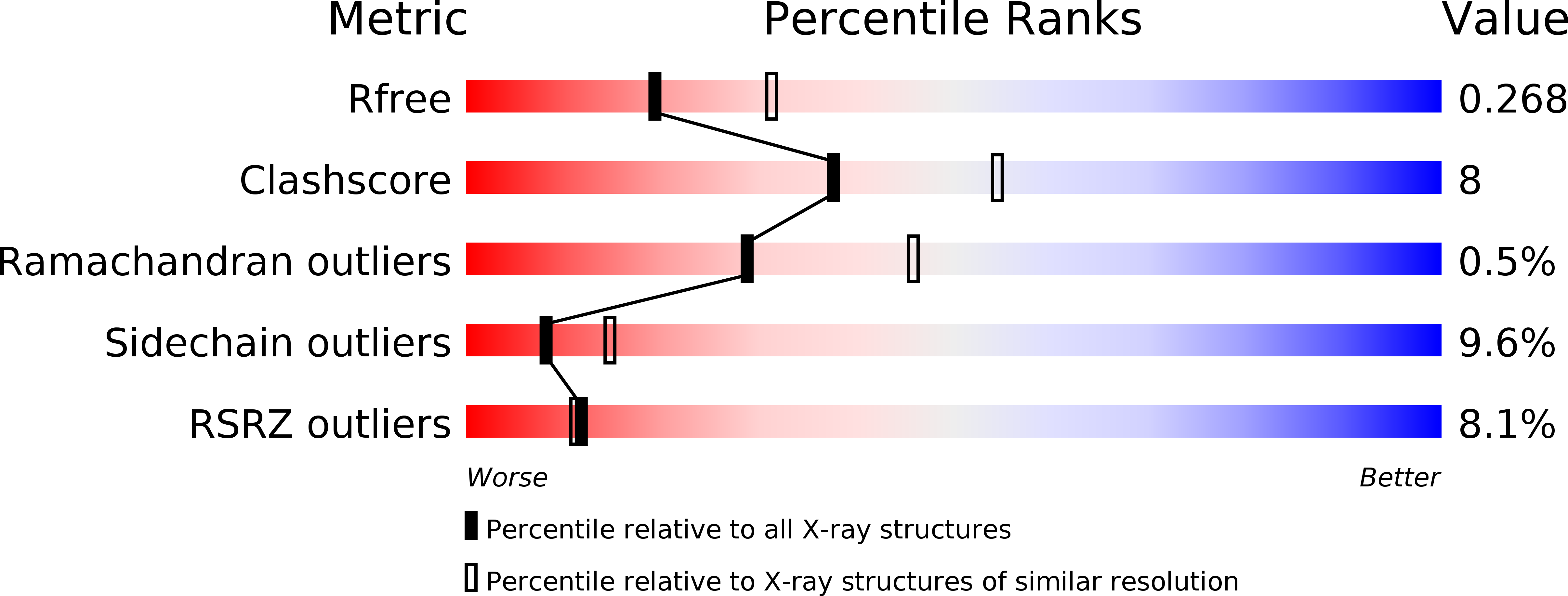
2.48 Å
R-Value Free:
0.26
R-Value Work:
0.22
R-Value Observed:
0.22
Space Group:
P 1 21 1
Macromolecular Entities
Structures with similar UniProt ID
Protein Blast
Polymer Type:polypeptide(L)
Molecule:Toll-like receptor 4
Gene (Uniprot):Tlr4
Chain IDs:A, C (auth: B)
Chain Length:606
Number of Molecules:2
Biological Source:Mus musculus
Structures with similar UniProt ID
Protein Blast
Polymer Type:polypeptide(L)
Molecule:Lymphocyte antigen 96
Gene (Uniprot):Ly96
Chain IDs:B (auth: C), D
Chain Length:144
Number of Molecules:2
Biological Source:Mus musculus
Modified Residue
Compound ID Chain ID Parent Comp ID Details 2D Image
ASN A ASN GLYCOSYLATION SITE
Primary Citation
Structural basis of species-specific endotoxin sensing by innate immune receptor TLR4/MD-2
Proc.Natl.Acad.Sci.USA 109 7421 7426 (2012)
PMID: 22532668 DOI: 10.1073/pnas.1201193109

Abstact

Lipopolysaccharide (LPS), also known as endotoxin, activates the innate immune response through toll-like receptor 4 (TLR4) and its coreceptor, MD-2. MD-2 has a unique hydrophobic cavity that directly binds to lipid A, the active center of LPS. Tetraacylated lipid IVa, a synthetic lipid A precursor, acts as a weak agonist to mouse TLR4/MD-2, but as an antagonist to human TLR4/MD-2. However, it remains unclear as to how LPS and lipid IVa show agonistic or antagonistic activities in a species-specific manner. The present study reports the crystal structures of mouse TLR4/MD-2/LPS and TLR4/MD-2/lipid IVa complexes at 2.5 and 2.7 Å resolutions, respectively. Mouse TLR4/MD-2/LPS exhibited an agonistic "m"-shaped 2:2:2 complex similar to the human TLR4/MD-2/LPS complex. Mouse TLR4/MD-2/lipid IVa complex also showed an agonistic structural feature, exhibiting architecture similar to the 2:2:2 complex. Remarkably, lipid IVa in the mouse TLR4/MD-2 complex occupied nearly the same space as LPS, although lipid IVa lacked the two acyl chains. Human MD-2 binds lipid IVa in an antagonistic manner completely differently from the way mouse MD-2 does. Together, the results provide structural evidence of the agonistic property of lipid IVa on mouse TLR4/MD-2 and deepen understanding of the ligand binding and dimerization mechanism by the structurally diverse LPS variants.

Legend

Protein

Chemical

Disease

Primary Citation of related structures
Feedback Form
Name
Email
Institute
Feedback