3VLX image
Deposition Date 2011-12-05
Release Date 2012-09-26
Last Version Date 2023-12-27
Entry Detail
PDB ID:
3VLX
Keywords:
Title:
Assimilatory nitrite reductase (Nii3) - N226K mutant - ligand free form from tobacco leaf
Biological Source:
Source Organism:
Host Organism:
Method Details:
Experimental Method:
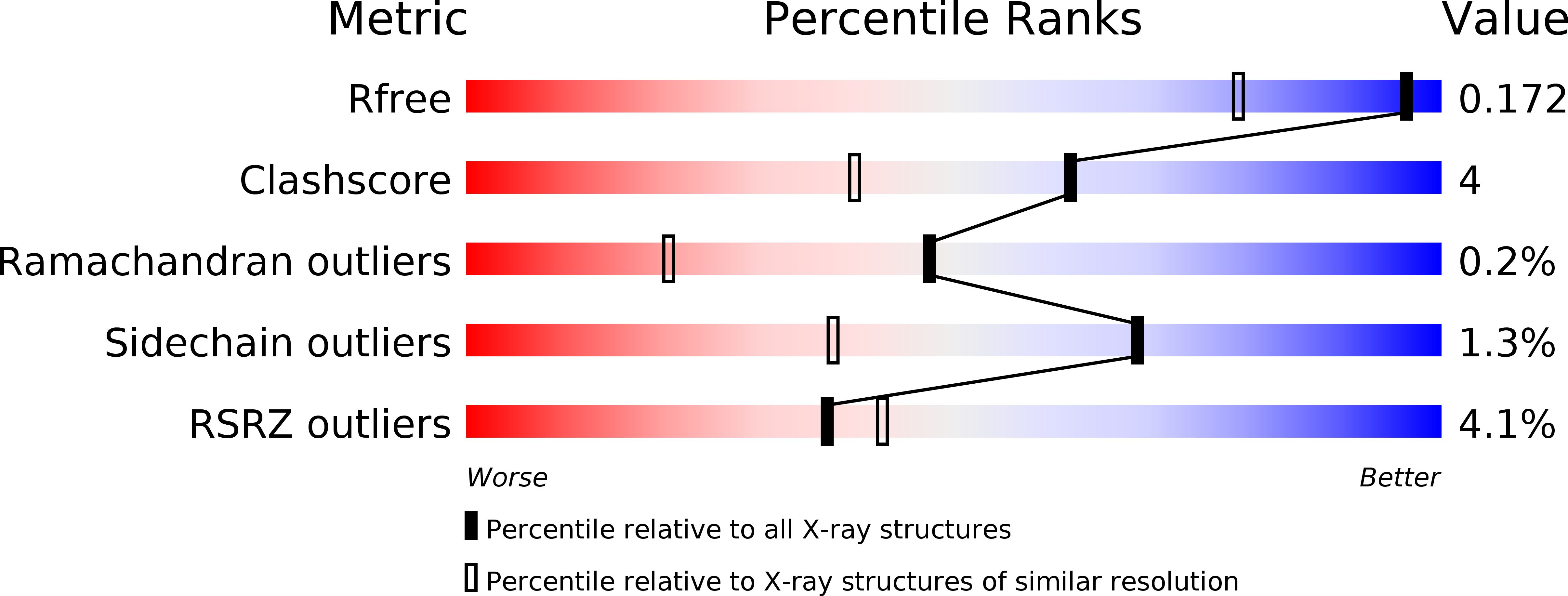
Resolution:
1.35 Å
R-Value Free:
0.17
R-Value Work:
0.16
R-Value Observed:
0.16
Space Group:
P 4 21 2
Macromolecular Entities
Structures with similar UniProt ID
Protein Blast
Polymer Type:polypeptide(L)
Molecule:Nitrite reductase
Gene (Uniprot):nii3
Mutagens:N226K
Chain IDs:A
Chain Length:584
Number of Molecules:1
Biological Source:Nicotiana tabacum
Primary Citation
X-ray crystal structure of a mutant assimilatory nitrite reductase that shows sulfite reductase-like activity
Chem.Biodivers. 9 1989 1999 (2012)
PMID: 22976986 DOI: 10.1002/cbdv.201100442

Abstact

Assimilatory nitrite reductase (aNiR) reduces nitrite ions (NO(2)(-)) to ammonium ions (NH(4)(+)), whereas assimilatory sulfite reductase reduces sulfite (SO(3)(2-)) to hydrogen sulfide (HS(-)). Although aNiR can also reduce SO(3)(2-), its activity is much lower than when NO(2)(-) is reduced as the substrate. To increase the SO(3)(2-)-reduction activity of aNiR, we performed a N226K mutation of Nii3, a representative aNiR. The resulting Nii3-N226K variant could bind non-native targets, SO(3)(2-), and HCO(3)(-), in addition to its native target, i.e., NO(2)(-). We have determined the high-resolution structure of Nii3-N226K in its apo-state and in complex with SO(3)(2-), NO(2)(-), and HCO(3)(-). This analysis revealed conformational changes of Lys226 and the adjacent Lys224 upon binding of SO(3)(2-), but not NO(2)(-)In contrast, HCO(3)(-) binding induced a conformational change at Arg179. After replacing Asn226 with a positively charged Lys, aNiR showed affinity for several anions. A comparison of all ligand-bound structures for Nii3-N226K revealed that structural changes in the active site depend on the size of the substrate.

Legend

Protein

Chemical

Disease

Primary Citation of related structures
Feedback Form
Name
Email
Institute
Feedback