3VLC image
Deposition Date 2011-11-30
Release Date 2012-06-20
Last Version Date 2023-11-08
Entry Detail
PDB ID:
3VLC
Title:
Crystal structure of S. cerevisiae Get3 in the semi open conformation in complex with Get1 cytosolic domain at 4.5 angstrom resolution
Biological Source:
Source Organism:
Host Organism:
Method Details:
Experimental Method:
Resolution:
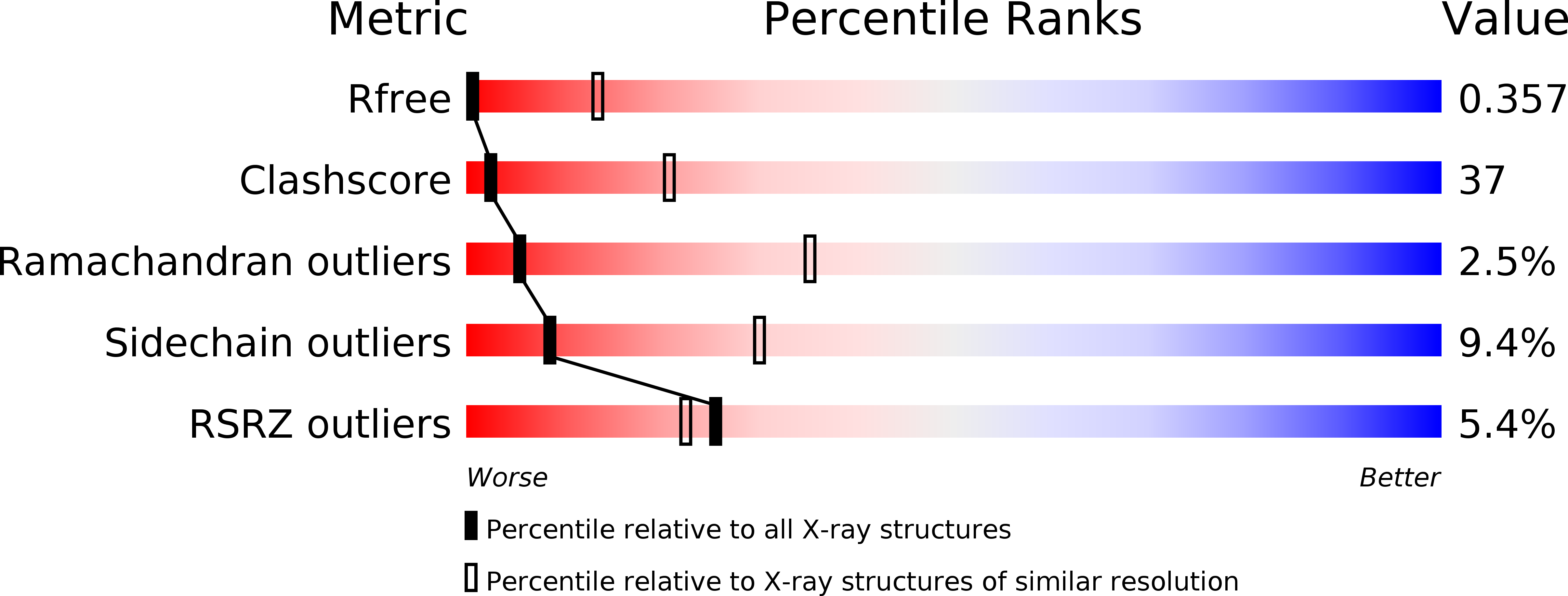
4.50 Å
R-Value Free:
0.36
R-Value Work:
0.34
Space Group:
H 3 2
Macromolecular Entities
Structures with similar UniProt ID
Protein Blast
Polymer Type:polypeptide(L)
Molecule:ATPase GET3
Chain IDs:A
Chain Length:354
Number of Molecules:1
Biological Source:Saccharomyces cerevisiae
Structures with similar UniProt ID
Protein Blast
Polymer Type:polypeptide(L)
Molecule:Golgi to ER traffic protein 1
Gene (Uniprot):GET1
Chain IDs:B (auth: E)
Chain Length:94
Number of Molecules:1
Biological Source:Saccharomyces cerevisiae
Ligand Molecules
Primary Citation
Get1 stabilizes an open dimer conformation of get3 ATPase by binding two distinct interfaces
J.Mol.Biol. 422 366 375 (2012)
PMID: 22684149 DOI: 10.1016/j.jmb.2012.05.045

Abstact

Tail-anchored (TA) proteins are integral membrane proteins that possess a single transmembrane domain near their carboxy terminus. TA proteins play critical roles in many important cellular processes such as membrane trafficking, protein translocation, and apoptosis. The GET complex mediates posttranslational insertion of newly synthesized TA proteins to the endoplasmic reticulum membrane. The GET complex is composed of the homodimeric Get3 ATPase and its heterooligomeric receptor, Get1/2. During insertion, the Get3 dimer shuttles between open and closed conformational states, coupled with ATP hydrolysis and the binding/release of TA proteins. We report crystal structures of ADP-bound Get3 in complex with the cytoplasmic domain of Get1 (Get1CD) in open and semi-open conformations at 3.0- and 4.5-Å resolutions, respectively. Our structures and biochemical data suggest that Get1 uses two interfaces to stabilize the open dimer conformation of Get3. We propose that one interface is sufficient for binding of Get1 by Get3, while the second interface stabilizes the open dimer conformation of Get3.

Legend

Protein

Chemical

Disease

Primary Citation of related structures
Feedback Form
Name
Email
Institute
Feedback