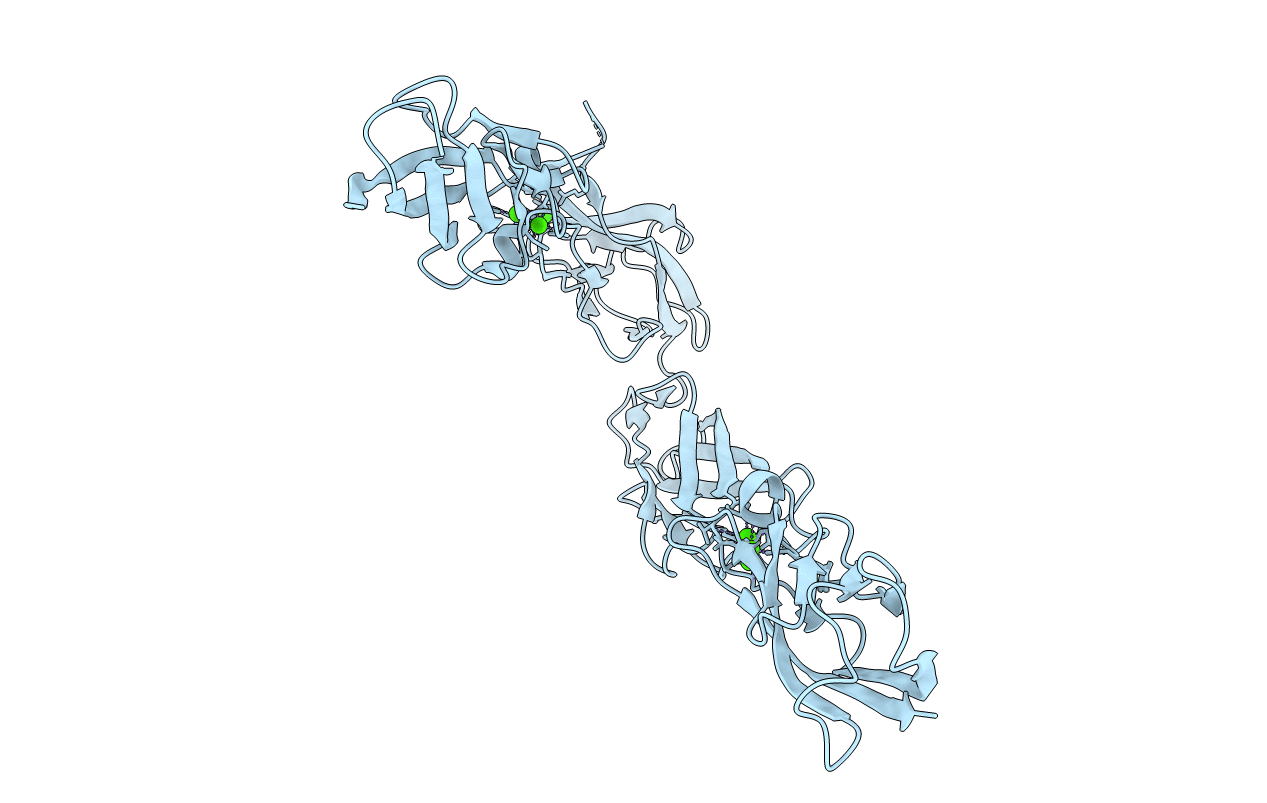
3UBH image
Deposition Date 2011-10-24
Release Date 2011-12-21
Last Version Date 2024-02-28
Entry Detail
PDB ID:
3UBH
Keywords:
Title:
Crystal structure of Drosophila N-cadherin EC1-4
Biological Source:
Source Organism:
Host Organism:
Method Details:
Experimental Method:
Resolution:
2.70 Å
R-Value Free:
0.27
R-Value Work:
0.20
R-Value Observed:
0.20
Space Group:
P 21 21 2
Macromolecular Entities
Structures with similar UniProt ID
Protein Blast
Polymer Type:polypeptide(L)
Molecule:Neural-cadherin
Gene (Uniprot):CadN
Chain IDs:A
Chain Length:419
Number of Molecules:1
Biological Source:Drosophila melanogaster
Ligand Molecules
Primary Citation
Crystal structures of Drosophila N-cadherin ectodomain regions reveal a widely used class of Ca2+-free interdomain linkers.
Proc.Natl.Acad.Sci.USA 109 E127 E134 (2012)
PMID: 22171007 DOI: 10.1073/pnas.1117538108

Abstact

Vertebrate classical cadherins mediate selective calcium-dependent cell adhesion by mechanisms now understood at the atomic level. However, structures and adhesion mechanisms of cadherins from invertebrates, which are highly divergent yet function in similar roles, remain unknown. Here we present crystal structures of three- and four-tandem extracellular cadherin (EC) domain segments from Drosophila N-cadherin (DN-cadherin), each including the predicted N-terminal EC1 domain (denoted EC1') of the mature protein. While the linker regions for the EC1'-EC2' and EC3'-EC4' pairs display binding of three Ca(2+) ions similar to that of vertebrate cadherins, domains EC2' and EC3' are joined in a "kinked" orientation by a previously uncharacterized Ca(2+)-free linker. Biophysical analysis demonstrates that a construct containing the predicted N-terminal nine EC domains of DN-cadherin forms homodimers with affinity similar to vertebrate classical cadherins, whereas deleting the ninth EC domain ablates dimerization. These results suggest that, unlike their vertebrate counterparts, invertebrate cadherins may utilize multiple EC domains to form intercellular adhesive bonds. Sequence analysis reveals that similar Ca(2+)-free linkers are widely distributed in the ectodomains of both vertebrate and invertebrate cadherins.

Legend

Protein

Chemical

Disease

Primary Citation of related structures
Feedback Form
Name
Email
Institute
Feedback