3U6W image
Deposition Date 2011-10-13
Release Date 2012-03-14
Last Version Date 2023-09-13
Entry Detail
PDB ID:
3U6W
Keywords:
Title:
Truncated M. tuberculosis LeuA (1-425) complexed with KIV
Biological Source:
Source Organism:
Host Organism:
Method Details:
Experimental Method:
Resolution:
2.21 Å
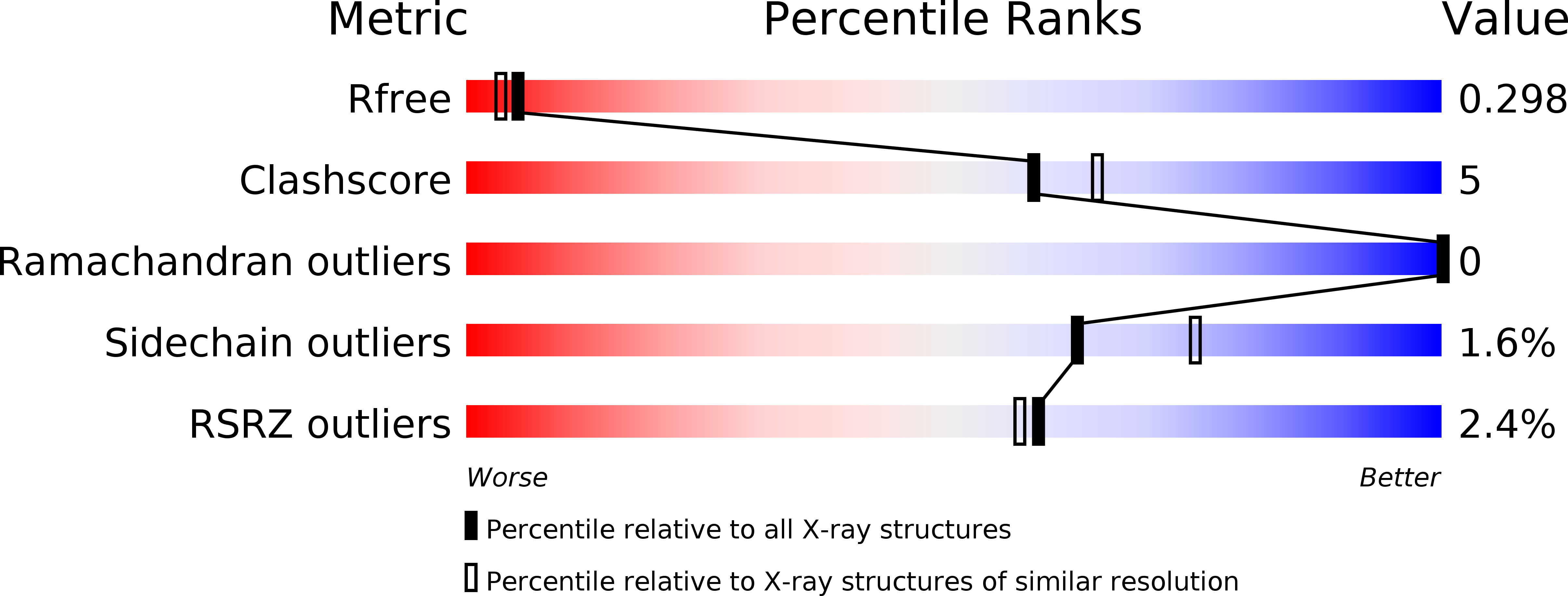
R-Value Free:
0.29
R-Value Work:
0.22
R-Value Observed:
0.22
Space Group:
P 1
Macromolecular Entities
Structures with similar UniProt ID
Protein Blast
Polymer Type:polypeptide(L)
Molecule:2-isopropylmalate synthase
Chain IDs:A, B
Chain Length:427
Number of Molecules:2
Biological Source:Mycobacterium tuberculosis
Primary Citation
Removal of the C-terminal regulatory domain of alpha-isopropylmalate synthase disrupts functional substrate binding.
Biochemistry 51 2289 2297 (2012)
PMID: 22352945 DOI: 10.1021/bi201717j

Abstact

α-Isopropylmalate synthase (α-IPMS) catalyzes the metal-dependent aldol reaction between α-ketoisovalerate (α-KIV) and acetyl-coenzyme A (AcCoA) to give α-isopropylmalate (α-IPM). This reaction is the first committed step in the biosynthesis of leucine in bacteria. α-IPMS is homodimeric, with monomers consisting of (β/α)(8) barrel catalytic domains fused to a C-terminal regulatory domain, responsible for binding leucine and providing feedback regulation for leucine biosynthesis. In these studies, we demonstrate that removal of the regulatory domain from the α-IPMS enzymes of both Neisseria meningitidis (NmeIPMS) and Mycobacterium tuberculosis (MtuIPMS) results in enzymes that are unable to catalyze the formation of α-IPM, although truncated NmeIPMS was still able to slowly hydrolyze AcCoA. The lack of catalytic activity of these truncation variants was confirmed by complementation studies with Escherichia coli cells lacking the α-IPMS gene, where transformation with the plasmids encoding the truncated α-IPMS enzymes was not able to rescue α-IPMS activity. X-ray crystal structures of both truncation variants reveal that both proteins are dimeric and that the catalytic sites of the proteins are intact, although the divalent metal ion that is thought to be responsible for activating substrate α-KIV is displaced slightly relative to its position in the substrate-bound, wild-type structure. Isothermal titration calorimetry and WaterLOGSY nuclear magnetic resonance experiments demonstrate that although these truncation variants are not able to catalyze the reaction between α-KIV and AcCoA, they are still able to bind the substrate α-KIV. It is proposed that the regulatory domain is crucial for ensuring protein dynamics necessary for competent catalysis.

Legend

Protein

Chemical

Disease

Primary Citation of related structures
Feedback Form
Name
Email
Institute
Feedback