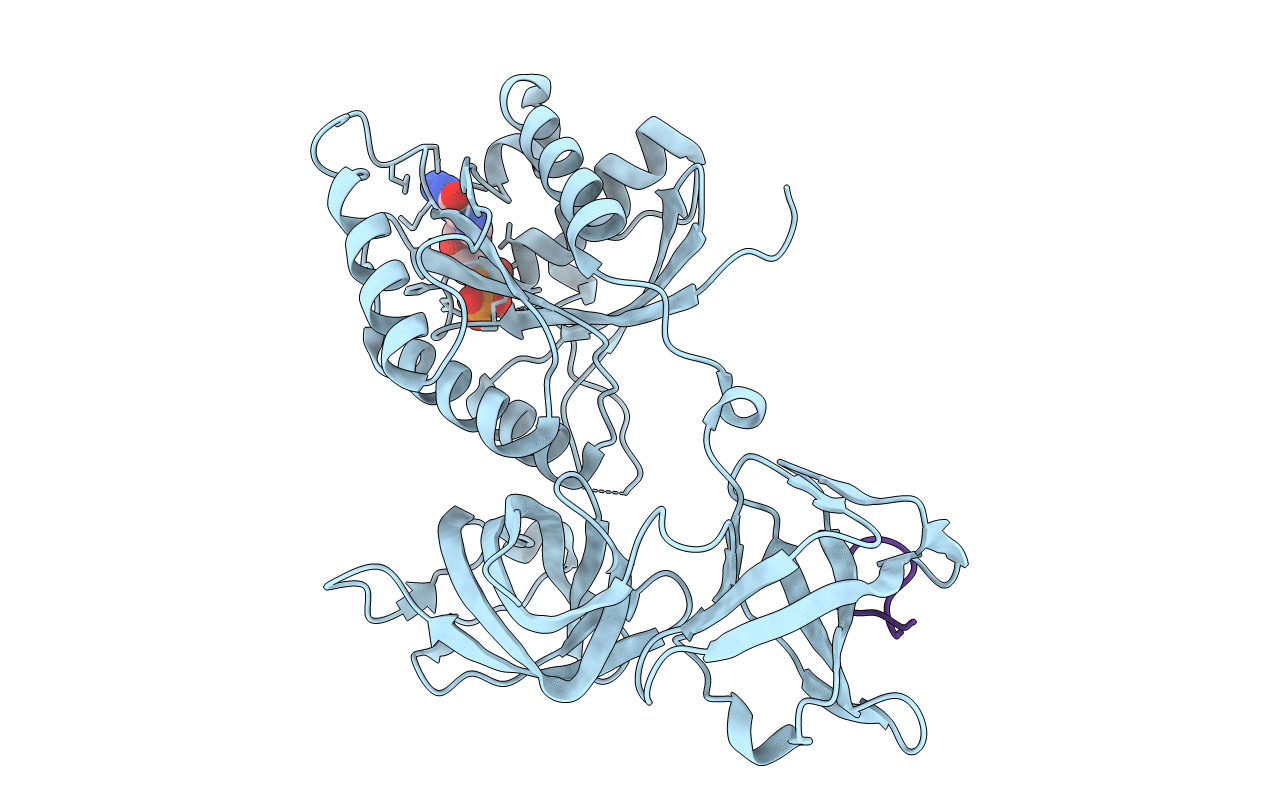
3U2Q image
Deposition Date 2011-10-04
Release Date 2012-05-02
Last Version Date 2023-11-15
Entry Detail
PDB ID:
3U2Q
Title:
EF-Tu (Escherichia coli) in complex with NVP-LFF571
Biological Source:
Source Organism:
Host Organism:
Method Details:
Experimental Method:
Resolution:
2.70 Å
R-Value Free:
0.31
R-Value Work:
0.23
Space Group:
P 21 21 2

Macromolecular Entities
Structures with similar UniProt ID
Protein Blast
Polymer Type:polypeptide(L)
Molecule:Elongation factor Tu 1
Gene (Uniprot):tufA
Chain IDs:A
Chain Length:394
Number of Molecules:1
Biological Source:Escherichia coli
Modified Residue
Compound ID Chain ID Parent Comp ID Details 2D Image
BB6 B CYS (2Z)-2-AMINO-3-SULFANYLBUT-2-ENOIC ACID
BB7 B CYS ?
BB8 B PHE (2S,3S)-BETA-HYDROXY-PHENYLALANINE
BB9 B CYS ?
MEN B ASN N-METHYL ASPARAGINE
MH6 B SER 3-HYDROXY-2-IMINOPROPANOIC ACID
Peptide-like Molecules
PRD_001072
Primary Citation

Abstact

Clostridium difficile (C. difficile) is a Gram positive, anaerobic bacterium that infects the lumen of the large intestine and produces toxins. This results in a range of syndromes from mild diarrhea to severe toxic megacolon and death. Alarmingly, the prevalence and severity of C. difficile infection are increasing; thus, associated morbidity and mortality rates are rising. 4-Aminothiazolyl analogues of the antibiotic natural product GE2270 A (1) were designed, synthesized, and optimized for the treatment of C. difficile infection. The medicinal chemistry effort focused on enhancing aqueous solubility relative to that of the natural product and previous development candidates (2, 3) and improving antibacterial activity. Structure-activity relationships, cocrystallographic interactions, pharmacokinetics, and efficacy in animal models of infection were characterized. These studies identified a series of dicarboxylic acid derivatives, which enhanced solubility/efficacy profile by several orders of magnitude compared to previously studied compounds and led to the selection of LFF571 (4) as an investigational new drug for treating C. difficile infection.

Legend

Protein

Chemical

Disease

Primary Citation of related structures
Feedback Form
Name
Email
Institute
Feedback