3U2H image
Deposition Date 2011-10-03
Release Date 2012-07-04
Last Version Date 2023-09-13
Entry Detail
PDB ID:
3U2H
Title:
Crystal structure of the C-terminal DUF1608 domain of the Methanosarcina acetivorans S-layer (MA0829) protein
Biological Source:
Source Organism:
Host Organism:
Method Details:
Experimental Method:
Resolution:
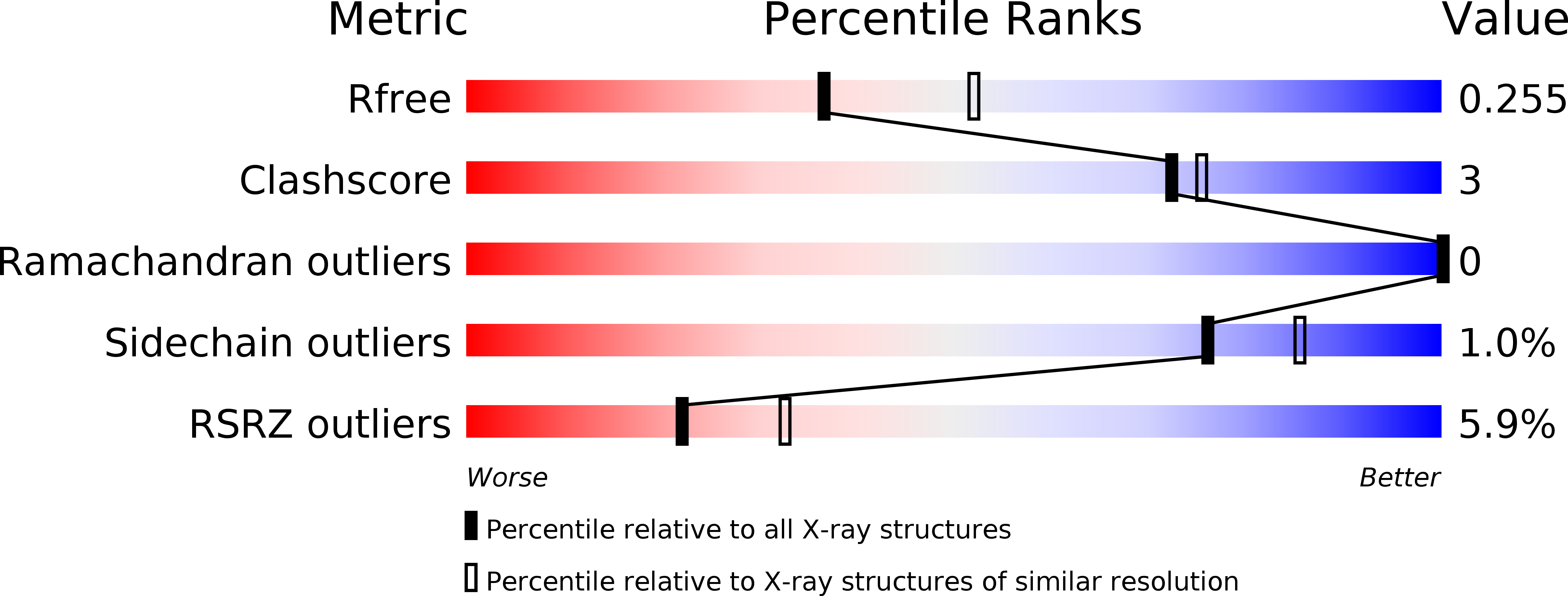
2.36 Å
R-Value Free:
0.25
R-Value Work:
0.20
R-Value Observed:
0.21
Space Group:
C 1 2 1
Macromolecular Entities
Structures with similar UniProt ID
Protein Blast
Polymer Type:polypeptide(L)
Molecule:S-layer protein MA0829
Gene (Uniprot):MA_0829
Chain IDs:A
Chain Length:286
Number of Molecules:1
Biological Source:Methanosarcina acetivorans
Ligand Molecules
Primary Citation
Structure of the surface layer of the methanogenic archaean Methanosarcina acetivorans.
Proc.Natl.Acad.Sci.USA 109 11812 11817 (2012)
PMID: 22753492 DOI: 10.1073/pnas.1120595109

Abstact

Archaea have a self-assembling proteinaceous surface (S-) layer as the primary and outermost boundary of their cell envelopes. The S-layer maintains structural rigidity, protects the organism from adverse environmental elements, and yet provides access to all essential nutrients. We have determined the crystal structure of one of the two "homologous" tandem polypeptide repeats that comprise the Methanosarcina acetivorans S-layer protein and propose a high-resolution model for a microbial S-layer. The molecular features of our hexameric S-layer model recapitulate those visualized by medium resolution electron microscopy studies of microbial S-layers and greatly expand our molecular view of S-layer dimensions, porosity, and symmetry. The S-layer model reveals a negatively charged molecular sieve that presents both a charge and size barrier to restrict access to the cell periplasmic-like space. The β-sandwich folds of the S-layer protein are structurally homologous to eukaryotic virus envelope proteins, suggesting that Archaea and viruses have arrived at a common solution for protective envelope structures. These results provide insight into the evolutionary origins of primitive cell envelope structures, of which the S-layer is considered to be among the most primitive: it also provides a platform for the development of self-assembling nanomaterials with diverse functional and structural properties.

Legend

Protein

Chemical

Disease

Primary Citation of related structures
Feedback Form
Name
Email
Institute
Feedback