3U0R image
Deposition Date 2011-09-29
Release Date 2012-02-22
Last Version Date 2024-03-20
Entry Detail
PDB ID:
3U0R
Title:
Helical repeat structure of apoptosis inhibitor 5 reveals protein-protein interaction modules
Biological Source:
Source Organism:
Homo sapiens (Taxon ID: 9606)
Host Organism:
Method Details:
Experimental Method:
Resolution:
2.50 Å
R-Value Free:
0.24
R-Value Work:
0.21
R-Value Observed:
0.21
Space Group:
P 21 21 21
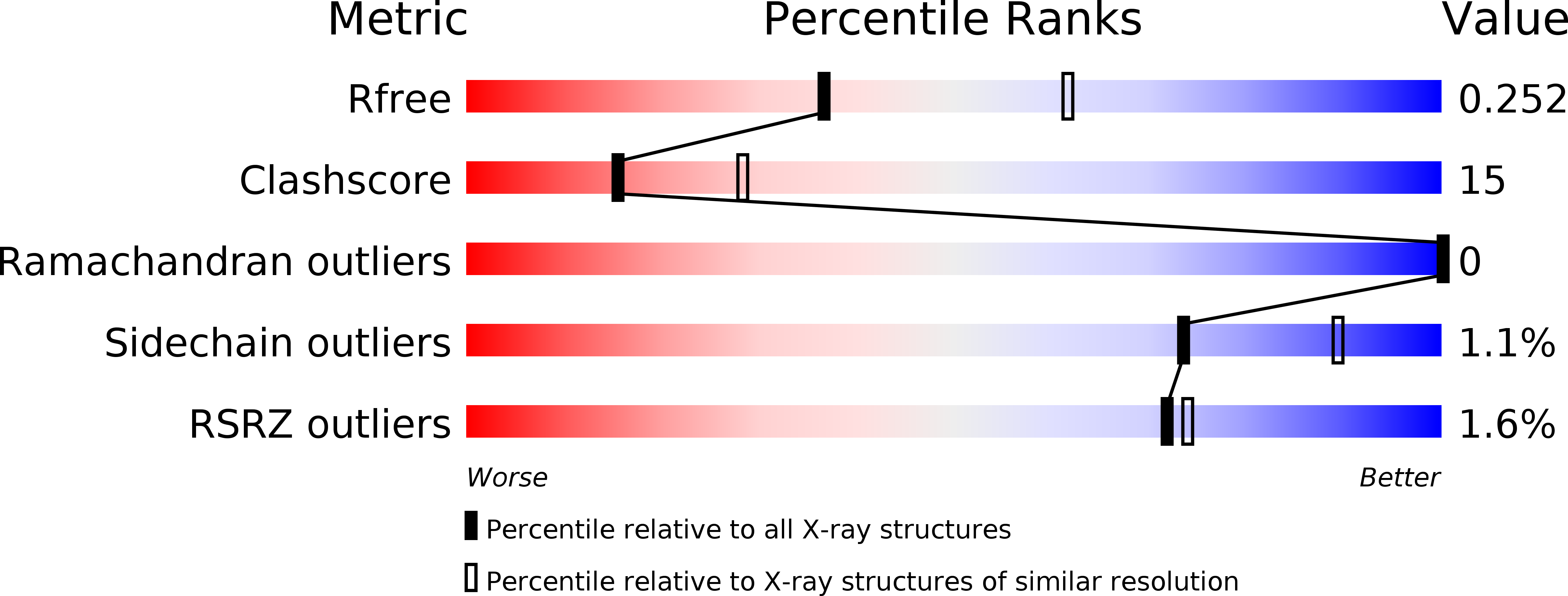
Macromolecular Entities
Structures with similar UniProt ID
Protein Blast
Polymer Type:polypeptide(L)
Molecule:Apoptosis inhibitor 5
Gene (Uniprot):API5
Chain IDs:A
Chain Length:507
Number of Molecules:1
Biological Source:Homo sapiens
Primary Citation
Helical repeat structure of apoptosis inhibitor 5 reveals protein-protein interaction modules.
J.Biol.Chem. 287 10727 10737 (2012)
PMID: 22334682 DOI: 10.1074/jbc.M111.317594

Abstact

Apoptosis inhibitor 5 (API5) is an anti-apoptotic protein that is up-regulated in various cancer cells. Here, we present the crystal structure of human API5. API5 exhibits an elongated all α-helical structure. The N-terminal half of API5 is similar to the HEAT repeat and the C-terminal half is similar to the ARM (Armadillo-like) repeat. HEAT and ARM repeats have been implicated in protein-protein interactions, suggesting that the cellular roles of API5 may be to mediate protein-protein interactions. Various components of multiprotein complexes have been identified as API5-interacting protein partners, suggesting that API5 may act as a scaffold for multiprotein complexes. API5 exists as a monomer, and the functionally important heptad leucine repeat does not exhibit the predicted a dimeric leucine zipper. Additionally, Lys-251, which can be acetylated in cells, plays important roles in the inhibition of apoptosis under serum deprivation conditions. The acetylation of this lysine also affects the stability of API5 in cells.

Legend

Protein

Chemical

Disease

Primary Citation of related structures
Feedback Form
Name
Email
Institute
Feedback