3TQ6 image
Deposition Date 2011-09-09
Release Date 2011-11-02
Last Version Date 2024-02-28
Entry Detail
PDB ID:
3TQ6
Title:
Crystal structure of human mitochondrial transcription factor A, TFAM or mtTFA, bound to the light strand promoter LSP
Biological Source:
Source Organism:
Homo sapiens (Taxon ID: 9606)
Host Organism:
Method Details:
Experimental Method:
Resolution:
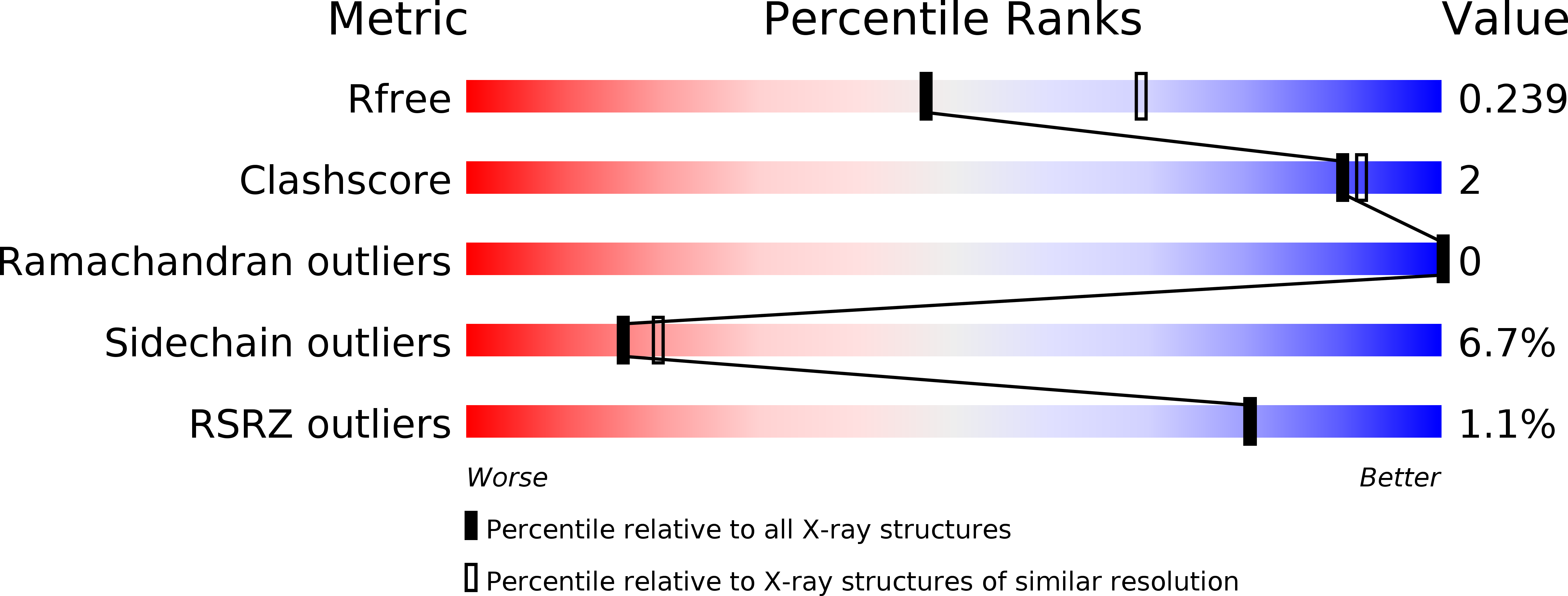
2.45 Å
R-Value Free:
0.22
R-Value Work:
0.18
R-Value Observed:
0.18
Space Group:
P 21 21 2
Macromolecular Entities
Structures with similar UniProt ID
Protein Blast
Polymer Type:polypeptide(L)
Molecule:Transcription factor A, mitochondrial
Gene (Uniprot):TFAM
Chain IDs:A, B
Chain Length:214
Number of Molecules:2
Biological Source:Homo sapiens
Polymer Type:polydeoxyribonucleotide
Molecule:DNA (5'-D(*TP*AP*AP*CP*AP*GP*TP*CP*AP*CP*CP*CP*CP*CP*CP*AP*AP*CP*(BRU)P*AP*AP*C)-3')
Chain IDs:C, E
Chain Length:22
Number of Molecules:2
Biological Source:Homo sapiens
Polymer Type:polydeoxyribonucleotide
Molecule:DNA (5'-D(*GP*TP*TP*AP*GP*TP*TP*GP*GP*GP*GP*GP*GP*TP*GP*AP*CP*TP*GP*TP*TP*A)-3')
Chain IDs:D, F
Chain Length:22
Number of Molecules:2
Biological Source:Homo sapiens
Modified Residue
Compound ID Chain ID Parent Comp ID Details 2D Image
BRU C DU ?
Primary Citation
Human mitochondrial transcription factor A induces a U-turn structure in the light strand promoter.
Nat.Struct.Mol.Biol. 18 1281 1289 (2011)
PMID: 22037172 DOI: 10.1038/nsmb.2160

Abstact

Human mitochondrial transcription factor A, TFAM, is essential for mitochondrial DNA packaging and maintenance and also has a crucial role in transcription. Crystallographic analysis of TFAM in complex with an oligonucleotide containing the mitochondrial light strand promoter (LSP) revealed two high-mobility group (HMG) protein domains that, through different DNA recognition properties, intercalate residues at two inverted DNA motifs. This induced an overall DNA bend of ~180°, stabilized by the interdomain linker. This U-turn allows the TFAM C-terminal tail, which recruits the transcription machinery, to approach the initiation site, despite contacting a distant DNA sequence. We also ascertained that structured protein regions contacting DNA in the crystal were highly flexible in solution in the absence of DNA. Our data suggest that TFAM bends LSP to create an optimal DNA arrangement for transcriptional initiation while facilitating DNA compaction elsewhere in the genome.

Legend

Protein

Chemical

Disease

Primary Citation of related structures
Feedback Form
Name
Email
Institute
Feedback