3TO4 image
Deposition Date 2011-09-04
Release Date 2011-12-14
Last Version Date 2024-11-06
Entry Detail
PDB ID:
3TO4
Keywords:
Title:
Structure of mouse Valpha14Vbeta2-mouseCD1d-alpha-Galactosylceramide
Biological Source:
Source Organism:
Host Organism:
Method Details:
Experimental Method:
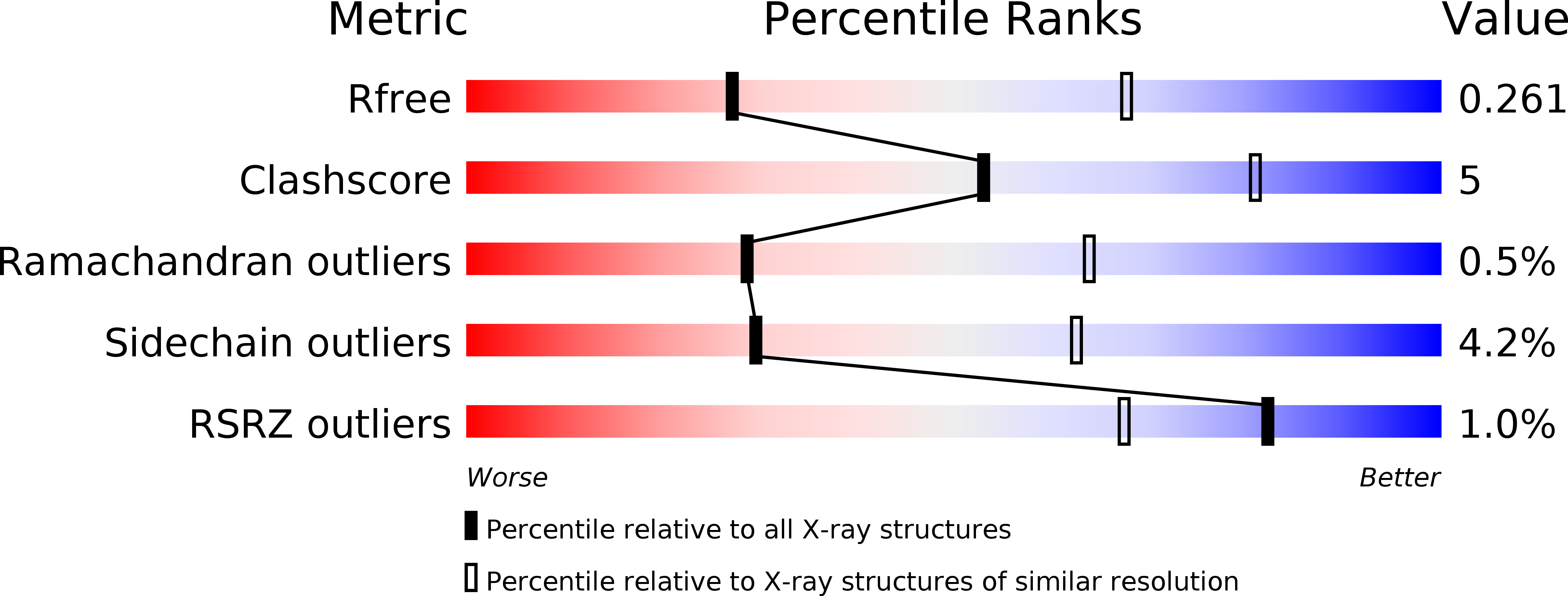
Resolution:
3.10 Å
R-Value Free:
0.26
R-Value Work:
0.21
R-Value Observed:
0.21
Space Group:
P 21 21 21
Macromolecular Entities
Structures with similar UniProt ID
Protein Blast
Polymer Type:polypeptide(L)
Molecule:Antigen-presenting glycoprotein CD1d1
Gene (Uniprot):Cd1d1
Chain IDs:A
Chain Length:302
Number of Molecules:1
Biological Source:Mus musculus
Structures with similar UniProt ID
Protein Blast
Polymer Type:polypeptide(L)
Molecule:Beta-2 microglobulin
Chain IDs:B
Chain Length:99
Number of Molecules:1
Biological Source:Mus musculus
Polymer Type:polypeptide(L)
Molecule:NKT Valpha14 (MOUSE VARIABLE DOMAIN, HUMAN CONSTANT DOMAIN)
Chain IDs:C
Chain Length:212
Number of Molecules:1
Biological Source:HOMO SAPIENS, Mus musculus
Polymer Type:polypeptide(L)
Molecule:NKT Vbeta2 (MOUSE VARIABLE DOMAIN, HUMAN CONSTANT DOMAIN)
Chain IDs:D
Chain Length:253
Number of Molecules:1
Biological Source:HOMO SAPIENS, Mus musculus
Modified Residue
Compound ID Chain ID Parent Comp ID Details 2D Image
ASN A ASN GLYCOSYLATION SITE
Primary Citation
Vbeta2 natural killer T cell antigen receptor-mediated recognition of CD1d-glycolipid antigen.
Proc.Natl.Acad.Sci.USA 108 19007 19012 (2011)
PMID: 22065767 DOI: 10.1073/pnas.1109066108

Abstact

Natural killer T cell antigen receptors (NKT TCRs) recognize lipid-based antigens (Ags) presented by CD1d. Although the TCR α-chain is invariant, NKT TCR Vβ exhibits greater diversity, with one (Vβ11) and three (Vβ8, Vβ7, and Vβ2) Vβ chains in humans and mice, respectively. With the exception of the Vβ2 NKT TCR, NKT TCRs possess canonical tyrosine residues within complementarity determining region (CDR) 2β that are critical for CD1d binding. Thus, how Vβ2 NKT TCR docks with CD1d-Ag was unclear. Despite the absence of the CDR2β-encoded tyrosine residues, we show that the Vβ2 NKT TCR engaged CD1d-Ag in a similar manner and with a comparable affinity and energetic footprint to the manner observed for the Vβ8.2 and Vβ7 NKT TCRs. Accordingly, the germline-encoded regions of the TCR β-chain do not exclusively dictate the innate NKT TCR-CD1d-Ag docking mode. Nevertheless, clear fine specificity differences for the CD1d-Ag existed between the Vβ2 NKT TCR and the Vβ8.2 and Vβ7 NKT TCRs, with the Vβ2 NKT TCR exhibiting greater sensitivity to modifications to the glycolipid Ag. Furthermore, within the Vβ2 NKT TCR-CD1d-αGalCer complex, the CDR2β loop mediated fewer contacts with CD1d, whereas the CDR1β and CDR3β loops contacted CD1d to a much greater extent compared with most Vβ11, Vβ8.2, and Vβ7 NKT TCRs. Accordingly, there is a greater interplay between the germline- and nongermline-encoded loops within the TCR β-chain of the Vβ2 NKT TCR that enables CD1d-Ag ligation.

Legend

Protein

Chemical

Disease

Primary Citation of related structures
Feedback Form
Name
Email
Institute
Feedback