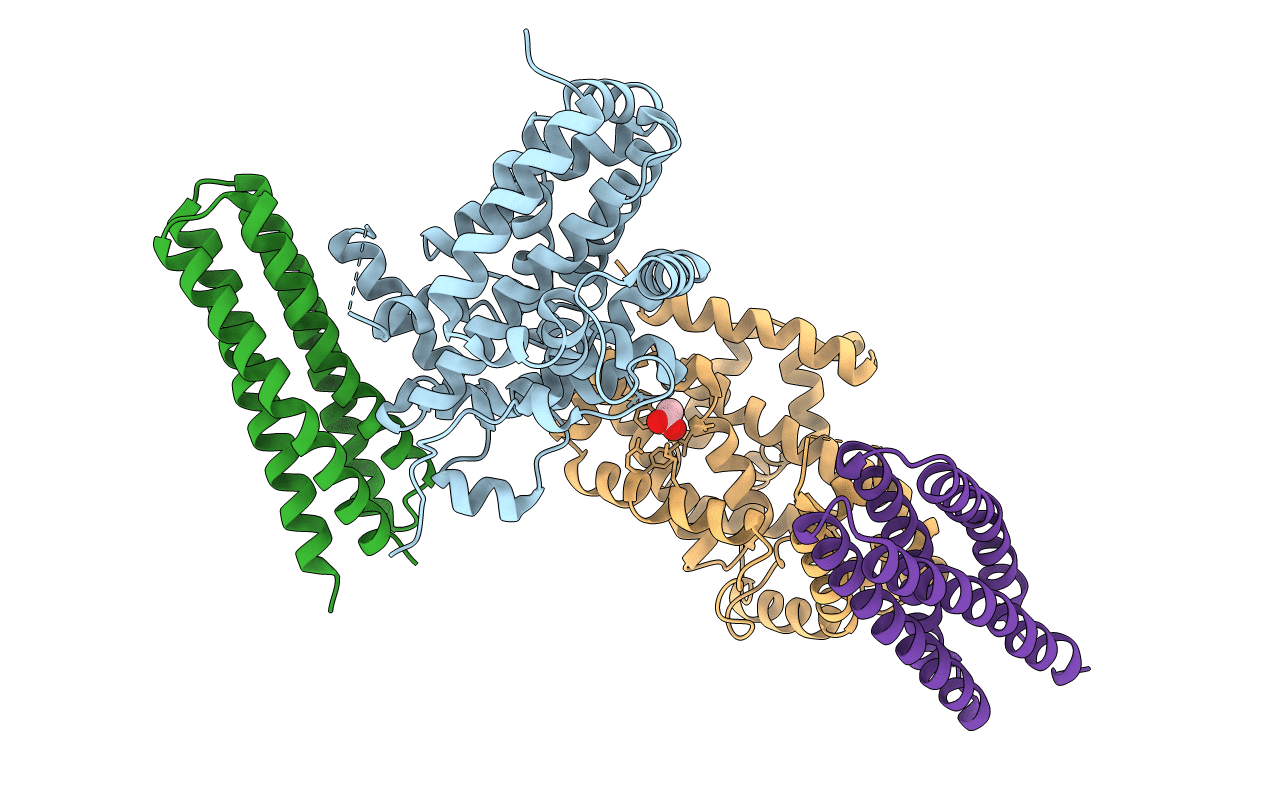
3T6G image
Deposition Date 2011-07-28
Release Date 2011-11-23
Last Version Date 2024-02-28
Entry Detail
PDB ID:
3T6G
Title:
Structure of the complex between NSP3 (SHEP1) and p130Cas
Biological Source:
Source Organism:
Homo sapiens (Taxon ID: 9606)
Host Organism:
Method Details:
Experimental Method:
Resolution:
2.50 Å
R-Value Free:
0.26
R-Value Work:
0.19
R-Value Observed:
0.19
Space Group:
I 41
Macromolecular Entities
Structures with similar UniProt ID
Protein Blast
Polymer Type:polypeptide(L)
Molecule:SH2 domain-containing protein 3C
Gene (Uniprot):SH2D3C
Mutagens:C654S, C755S
Chain IDs:A, C
Chain Length:331
Number of Molecules:2
Biological Source:Homo sapiens
Structures with similar UniProt ID
Protein Blast
Polymer Type:polypeptide(L)
Molecule:Breast cancer anti-estrogen resistance protein 1
Gene (Uniprot):BCAR1
Chain IDs:B, D
Chain Length:229
Number of Molecules:2
Biological Source:Homo sapiens
Ligand Molecules
Primary Citation
NSP-Cas protein structures reveal a promiscuous interaction module in cell signaling.
Nat.Struct.Mol.Biol. 18 1381 1387 (2011)
PMID: 22081014 DOI: 10.1038/nsmb.2152

Abstact

Members of the novel SH2-containing protein (NSP) and Crk-associated substrate (Cas) protein families form multidomain signaling platforms that mediate cell migration and invasion through a collection of distinct signaling motifs. Members of each family interact via their respective C-terminal domains, but the mechanism of this association has remained enigmatic. Here we present the crystal structures of the C-terminal domain from the NSP protein BCAR3 and the complex of NSP3 with p130Cas. BCAR3 adopts the Cdc25-homology fold of Ras GTPase exchange factors, but it has a 'closed' conformation incapable of enzymatic activity. The structure of the NSP3-p130Cas complex reveals that this closed conformation is instrumental for interaction of NSP proteins with a focal adhesion-targeting domain present in Cas proteins. This enzyme-to-adaptor conversion enables high-affinity, yet promiscuous, interactions between NSP and Cas proteins and represents an unprecedented mechanistic paradigm linking cellular signaling networks.

Legend

Protein

Chemical

Disease

Primary Citation of related structures
Feedback Form
Name
Email
Institute
Feedback