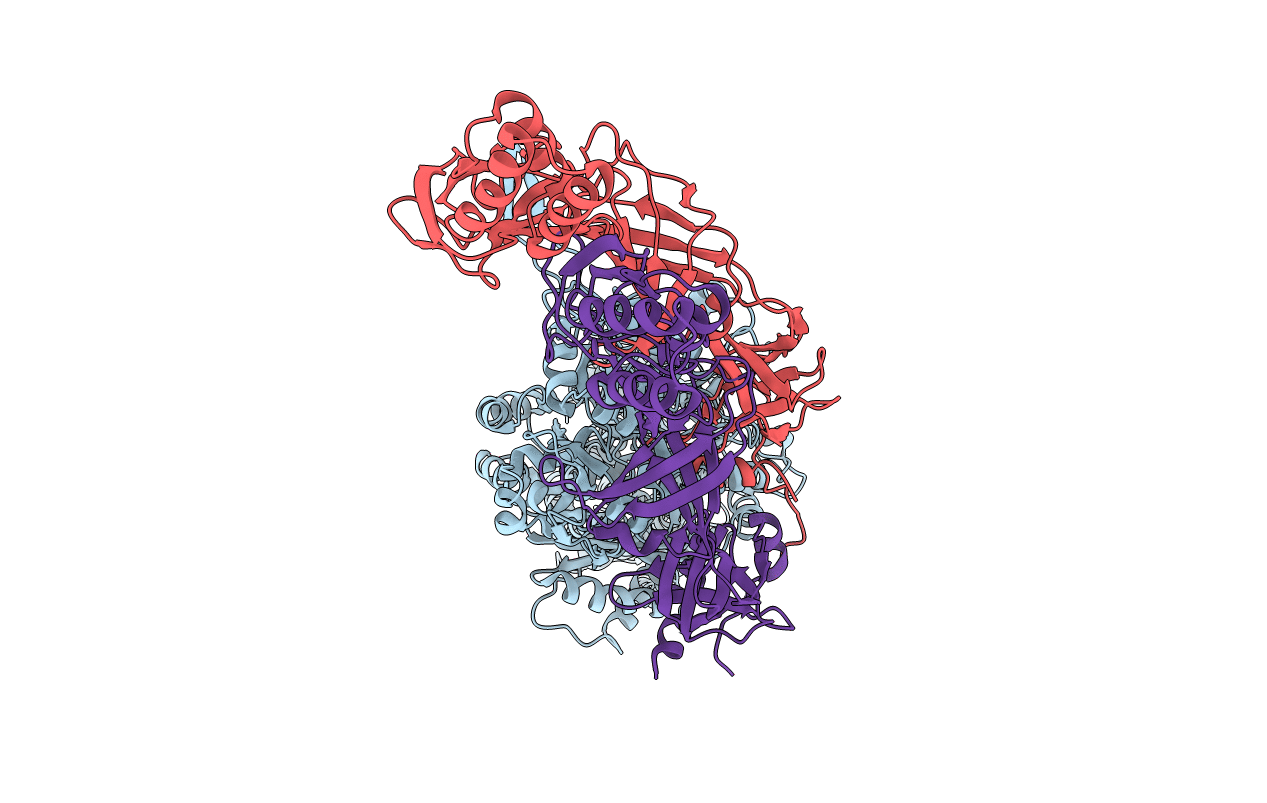
3T51 image
Deposition Date 2011-07-26
Release Date 2012-06-20
Last Version Date 2024-02-28
Entry Detail
PDB ID:
3T51
Title:
Crystal structures of the pre-extrusion and extrusion states of the CusBA adaptor-transporter complex
Biological Source:
Source Organism:
Host Organism:
Method Details:
Experimental Method:
Resolution:
3.90 Å
R-Value Free:
0.32
R-Value Work:
0.25
R-Value Observed:
0.26
Space Group:
H 3 2
Macromolecular Entities
Structures with similar UniProt ID
Protein Blast
Polymer Type:polypeptide(L)
Molecule:Cation efflux system protein CusA
Gene (Uniprot):cusA
Chain IDs:C (auth: A)
Chain Length:1054
Number of Molecules:1
Biological Source:Escherichia coli
Structures with similar UniProt ID
Protein Blast
Polymer Type:polypeptide(L)
Molecule:Cation efflux system protein CusB
Gene (Uniprot):cusB
Chain IDs:A (auth: B), B (auth: C)
Chain Length:336
Number of Molecules:2
Biological Source:Escherichia coli
Ligand Molecules
Primary Citation
Charged Amino Acids (R83, E567, D617, E625, R669, and K678) of CusA Are Required for Metal Ion Transport in the Cus Efflux System.
J.Mol.Biol. 422 429 441 (2012)
PMID: 22683351 DOI: 10.1016/j.jmb.2012.05.038

Abstact

Gram-negative bacteria expel various toxic chemicals via tripartite efflux pumps belonging to the resistance-nodulation-cell division superfamily. These pumps span both the inner and outer membranes of the cell. The three components of these tripartite systems are an inner-membrane, substrate-binding transporter (or pump); a periplasmic membrane fusion protein (or adaptor); and an outer-membrane-anchored channel. These three efflux proteins interact in the periplasmic space to form the three-part complexes. We previously presented the crystal structures of both the inner-membrane transporter CusA and membrane fusion protein CusB of the CusCBA tripartite efflux system from Escherichia coli. We also described the co-crystal structure of the CusBA adaptor-transporter, revealing that the trimeric CusA efflux pump assembles with six CusB protein molecules to form the complex CusB(6)-CusA(3). We here report three different conformers of the crystal structures of CusBA-Cu(I), suggesting a mechanism on how Cu(I) binding initiates a sequence of conformational transitions in the transport cycle. Genetic analysis and transport assays indicate that charged residues, in addition to the methionine pairs and clusters, are essential for extruding metal ions out of the cell.

Legend

Protein

Chemical

Disease

Primary Citation of related structures
Feedback Form
Name
Email
Institute
Feedback