3SI7 image
Deposition Date 2011-06-17
Release Date 2012-02-01
Last Version Date 2024-02-28
Entry Detail
PDB ID:
3SI7
Keywords:
Title:
The crystal structure of the NBD1 domain of the mouse CFTR protein, deltaF508 mutant
Biological Source:
Source Organism:
Mus musculus (Taxon ID: 10090)
Host Organism:
Method Details:
Experimental Method:
Resolution:
2.25 Å
R-Value Free:
0.22
R-Value Work:
0.18
R-Value Observed:
0.18
Space Group:
P 4 21 2
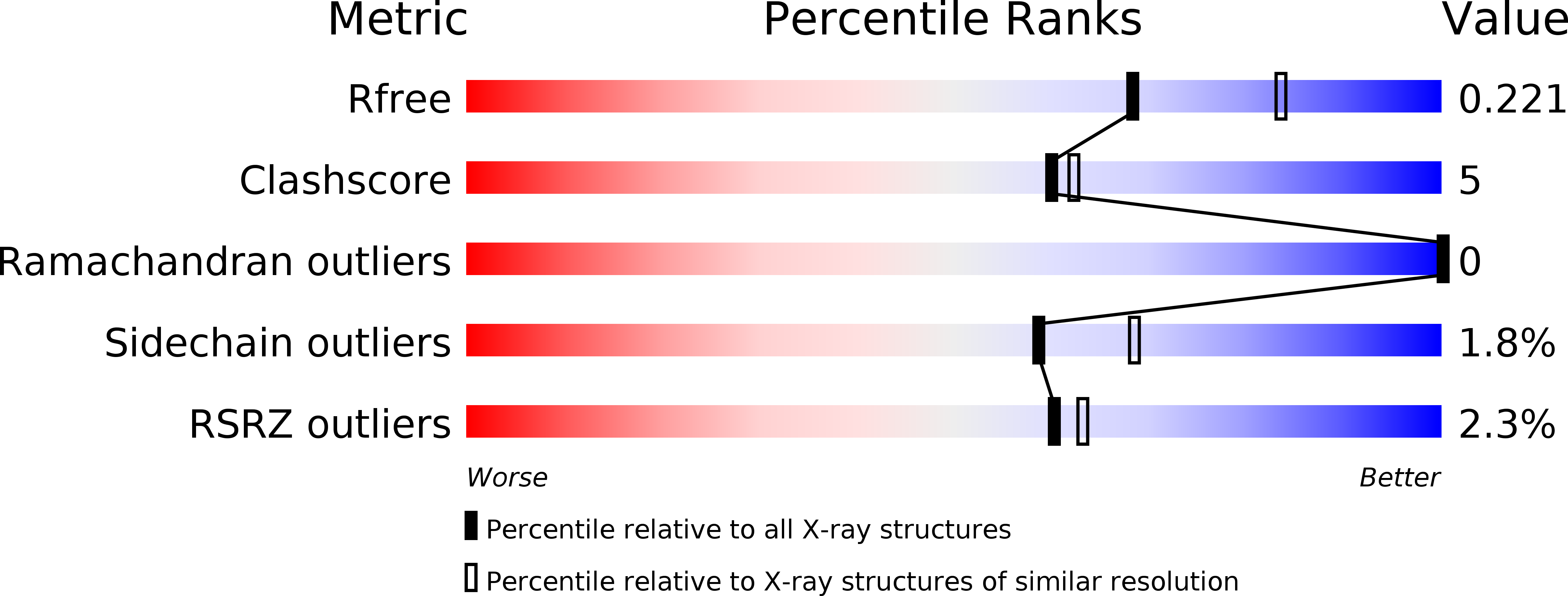
Macromolecular Entities
Structures with similar UniProt ID
Protein Blast
Polymer Type:polypeptide(L)
Molecule:Cystic fibrosis transmembrane conductance regulator
Gene (Uniprot):Cftr
Chain IDs:A, B, C, D
Chain Length:285
Number of Molecules:4
Biological Source:Mus musculus
Primary Citation
Requirements for efficient correction of DeltaF508 CFTR revealed by analyses of evolved sequences
Cell(Cambridge,Mass.) 148 164 174 (2012)
PMID: 22265409 DOI: 10.1016/j.cell.2011.11.023

Abstact

Misfolding of ΔF508 cystic fibrosis (CF) transmembrane conductance regulator (CFTR) underlies pathology in most CF patients. F508 resides in the first nucleotide-binding domain (NBD1) of CFTR near a predicted interface with the fourth intracellular loop (ICL4). Efforts to identify small molecules that restore function by correcting the folding defect have revealed an apparent efficacy ceiling. To understand the mechanistic basis of this obstacle, positions statistically coupled to 508, in evolved sequences, were identified and assessed for their impact on both NBD1 and CFTR folding. The results indicate that both NBD1 folding and interaction with ICL4 are altered by the ΔF508 mutation and that correction of either individual process is only partially effective. By contrast, combination of mutations that counteract both defects restores ΔF508 maturation and function to wild-type levels. These results provide a mechanistic rationale for the limited efficacy of extant corrector compounds and suggest approaches for identifying compounds that correct both defective steps.

Legend

Protein

Chemical

Disease

Primary Citation of related structures
Feedback Form
Name
Email
Institute
Feedback