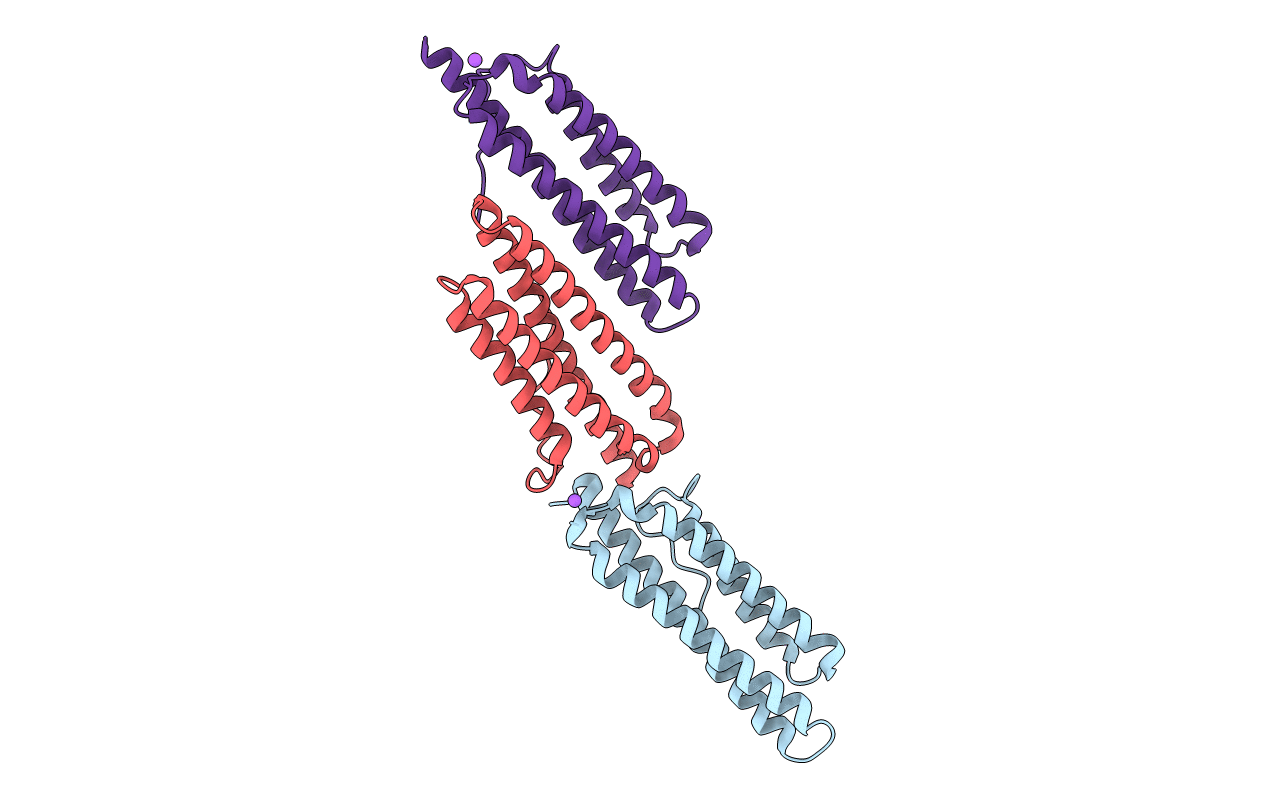
3S9O image
Deposition Date 2011-06-01
Release Date 2012-06-06
Last Version Date 2023-09-13
Entry Detail
PDB ID:
3S9O
Keywords:
Title:
The Focal Adhesion Targeting (FAT) domain of the Focal Adhesion Kinase showing N-terminal interactions in cis
Biological Source:
Source Organism:
Homo sapiens (Taxon ID: 9606)
Host Organism:
Method Details:
Experimental Method:
Resolution:
2.60 Å
R-Value Free:
0.28
R-Value Work:
0.23
R-Value Observed:
0.23
Space Group:
C 2 2 21

Macromolecular Entities
Structures with similar UniProt ID
Protein Blast
Polymer Type:polypeptide(L)
Molecule:Focal adhesion kinase 1
Gene (Uniprot):PTK2
Chain IDs:A, B, C
Chain Length:164
Number of Molecules:3
Biological Source:Homo sapiens
Primary Citation
Conformational dynamics of the focal adhesion targeting domain control specific functions of focal adhesion kinase in cells.
J.Biol.Chem. 290 478 491 (2015)
PMID: 25391654 DOI: 10.1074/jbc.M114.593632

Abstact

Focal adhesion (FA) kinase (FAK) regulates cell survival and motility by transducing signals from membrane receptors. The C-terminal FA targeting (FAT) domain of FAK fulfils multiple functions, including recruitment to FAs through paxillin binding. Phosphorylation of FAT on Tyr(925) facilitates FA disassembly and connects to the MAPK pathway through Grb2 association, but requires dissociation of the first helix (H1) of the four-helix bundle of FAT. We investigated the importance of H1 opening in cells by comparing the properties of FAK molecules containing wild-type or mutated FAT with impaired or facilitated H1 openings. These mutations did not alter the activation of FAK, but selectively affected its cellular functions, including self-association, Tyr(925) phosphorylation, paxillin binding, and FA targeting and turnover. Phosphorylation of Tyr(861), located between the kinase and FAT domains, was also enhanced by the mutation that opened the FAT bundle. Similarly phosphorylation of Ser(910) by ERK in response to bombesin was increased by FAT opening. Although FAK molecules with the mutation favoring FAT opening were poorly recruited at FAs, they efficiently restored FA turnover and cell shape in FAK-deficient cells. In contrast, the mutation preventing H1 opening markedly impaired FAK function. Our data support the biological importance of conformational dynamics of the FAT domain and its functional interactions with other parts of the molecule.

Legend

Protein

Chemical

Disease

Primary Citation of related structures
Feedback Form
Name
Email
Institute
Feedback