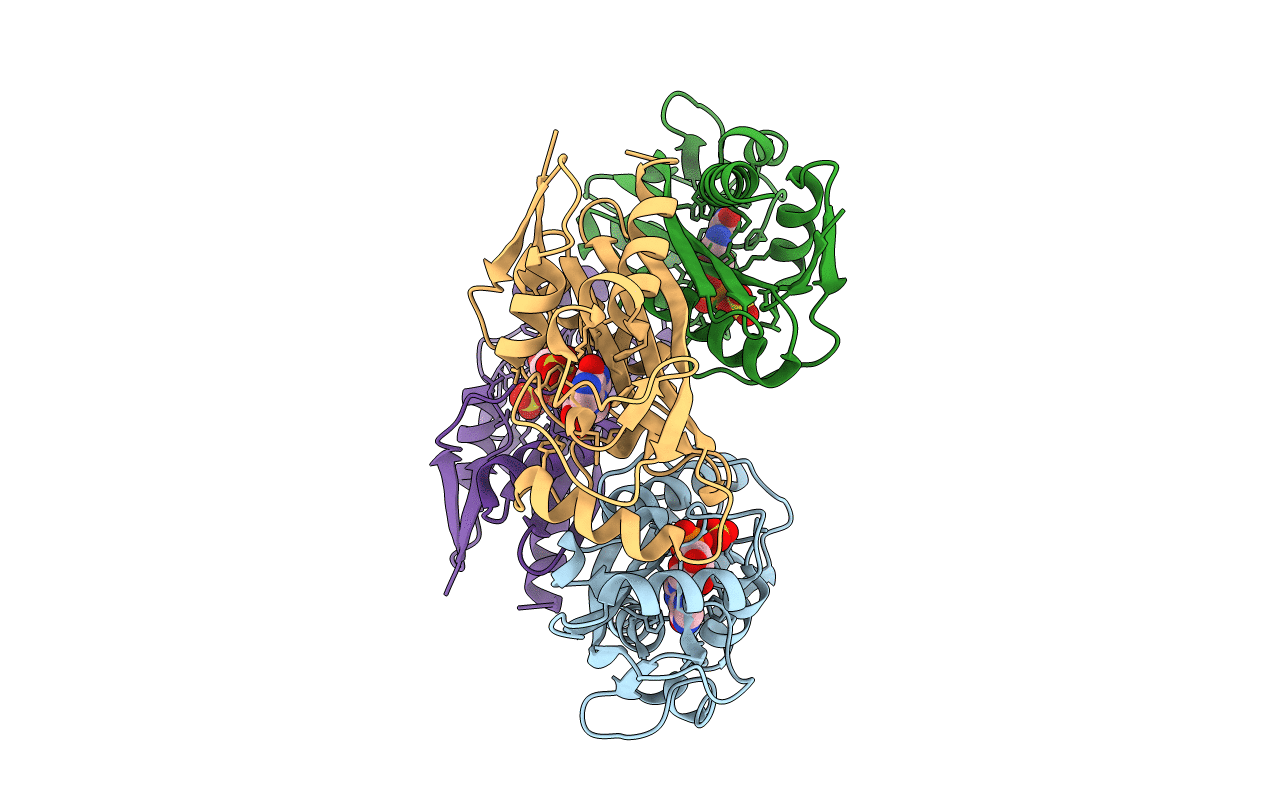
3S86 image
Deposition Date 2011-05-27
Release Date 2012-06-06
Last Version Date 2024-02-28
Entry Detail
PDB ID:
3S86
Keywords:
Title:
Crystal Structure of TM0159 with bound IMP
Biological Source:
Source Organism:
Host Organism:
Method Details:
Experimental Method:
Resolution:
2.15 Å
R-Value Free:
0.27
R-Value Work:
0.22
R-Value Observed:
0.22
Space Group:
P 21 21 21

Macromolecular Entities
Structures with similar UniProt ID
Protein Blast
Polymer Type:polypeptide(L)
Molecule:Nucleoside-triphosphatase
Gene (Uniprot):TM_0159
Chain IDs:A, B, C, D
Chain Length:208
Number of Molecules:4
Biological Source:Thermotoga maritima
Primary Citation
Structural and functional characterization of a noncanonical nucleoside triphosphate pyrophosphatase from Thermotoga maritima.
Acta Crystallogr.,Sect.D 69 184 193 (2013)
PMID: 23385455 DOI: 10.1107/S0907444912044630

Abstact

The hyperthermophilic bacterium Thermotoga maritima has a noncanonical nucleoside triphosphatase that catalyzes the conversion of inosine triphosphate (ITP), deoxyinosine triphosphate (dITP) and xanthosine triphosphate (XTP) into inosine monophosphate (IMP), deoxyinosine monophosphate (IMP) and xanthosine monophosphate (XMP), respectively. The k(cat)/K(m) values determined at 323 and 353 K fall between 1.31 × 10(4) and 7.80 × 10(4) M(-1) s(-1). ITP and dITP are slightly preferred over XTP. Activity towards canonical nucleoside triphosphates (ATP and GTP) was not detected. The enzyme has an absolute requirement for Mg(2+) as a cofactor and has a preference for alkaline conditions. A protein X-ray structure of the enzyme with bound IMP was obtained at 2.15 Å resolution. The active site houses a well conserved network of residues that are critical for substrate recognition and catalysis. The crystal structure shows a tetramer with two possible dimer interfaces. One of these interfaces strongly resembles the dimer interface that is found in the structures of other noncanonical nucleoside pyrophosphatases from human (human ITPase) and archaea (Mj0226 and PhNTPase).

Legend

Protein

Chemical

Disease

Primary Citation of related structures
Feedback Form
Name
Email
Institute
Feedback