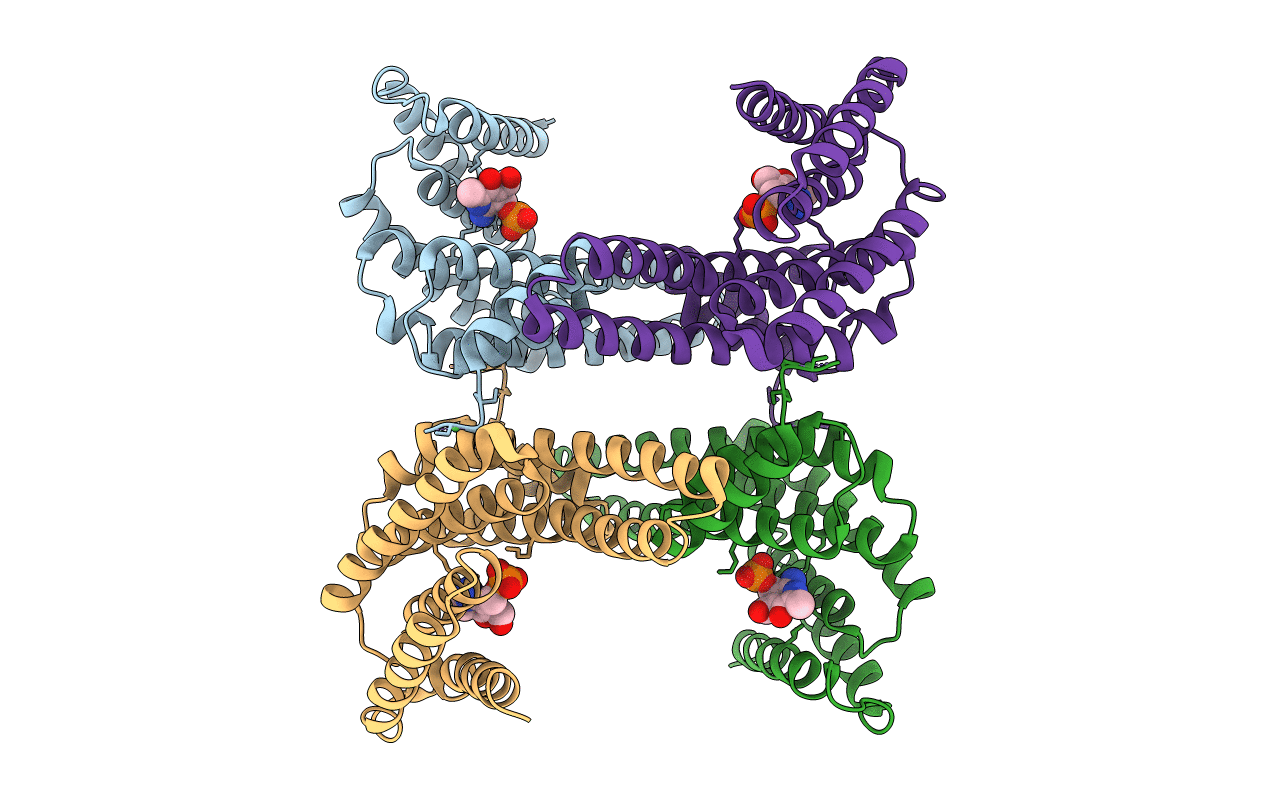
3RDH image
Deposition Date 2011-04-01
Release Date 2011-09-28
Last Version Date 2024-11-20
Entry Detail
PDB ID:
3RDH
Title:
X-ray induced covalent inhibition of 14-3-3
Biological Source:
Source Organism:
Homo sapiens (Taxon ID: 9606)
Host Organism:
Method Details:
Experimental Method:
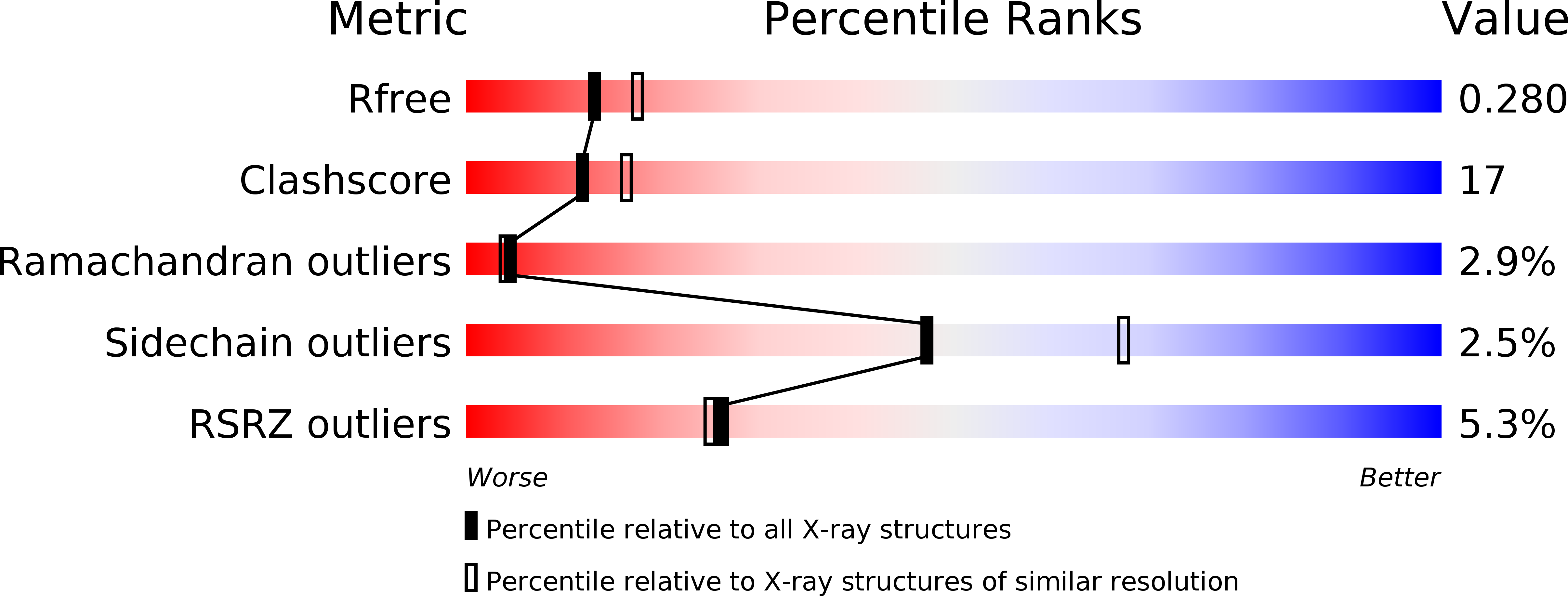
Resolution:
2.39 Å
R-Value Free:
0.28
R-Value Work:
0.23
R-Value Observed:
0.23
Space Group:
P 65
Macromolecular Entities
Structures with similar UniProt ID
Protein Blast
Polymer Type:polypeptide(L)
Molecule:14-3-3 protein zeta/delta
Gene (Uniprot):YWHAZ
Chain IDs:A, B, C, D
Chain Length:248
Number of Molecules:4
Biological Source:Homo sapiens
Primary Citation
Discovery and structural characterization of a small molecule 14-3-3 protein-protein interaction inhibitor.
Proc.Natl.Acad.Sci.USA 108 16212 16216 (2011)
PMID: 21908710 DOI: 10.1073/pnas.1100012108

Abstact

The 14-3-3 family of phosphoserine/threonine-recognition proteins engage multiple nodes in signaling networks that control diverse physiological and pathophysiological functions and have emerged as promising therapeutic targets for such diseases as cancer and neurodegenerative disorders. Thus, small molecule modulators of 14-3-3 are much needed agents for chemical biology investigations and therapeutic development. To analyze 14-3-3 function and modulate its activity, we conducted a chemical screen and identified 4-[(2Z)-2-[4-formyl-6-methyl-5-oxo-3-(phosphonatooxymethyl)pyridin-2-ylidene]hydrazinyl]benzoate as a 14-3-3 inhibitor, which we termed FOBISIN (FOurteen-three-three BInding Small molecule INhibitor) 101. FOBISIN101 effectively blocked the binding of 14-3-3 with Raf-1 and proline-rich AKT substrate, 40 kD(a) and neutralized the ability of 14-3-3 to activate exoenzyme S ADP-ribosyltransferase. To provide a mechanistic basis for 14-3-3 inhibition, the crystal structure of 14-3-3ζ in complex with FOBISIN101 was solved. Unexpectedly, the double bond linking the pyridoxal-phosphate and benzoate moieties was reduced by X-rays to create a covalent linkage of the pyridoxal-phosphate moiety to lysine 120 in the binding groove of 14-3-3, leading to persistent 14-3-3 inactivation. We suggest that FOBISIN101-like molecules could be developed as an entirely unique class of 14-3-3 inhibitors, which may serve as radiation-triggered therapeutic agents for the treatment of 14-3-3-mediated diseases, such as cancer.

Legend

Protein

Chemical

Disease

Primary Citation of related structures
Feedback Form
Name
Email
Institute
Feedback