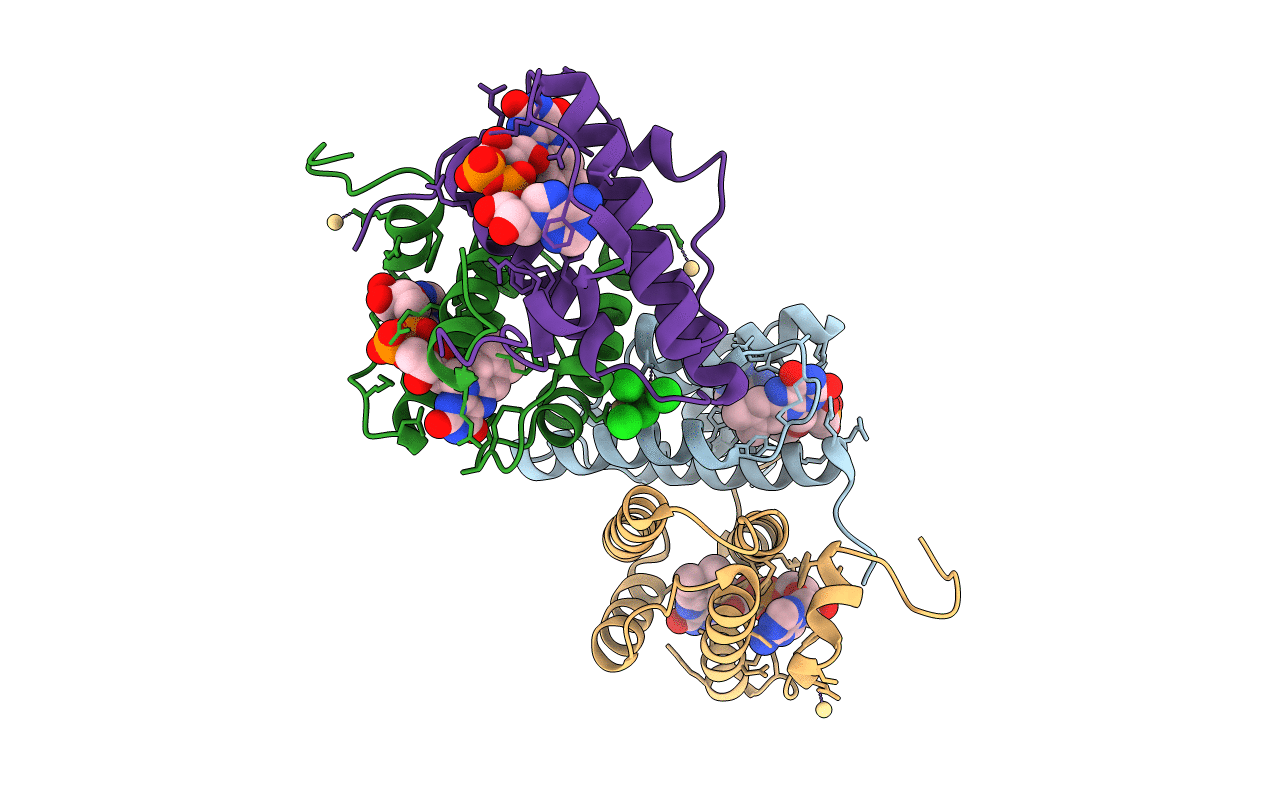
3R7C image
Deposition Date 2011-03-22
Release Date 2012-03-28
Last Version Date 2025-11-12
Entry Detail
PDB ID:
3R7C
Keywords:
Title:
The structure of a hexahestidine-tagged form of augmenter of liver regeneration reveals a novel Cd(2)Cl(4)O(6) cluster that aids in crystal packing
Biological Source:
Source Organism(s):
Expression System(s):
Method Details:
Experimental Method:
Resolution:
2.40 Å
R-Value Free:
0.21
R-Value Work:
0.16
R-Value Observed:
0.16
Space Group:
I 41
Macromolecular Entities
Structures with similar UniProt ID
Protein Blast
Polymer Type:polypeptide(L)
Molecule:FAD-linked sulfhydryl oxidase ALR
Gene (Uniprot):Gfer
Chain IDs:A, B, C, D
Chain Length:139
Number of Molecules:4
Biological Source:Rattus norvegicus
Primary Citation
The structure of augmenter of liver regeneration crystallized in the presence of 50 mM CdCl2 reveals a novel Cd2Cl4O6 cluster that aids in crystal packing.
Acta Crystallogr.,Sect.D 68 1128 1133 (2012)
PMID: 22948913 DOI: 10.1107/S0907444912022561

Abstact

The crystal structure of the protein augmenter of liver regeneration containing a 14-residue hexahistidine purification tag (hsALR) has been determined to 2.4 Å resolution by Cd-SAD using a highly redundant data set collected on a rotating-anode home X-ray source and processed in 1998. The hsALR crystal structure is a tetramer composed of two homodimers bridged by a novel Cd(2)Cl(4)O(6) cluster via binding to the side-chain carboxylate groups of two solvent-exposed aspartic acid residues. A comparison with the native sALR tetramer shows that the cluster dramatically changes the hsALR dimer-dimer interface, which can now better accommodate the extra 14 N-terminal residues associated with the purification tag. The refined 2.4 Å resolution structure is in good agreement with both the X-ray data (R(cryst) of 0.165, R(free) of 0.211) and the expected stereochemistry (r.m.s. deviations from ideality for bond lengths and bond angles of 0.007 Å and 1.15°, respectively).

Legend

Protein

Chemical

Disease

Primary Citation of related structures
Feedback Form
Name
Email
Institute
Feedback