3QRB image
Deposition Date 2011-02-17
Release Date 2011-05-18
Last Version Date 2023-09-13
Entry Detail
PDB ID:
3QRB
Keywords:
Title:
crystal structure of E-cadherin EC1-2 P5A P6A
Biological Source:
Source Organism:
Mus musculus (Taxon ID: 10090)
Host Organism:
Method Details:
Experimental Method:
Resolution:
1.80 Å
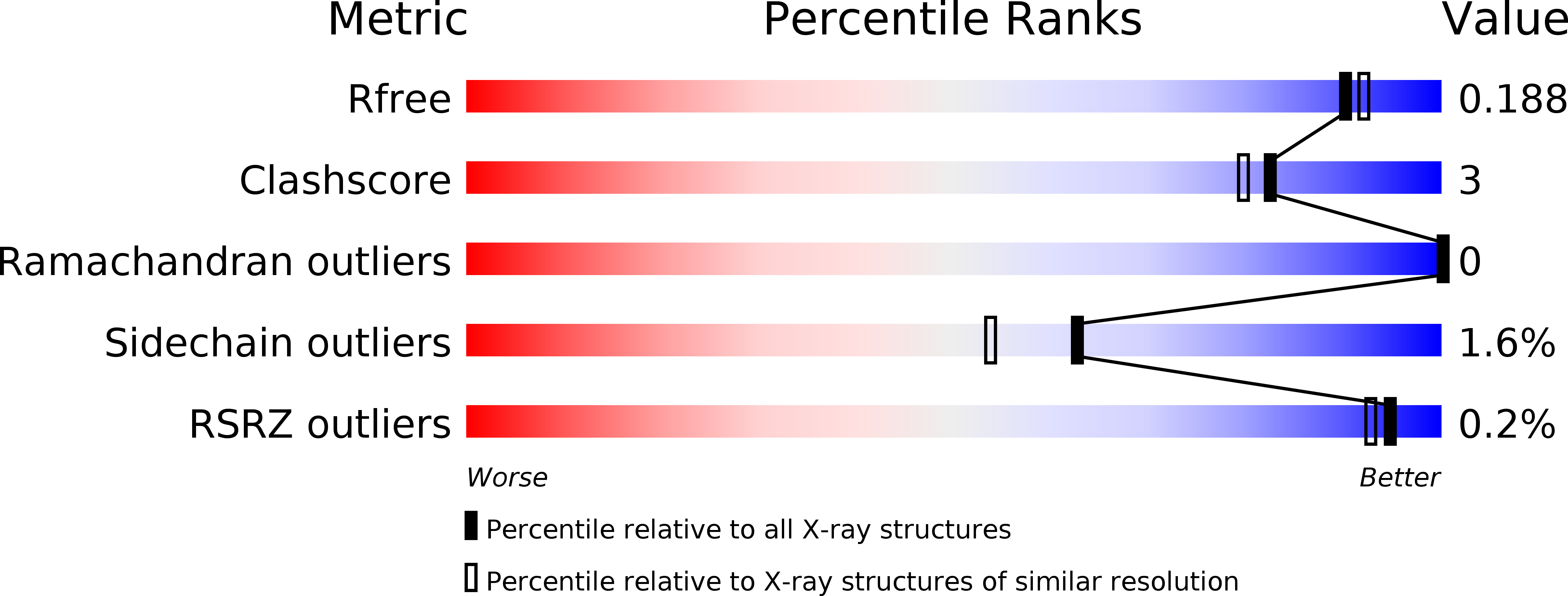
R-Value Free:
0.17
R-Value Work:
0.16
R-Value Observed:
0.16
Space Group:
C 1 2 1
Macromolecular Entities
Structures with similar UniProt ID
Protein Blast
Polymer Type:polypeptide(L)
Molecule:Cadherin-1
Gene (Uniprot):Cdh1
Mutagens:P161A, P162A
Chain IDs:A, B
Chain Length:213
Number of Molecules:2
Biological Source:Mus musculus
Primary Citation
Molecular design principles underlying beta-strand swapping in the adhesive dimerization of cadherins.
Nat.Struct.Mol.Biol. 18 693 700 (2011)
PMID: 21572446 DOI: 10.1038/nsmb.2051

Abstact

Cell adhesion by classical cadherins is mediated by dimerization of their EC1 domains through the 'swapping' of N-terminal β-strands. We use molecular simulations, measurements of binding affinities and X-ray crystallography to provide a detailed picture of the structural and energetic factors that control the adhesive dimerization of cadherins. We show that strand swapping in EC1 is driven by conformational strain in cadherin monomers that arises from the anchoring of their short N-terminal strand at one end by the conserved Trp2 and at the other by ligation to Ca(2+) ions. We also demonstrate that a conserved proline-proline motif functions to avoid the formation of an overly tight interface where affinity differences between different cadherins, crucial at the cellular level, are lost. We use these findings to design site-directed mutations that transform a monomeric EC2-EC3 domain cadherin construct into a strand-swapped dimer.

Legend

Protein

Chemical

Disease

Primary Citation of related structures
Feedback Form
Name
Email
Institute
Feedback