3Q2E image
Deposition Date 2010-12-20
Release Date 2011-02-16
Last Version Date 2023-11-01
Entry Detail
PDB ID:
3Q2E
Title:
Crystal structure of the second bromodomain of human bromodomain and WD repeat-containing protein 1 isoform A (WDR9)
Biological Source:
Source Organism:
Homo sapiens (Taxon ID: 9606)
Host Organism:
Method Details:
Experimental Method:
Resolution:
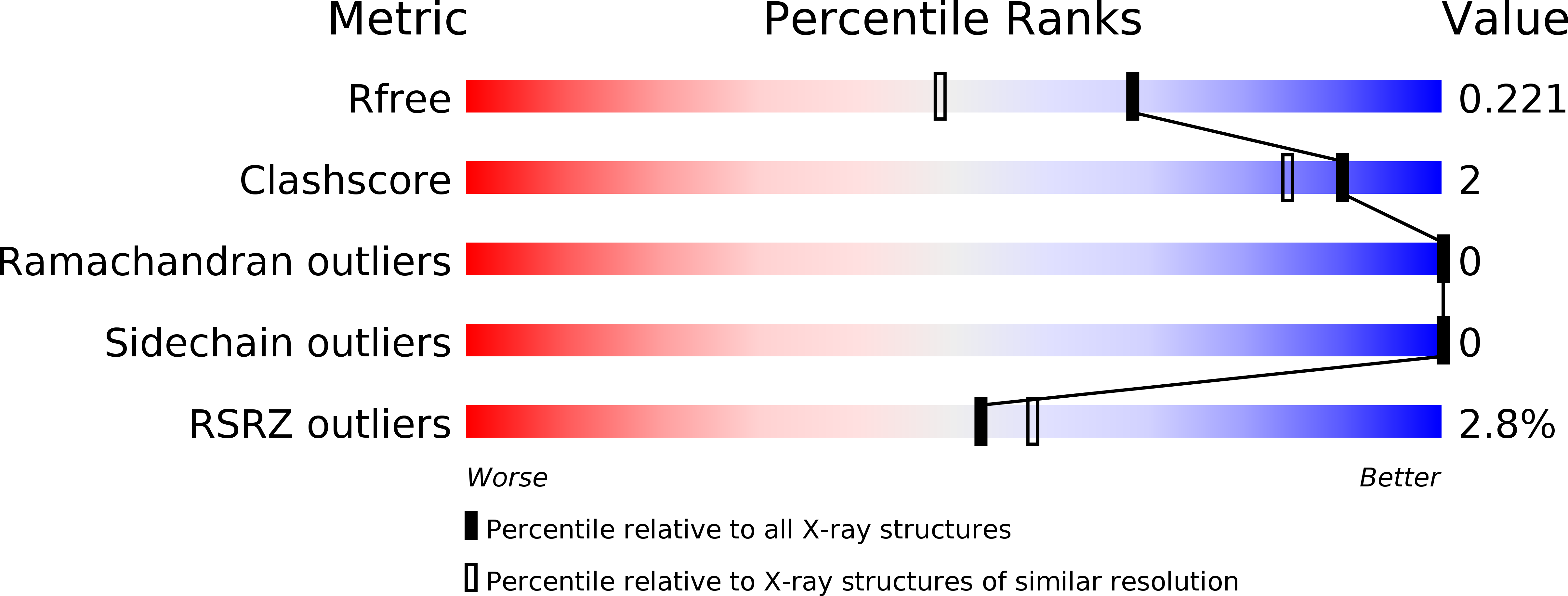
1.74 Å
R-Value Free:
0.21
R-Value Work:
0.18
R-Value Observed:
0.18
Space Group:
P 61 2 2
Macromolecular Entities
Structures with similar UniProt ID
Protein Blast
Polymer Type:polypeptide(L)
Molecule:Bromodomain and WD repeat-containing protein 1
Gene (Uniprot):BRWD1
Chain IDs:A
Chain Length:123
Number of Molecules:1
Biological Source:Homo sapiens
Ligand Molecules
Primary Citation
Histone recognition and large-scale structural analysis of the human bromodomain family.
Cell(Cambridge,Mass.) 149 214 231 (2012)
PMID: 22464331 DOI: 10.1016/j.cell.2012.02.013

Abstact

Bromodomains (BRDs) are protein interaction modules that specifically recognize ε-N-lysine acetylation motifs, a key event in the reading process of epigenetic marks. The 61 BRDs in the human genome cluster into eight families based on structure/sequence similarity. Here, we present 29 high-resolution crystal structures, covering all BRD families. Comprehensive crossfamily structural analysis identifies conserved and family-specific structural features that are necessary for specific acetylation-dependent substrate recognition. Screening of more than 30 representative BRDs against systematic histone-peptide arrays identifies new BRD substrates and reveals a strong influence of flanking posttranslational modifications, such as acetylation and phosphorylation, suggesting that BRDs recognize combinations of marks rather than singly acetylated sequences. We further uncovered a structural mechanism for the simultaneous binding and recognition of diverse diacetyl-containing peptides by BRD4. These data provide a foundation for structure-based drug design of specific inhibitors for this emerging target family.

Legend

Protein

Chemical

Disease

Primary Citation of related structures
Feedback Form
Name
Email
Institute
Feedback