3PWZ image
Deposition Date 2010-12-09
Release Date 2011-09-28
Last Version Date 2024-02-21
Entry Detail
PDB ID:
3PWZ
Keywords:
Title:
Crystal structure of an Ael1 enzyme from Pseudomonas putida
Biological Source:
Source Organism:
Host Organism:
Method Details:
Experimental Method:
Resolution:
1.71 Å
R-Value Free:
0.24
R-Value Work:
0.21
R-Value Observed:
0.21
Space Group:
C 1 2 1
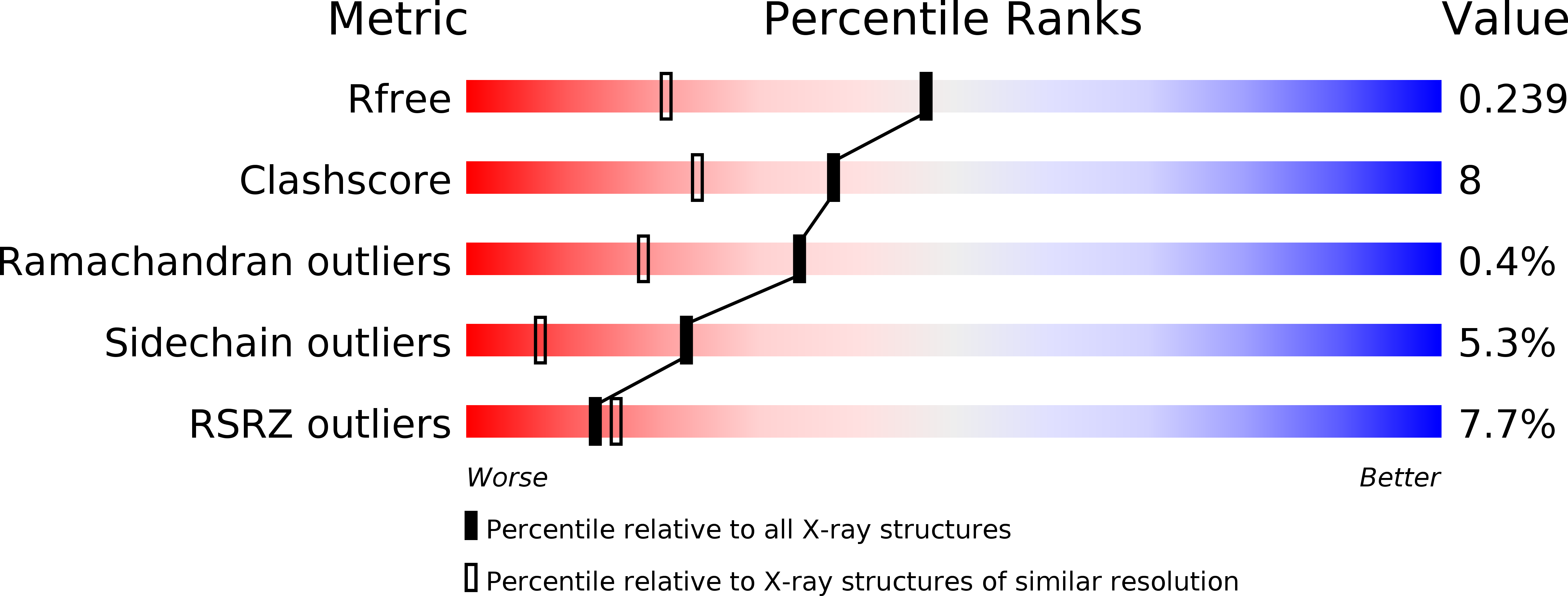
Macromolecular Entities
Structures with similar UniProt ID
Protein Blast
Polymer Type:polypeptide(L)
Molecule:Shikimate dehydrogenase 3
Gene (Uniprot):aroE
Chain IDs:A
Chain Length:272
Number of Molecules:1
Biological Source:Pseudomonas putida
Primary Citation
Structural and mechanistic analysis of a novel class of shikimate dehydrogenases: evidence for a conserved catalytic mechanism in the shikimate dehydrogenase family.
Biochemistry 50 8616 8627 (2011)
PMID: 21846128 DOI: 10.1021/bi200586y

Abstact

Shikimate dehydrogenase (SDH) catalyzes the reversible NADPH-dependent reduction of 3-dehydroshikimate to shikimate. This reaction represents the fourth step of the shikimate pathway, the essential route for the biosynthesis of the aromatic amino acids in plants, fungi, bacteria, and apicomplexan parasites. The absence of this pathway in animals makes it an attractive target for herbicides and antimicrobials. At least four functionally distinct enzyme classes, AroE, YdiB, SDH-like (SdhL), and AroE-like1 (Ael1), utilize shikimate as a substrate in vitro and form the SDH family. Crystal structures have been determined for AroE, YdiB, and SdhL. In this study, we have determined the first representative crystal structure of an Ael1 enzyme. We demonstrate that Ael1 shares a similar overall structure with the other members of the SDH family. This high level of structural conservation extends to the active sites of the enzymes. In particular, an ionizable active site lysine and aspartate are present in all SDH homologues. Two distinct biochemical roles have been reported for this Lys-Asp pair: as binding residues in YdiB and as a catalytic dyad in AroE and SdhL. Here, we establish that the residues function as a catalytic dyad in Ael1 and, interestingly, in at least one YdiB homologue. The conservation of three-dimensional fold, active site architecture, and catalytic mechanism among members of the SDH family will facilitate the design of drugs targeting the shikimate pathway.

Legend

Protein

Chemical

Disease

Primary Citation of related structures
Feedback Form
Name
Email
Institute
Feedback