3PGT image
Deposition Date 1999-03-22
Release Date 1999-09-01
Last Version Date 2023-09-06
Entry Detail
PDB ID:
3PGT
Keywords:
Title:
CRYSTAL STRUCTURE OF HGSTP1-1[I104] COMPLEXED WITH THE GSH CONJUGATE OF (+)-ANTI-BPDE
Biological Source:
Source Organism:
Homo sapiens (Taxon ID: 9606)
Host Organism:
Method Details:
Experimental Method:
Resolution:
2.14 Å
R-Value Free:
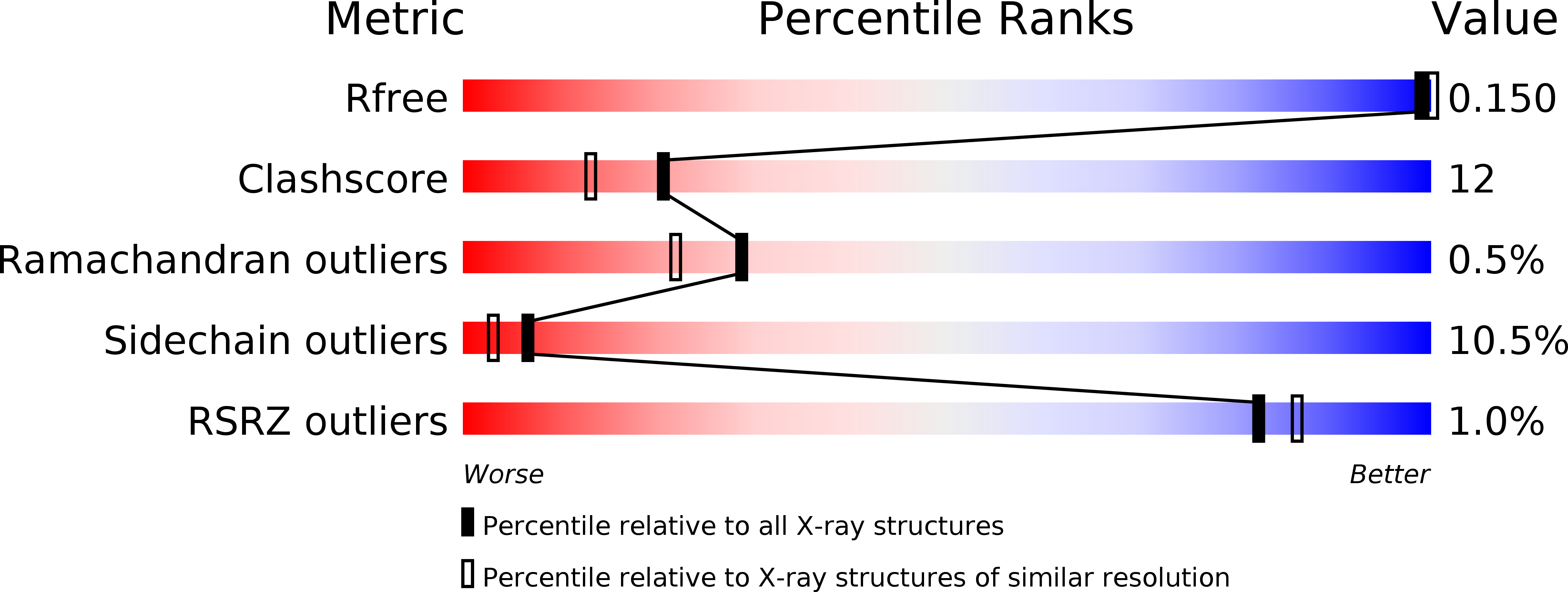
0.15
R-Value Observed:
0.15
Space Group:
C 1 2 1
Macromolecular Entities
Structures with similar UniProt ID
Protein Blast
Polymer Type:polypeptide(L)
Molecule:PROTEIN (GLUTATHIONE S-TRANSFERASE)
Gene (Uniprot):GSTP1
Chain IDs:A, B
Chain Length:210
Number of Molecules:2
Biological Source:Homo sapiens
Primary Citation
Structure and function of residue 104 and water molecules in the xenobiotic substrate-binding site in human glutathione S-transferase P1-1.
Biochemistry 38 10231 10238 (1999)
PMID: 10441116 DOI: 10.1021/bi990668u

Abstact

Two variants of human class pi glutathione (GSH) S-transferase 1-1 with either isoleucine or valine in position 104 (hGSTP1-1[I104] and hGSTP1-1[V104]) have distinct activity toward (+)-anti-7, 8-dihydroxy-9,10-oxy-7,8,9,10-tetrahydrobenzo[a]pyrene [(+)-anti-BPDE]. To elucidate their structure-function relationship, we determined the crystal structures of the two variants in complex with GSBpd, the GSH conjugate of (+)-anti-BPDE, at 2.1 and 2.0 A resolution, respectively. The crystal structures reveal that residue 104 in the xenobiotic substrate-binding site (H-site) dictates the binding modes of the product molecule GSBpd with the following three consequences. First, the distance between the hydroxyl group of Y7 and the sulfur atom of GSBpd is 5.9 A in the hGSTP1-1[I104].GSBpd complex versus 3.2 A in the V104 variant. Second, one of the hydroxyl groups of GSBpd forms a direct hydrogen bond with R13 in hGSTP1-1[V104].GSBpd; in contrast, this hydrogen bond is not observed in the I104 complex. Third, in the hydrophilic portion of the H-site of the I104 complex, five H-site water molecules [Ji, X., et al. (1997) Biochemistry 36, 9690-9702] are observed, whereas in the V104 complex, two of the five have been displaced by the Bpd moiety of GSBpd. Although there is no direct hydrogen bond between Y108 (OH) and the hydroxyl groups of GSBpd, indirect hydrogen bonds mediated by water molecules are observed in both complexes, supporting the previously suggested role of the hydroxyl group of Y108 as an electrophilic participant in the addition of GSH to epoxides.

Legend

Protein

Chemical

Disease

Primary Citation of related structures
Feedback Form
Name
Email
Institute
Feedback