3P9W image
Deposition Date 2010-10-18
Release Date 2012-04-18
Last Version Date 2024-10-16
Entry Detail
PDB ID:
3P9W
Title:
Crystal structure of an engineered human autonomous VH Domain in complex with VEGF
Biological Source:
Source Organism:
Homo sapiens (Taxon ID: 9606)
Host Organism:
Method Details:
Experimental Method:
Resolution:
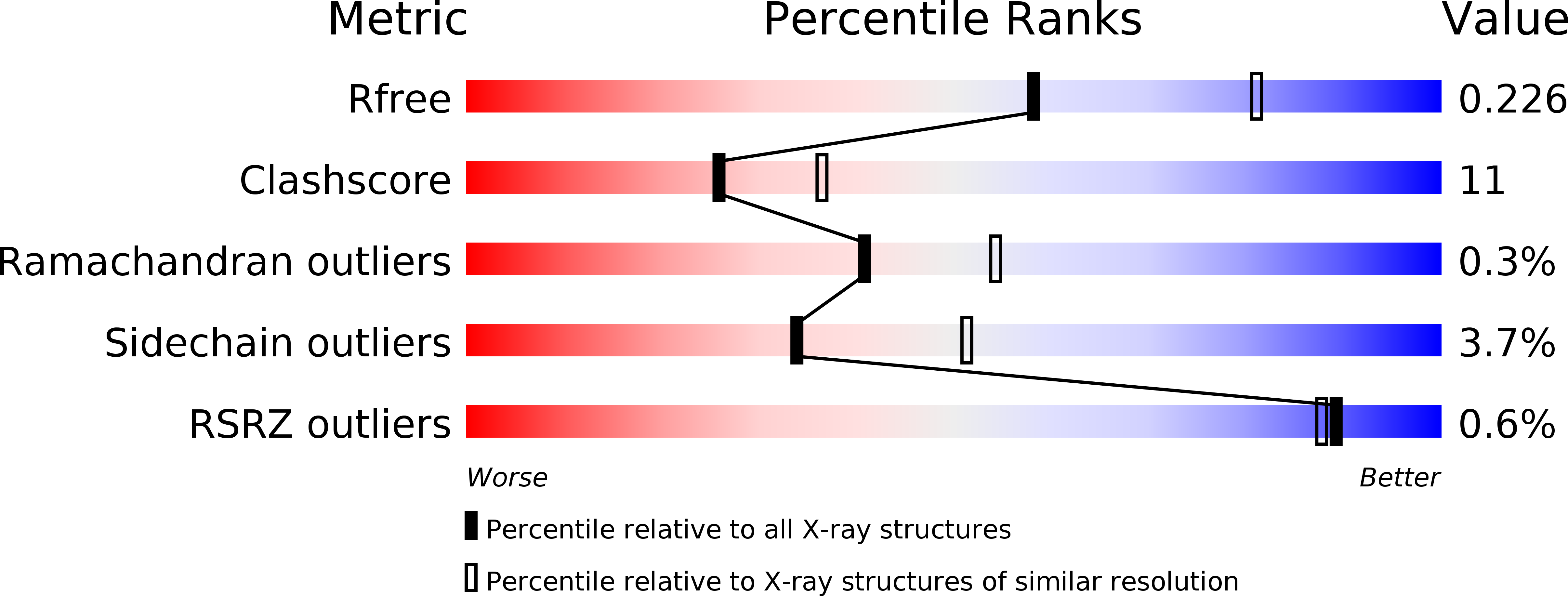
2.41 Å
R-Value Free:
0.23
R-Value Work:
0.19
R-Value Observed:
0.19
Space Group:
P 21 21 21
Macromolecular Entities
Structures with similar UniProt ID
Protein Blast
Polymer Type:polypeptide(L)
Molecule:Vascular endothelial growth factor A
Gene (Uniprot):VEGFA
Chain IDs:A, C, E, G
Chain Length:106
Number of Molecules:4
Biological Source:Homo sapiens
Polymer Type:polypeptide(L)
Molecule:human VEGF
Chain IDs:B, D, F, H
Chain Length:123
Number of Molecules:4
Biological Source:Homo sapiens
Primary Citation
Design of Synthetic Autonomous VH Domain Libraries and Structural Analysis of a VH Domain Bound to Vascular Endothelial Growth Factor.
J.Mol.Biol. 425 2247 2259 (2013)
PMID: 23507309 DOI: 10.1016/j.jmb.2013.03.020

Abstact

We compared the capacity of an autonomous heavy chain variable (VH) domain (VH-B1a) to support diversity within its antigen-binding site relative to the conventional antigen-binding fragment (Fab) from which it was derived. We find that VH-B1a can tolerate significant diversity within all three complementarity-determining regions (CDRs) and also within framework 3, and thus, VH-B1a and the Fab are similar in terms of the regions of the antigen-binding site that can tolerate diversity without compromising stability. We constructed libraries of synthetic VH domains and isolated binders with moderate affinity for vascular endothelial growth factor (VEGF) from a library in which only CDR3 was randomized. One binder was subjected to affinity maturation to derive an autonomous VH domain (VH-V1a) that recognized both human and mouse VEGF with high affinity (KD=16nM or 10nM, respectively). Structural analysis revealed that VH-V1a binds to an epitope that is distinct from the epitopes of a natural VEGF receptor and six different anti-VEGF Fabs. Moreover, VH-V1a recognizes VEGF by using an unusual paratope consisting predominantly of CDR3 but with significant contributions from framework residues within the former light chain interface. These results suggest that VH-B1a and other autonomous VH domains may be useful scaffolds to support both conventional libraries with antigen-binding sites built from the three CDR loops and, also, nonconventional libraries with antigen-binding sites built from CDR3 and the former light chain interface.

Legend

Protein

Chemical

Disease

Primary Citation of related structures
Feedback Form
Name
Email
Institute
Feedback