3P8E image
Deposition Date 2010-10-13
Release Date 2010-11-10
Last Version Date 2024-11-20
Entry Detail
PDB ID:
3P8E
Title:
Crystal structure of human DIMETHYLARGININE DIMETHYLAMINOHYDROLASE-1 (DDAH-1) covalently bound with N5-(1-iminopentyl)-L-ornithine
Biological Source:
Source Organism:
Homo sapiens (Taxon ID: 9606)
Host Organism:
Method Details:
Experimental Method:
Resolution:
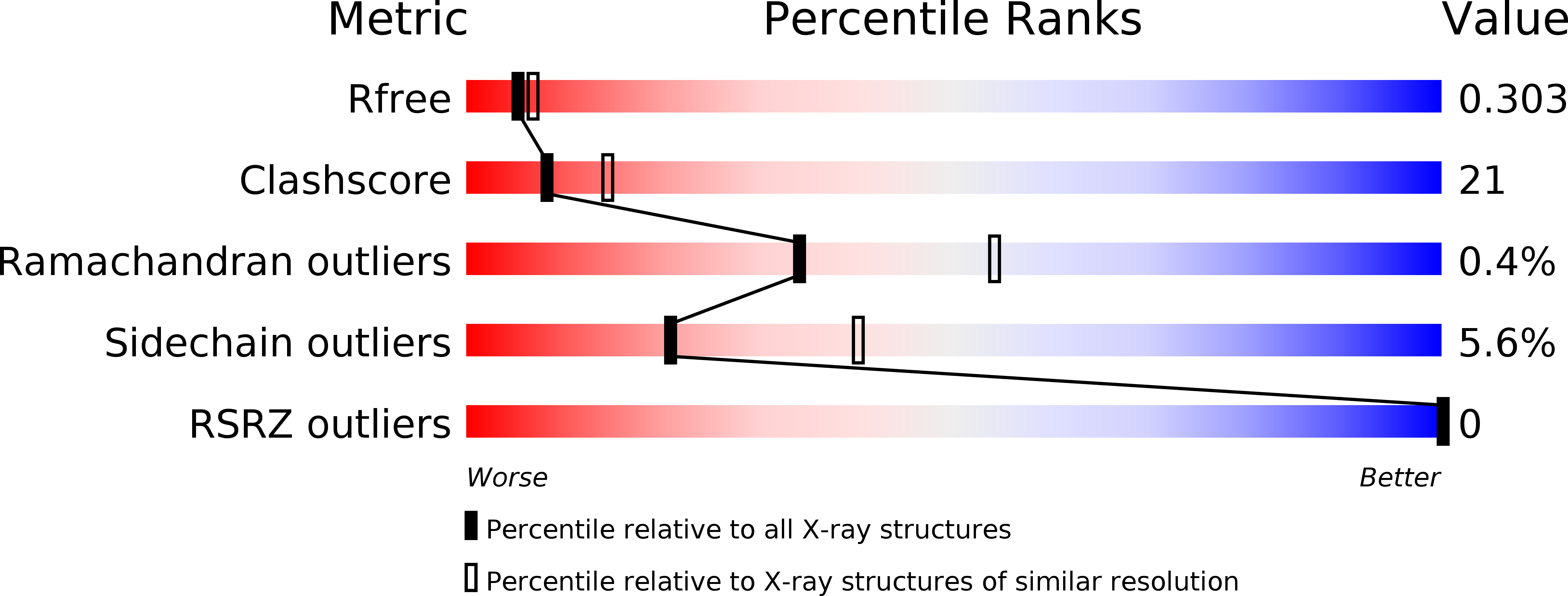
2.49 Å
R-Value Free:
0.30
R-Value Work:
0.21
R-Value Observed:
0.21
Space Group:
P 1 21 1
Macromolecular Entities
Structures with similar UniProt ID
Protein Blast
Polymer Type:polypeptide(L)
Molecule:N(G),N(G)-dimethylarginine dimethylaminohydrolase 1
Gene (Uniprot):DDAH1
Chain IDs:A, B
Chain Length:308
Number of Molecules:2
Biological Source:Homo sapiens
Ligand Molecules
Primary Citation
Characterization of C-Alkyl Amidines as Bioavailable Covalent Reversible Inhibitors of Human DDAH-1.
Chemmedchem 6 81 88 (2011)
PMID: 20979083 DOI: 10.1002/cmdc.201000392

Abstact

C-Alkyl amidine analogues of asymmetric N(ω),N(ω)-dimethyl-L-arginine are dual-targeted inhibitors of both human DDAH-1 and nitric oxide (NO) synthase, and provide a promising scaffold for the development of therapeutics to control NO overproduction in a variety of pathologies including septic shock and some cancers. Using a two-part click-chemistry-mediated activity probe, a homologated series of C-alkyl amidines were ranked for their ability to inhibit DDAH-1 within cultured HEK 293T cells. N⁵-(1-Iminopentyl)-L-ornithine was determined to be the most potent compound in vitro (K(d)=7 μM) as well as in cultured cells, and the binding conformation and covalent reversible mode of inhibition was investigated by comparison of interactions made with DDAH-1 and a catalytically inactive C274S variant, as gauged by X-ray crystallography and isothermal titration calorimetry. By interrupting the ability of the inhibitor to form a covalent bond, the contribution of this interaction could be estimated. These results suggest that further stabilization of the covalent adduct is a promising strategy for lead optimization in the design of effective reagents to block NO synthesis.

Legend

Protein

Chemical

Disease

Primary Citation of related structures
Feedback Form
Name
Email
Institute
Feedback