3P0G image
Deposition Date 2010-09-28
Release Date 2011-01-19
Last Version Date 2024-10-30
Entry Detail
PDB ID:
3P0G
Title:
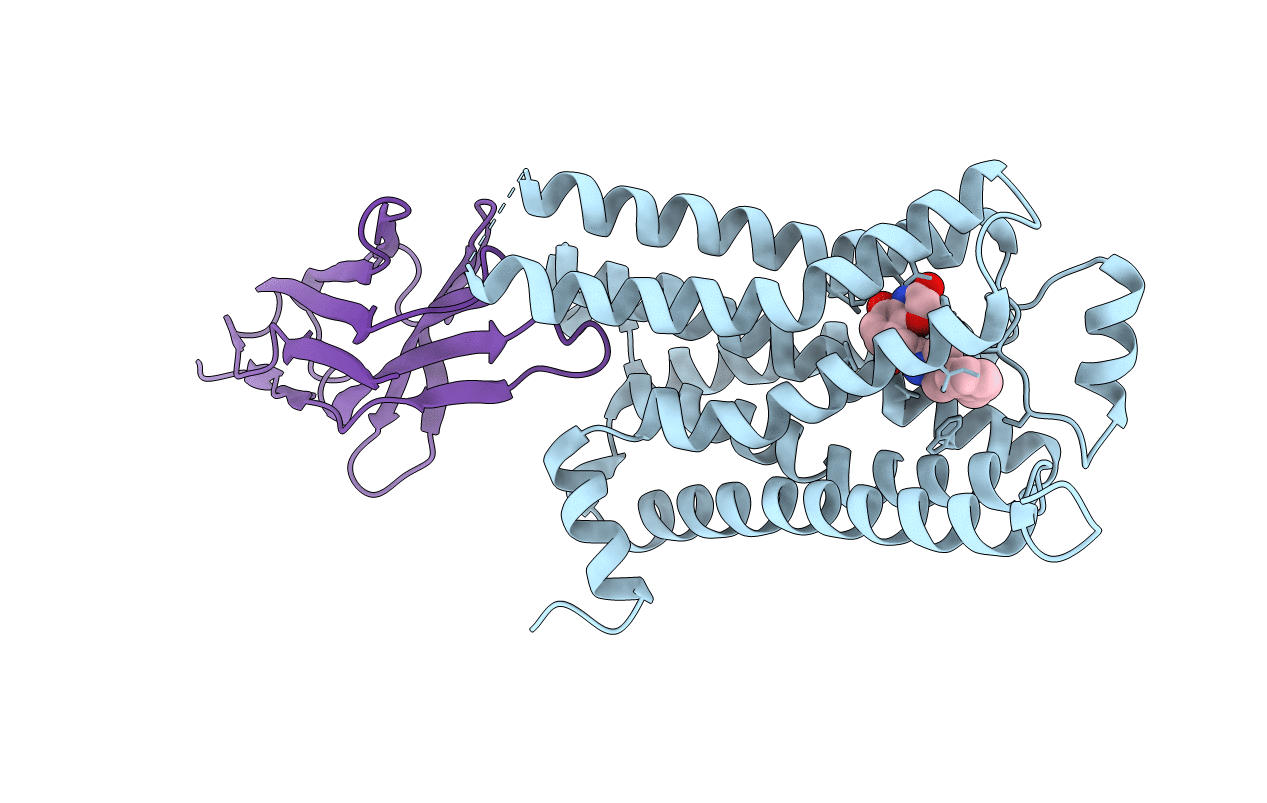
Structure of a nanobody-stabilized active state of the beta2 adrenoceptor
Biological Source:
Source Organism:
Homo sapiens (Taxon ID: 9606)
Enterobacteria phage T4 (Taxon ID: 10665)
LAMA GLAMA (Taxon ID: 9844)
Host Organism:
Method Details:
Experimental Method:
Resolution:
3.50 Å
R-Value Free:
0.30
R-Value Work:
0.23
R-Value Observed:
0.24
Space Group:
C 1 2 1
Macromolecular Entities
Protein Blast
Polymer Type:polypeptide(L)
Molecule:Beta-2 adrenergic receptor, Lysozyme
Gene (Uniprot):E, ADRB2
Mutagens:N187E
Chain IDs:A
Chain Length:501
Number of Molecules:1
Biological Source:Homo sapiens, Enterobacteria phage T4
Polymer Type:polypeptide(L)
Molecule:Camelid Antibody Fragment
Chain IDs:B
Chain Length:126
Number of Molecules:1
Biological Source:LAMA GLAMA
Ligand Molecules
Primary Citation
Structure of a nanobody-stabilized active state of the b2 adrenoceptor
Nature 469 175 180 (2011)
PMID: 21228869 DOI: 10.1038/nature09648

Abstact

G protein coupled receptors (GPCRs) exhibit a spectrum of functional behaviours in response to natural and synthetic ligands. Recent crystal structures provide insights into inactive states of several GPCRs. Efforts to obtain an agonist-bound active-state GPCR structure have proven difficult due to the inherent instability of this state in the absence of a G protein. We generated a camelid antibody fragment (nanobody) to the human β(2) adrenergic receptor (β(2)AR) that exhibits G protein-like behaviour, and obtained an agonist-bound, active-state crystal structure of the receptor-nanobody complex. Comparison with the inactive β(2)AR structure reveals subtle changes in the binding pocket; however, these small changes are associated with an 11 Å outward movement of the cytoplasmic end of transmembrane segment 6, and rearrangements of transmembrane segments 5 and 7 that are remarkably similar to those observed in opsin, an active form of rhodopsin. This structure provides insights into the process of agonist binding and activation.

Legend

Protein

Chemical

Disease

Primary Citation of related structures
Feedback Form
Name
Email
Institute
Feedback