3OF9 image
Deposition Date 2010-08-14
Release Date 2010-12-08
Last Version Date 2024-11-06
Entry Detail
PDB ID:
3OF9
Title:
Structural Basis for Irreversible Inhibition of Human Cathepsin L by a Diazomethylketone Inhibitor
Biological Source:
Source Organism:
Homo sapiens (Taxon ID: 9606)
Host Organism:
Method Details:
Experimental Method:
Resolution:
1.76 Å
R-Value Free:
0.24
R-Value Work:
0.22
R-Value Observed:
0.22
Space Group:
P 65
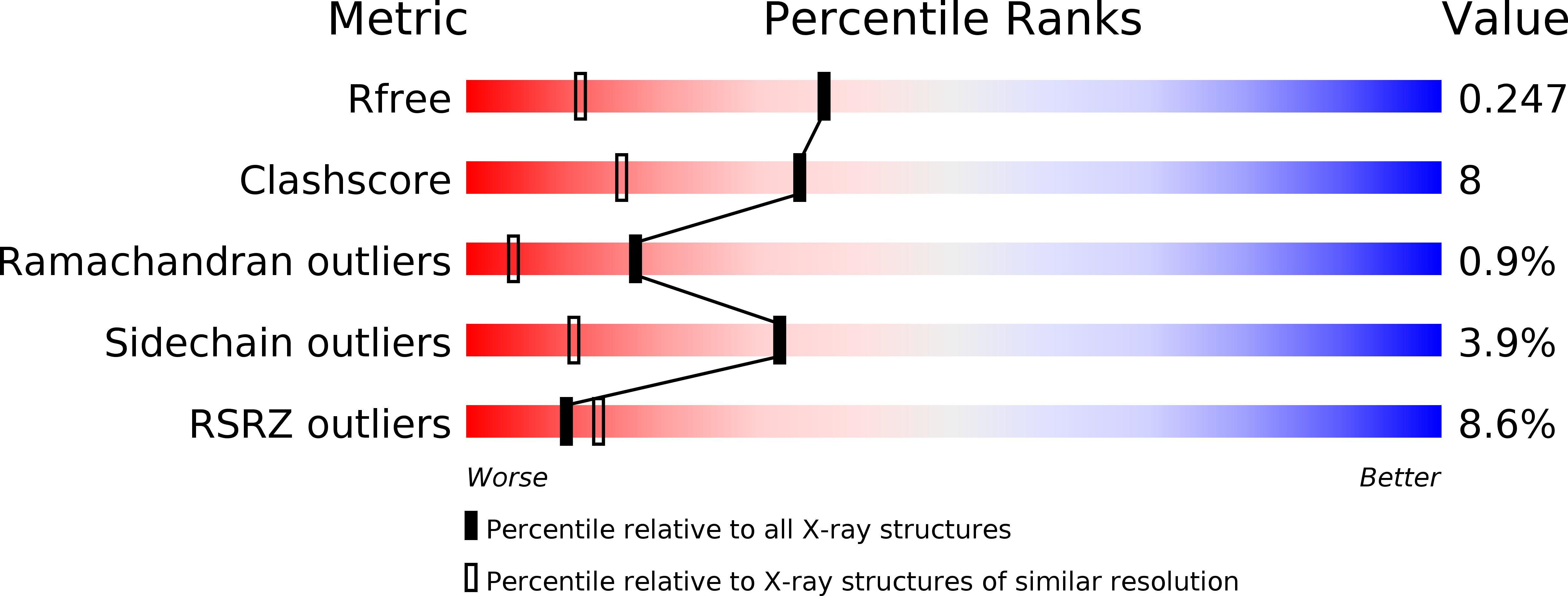
Macromolecular Entities
Structures with similar UniProt ID
Protein Blast
Polymer Type:polypeptide(L)
Molecule:Cathepsin L1
Gene (Uniprot):CTSL
Chain IDs:A
Chain Length:221
Number of Molecules:1
Biological Source:Homo sapiens
Ligand Molecules
Peptide-like Molecules
PRD_000784
Primary Citation
Structural basis for reversible and irreversible inhibition of human cathepsin L by their respective dipeptidyl glyoxal and diazomethylketone inhibitors.
J.Struct.Biol. 173 14 19 (2011)
PMID: 20850545 DOI: 10.1016/j.jsb.2010.09.007

Abstact

Cathepsin L plays a key role in many pathophysiological conditions including rheumatoid arthritis, tumor invasion and metastasis, bone resorption and remodeling. Here we report the crystal structures of two analogous dipeptidyl inhibitor complexes which inhibit human cathepsin L in reversible and irreversible modes, respectively. To-date, there are no crystal structure reports of complexes of proteases with their glyoxal inhibitors or complexes of cathepsin L and their diazomethylketone inhibitors. These two inhibitors - inhibitor 1, an α-keto-β-aldehyde and inhibitor 2, a diazomethylketone, have different groups in the S1 subsite. Inhibitor 1 [Z-Phe-Tyr (OBut)-COCHO], with a K(i) of 0.6nM, is the most potent, reversible, synthetic peptidyl inhibitor of cathepsin L reported to-date. The structure of the inhibitor 1 complex was refined up to 2.2Å resolution. The structure of the complex of the inhibitor 2 [Z-Phe-Tyr (t-Bu)-diazomethylketone], an irreversible inhibitor that can inactivate cathepsin L at μM concentrations, was refined up to 1.76Å resolution. These two inhibitors have substrate-like interactions with the active site cysteine (Cys25). Inhibitor 1 forms a tetrahedral hemithioacetal adduct, whereas the inhibitor 2 forms a thioester with Cys25. The inhibitor 1 β-aldehyde group is shown to make a hydrogen bond with catalytic His163, whereas the ketone carbonyl oxygen of the inhibitor 2 interacts with the oxyanion hole. tert-Butyl groups of both inhibitors are found to make several non-polar contacts with S' subsite residues of cathepsin L. These studies, combined with other complex structures of cathepsin L, reveal the structural basis for their potency and selectivity.

Legend

Protein

Chemical

Disease

Primary Citation of related structures
Feedback Form
Name
Email
Institute
Feedback