3O6L image
Deposition Date 2010-07-29
Release Date 2010-11-10
Last Version Date 2024-11-20
Entry Detail
PDB ID:
3O6L
Keywords:
Title:
Anti-Tat HIV 11H6H1 Fab' complexed with a 15-mer Tat peptide
Biological Source:
Source Organism:
Mus musculus (Taxon ID: 10090)
Method Details:
Experimental Method:
Resolution:
2.10 Å
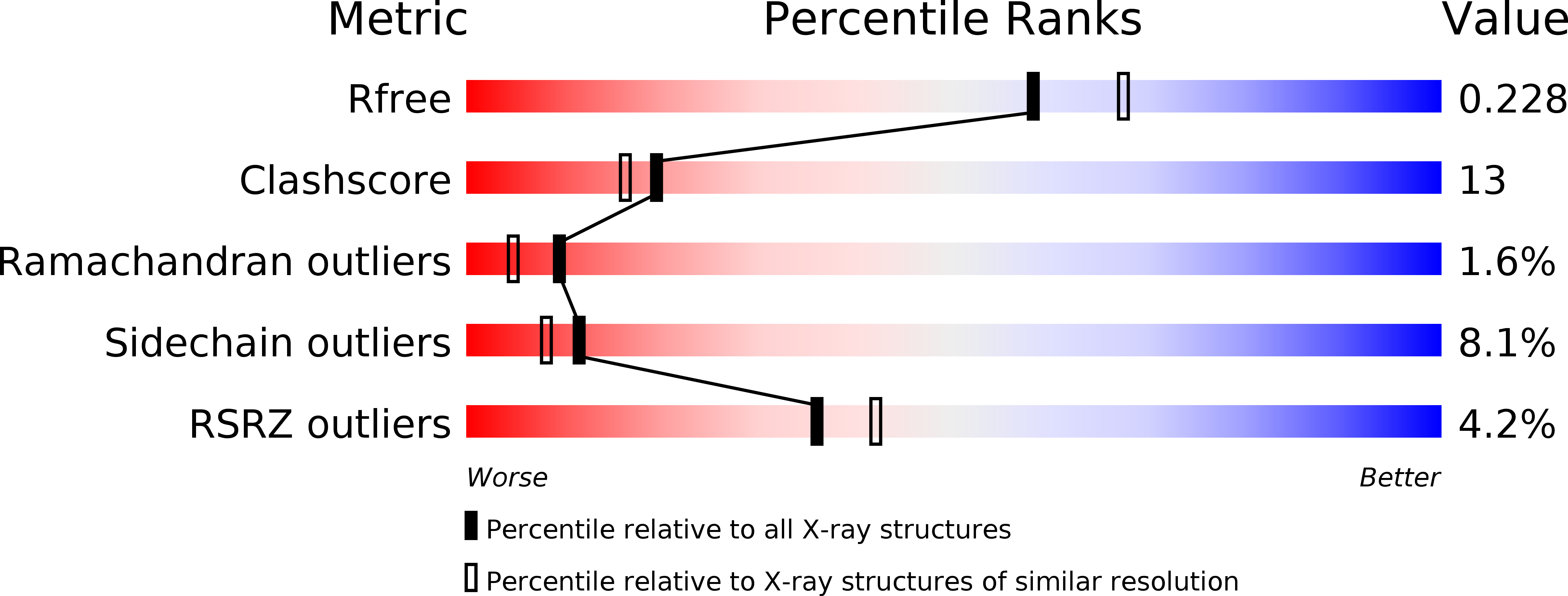
R-Value Free:
0.22
R-Value Work:
0.18
R-Value Observed:
0.18
Space Group:
C 1 2 1
Macromolecular Entities
Structures with similar UniProt ID
Protein Blast
Polymer Type:polypeptide(L)
Molecule:Protein Tat 15-mer peptide
Gene (Uniprot):tat
Chain IDs:C
Chain Length:15
Number of Molecules:1
Biological Source:
Polymer Type:polypeptide(L)
Molecule:11H6H1 Fab' heavy chain
Chain IDs:B (auth: H)
Chain Length:219
Number of Molecules:1
Biological Source:Mus musculus
Polymer Type:polypeptide(L)
Molecule:11H6H1 Fab' light chain
Chain IDs:A (auth: L)
Chain Length:219
Number of Molecules:1
Biological Source:Mus musculus
Primary Citation
Fab'-induced folding of antigenic N-terminal peptides from intrinsically disordered HIV-1 Tat revealed by X-ray crystallography.
J.Mol.Biol. 405 33 42 (2011)
PMID: 21035463 DOI: 10.1016/j.jmb.2010.10.033

Abstact

Tat, the transcriptional activator protein of human immunodeficiency virus type 1 (HIV-1), is critical for viral replication and is a potential HIV-1 vaccine candidate. This intrinsically disordered protein is present in the extracellular medium and is involved in the pathogenicity of HIV through its interaction with different cellular and viral biological partners. A monoclonal antibody termed 11H6H1, which is specific for the N-terminal region of Tat, was selected for a functional and structural study of the HIV-1 Tat protein. The equilibrium dissociation constants (K(d)) of Tat and Tat fragments complexed with 11H6H1 were estimated by competitive ELISA. Tat contains a single tryptophan residue, Trp11, located in the N-terminal region. We show that the substitution of Trp11 by a phenylalanine completely abolishes the binding of 11H6H1, whereas the transactivating activity of Tat is preserved. The epitope recognized by 11H6H1 was restricted to the 9-mer peptide P(6)KLEPWKHP(14) centered on Trp11. The crystal structures of this 9-mer peptide and of an overlapping 15-mer peptide were determined in complex with Fab' 11H6H1 at 2.4 Å and 2.1 Å resolution, respectively. Tat is intrinsically disordered and can undergo induced folding upon association with a biological partner. Our crystallographic study reveals that the two Tat peptides, which are lodged in the U-shaped groove of the Fab' antigen-binding site, adopt a standard type I β-turn conformation. The central Trp11 that is critical for Fab' recognition is further stabilized by π-stacking interactions. The structural and biological consequences of this induced folding in HIV pathogenesis are discussed.

Legend

Protein

Chemical

Disease

Primary Citation of related structures
Feedback Form
Name
Email
Institute
Feedback