3O4Q image
Deposition Date 2010-07-27
Release Date 2011-08-31
Last Version Date 2021-10-06
Entry Detail
PDB ID:
3O4Q
Title:
Crystal structure of the Rous Associated Virus Integrase catalytic domain A182T in citrate buffer pH 6.2
Biological Source:
Source Organism:
Host Organism:
Method Details:
Experimental Method:
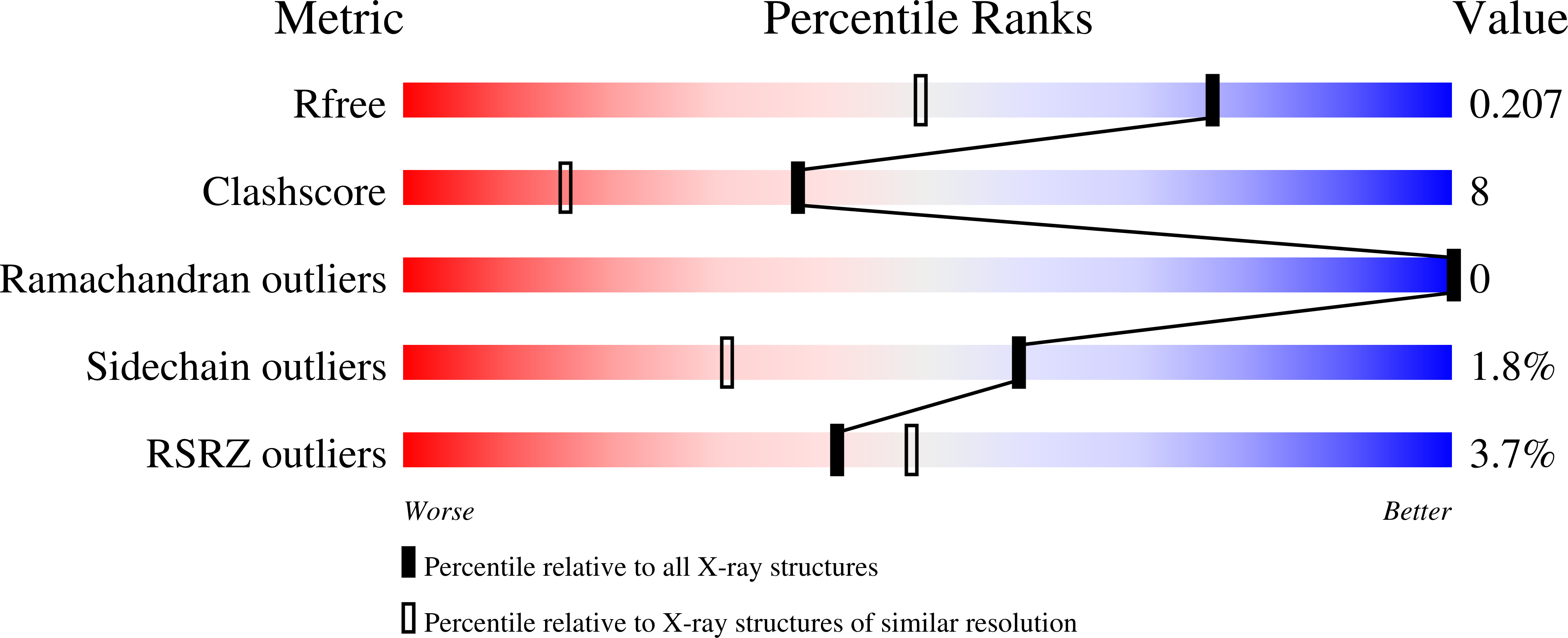
Resolution:
1.55 Å
R-Value Free:
0.21
R-Value Work:
0.16
R-Value Observed:
0.16
Space Group:
P 43 21 2
Macromolecular Entities
Structures with similar UniProt ID
Protein Blast
Polymer Type:polypeptide(L)
Molecule:integrase
Mutagens:A182T
Chain IDs:A
Chain Length:150
Number of Molecules:1
Biological Source:Rous sarcoma virus
Modified Residue
Compound ID Chain ID Parent Comp ID Details 2D Image
OCY A CYS HYDROXYETHYLCYSTEINE
Ligand Molecules
Primary Citation
A crystal structure of the catalytic core domain of an avian sarcoma and leukemia virus integrase suggests an alternate dimeric assembly.
Plos One 6 e23032 e23032 (2011)
PMID: 21857987 DOI: 10.1371/journal.pone.0023032

Abstact

Integrase (IN) is an important therapeutic target in the search for anti-Human Immunodeficiency Virus (HIV) inhibitors. This enzyme is composed of three domains and is hard to crystallize in its full form. First structural results on IN were obtained on the catalytic core domain (CCD) of the avian Rous and Sarcoma Virus strain Schmidt-Ruppin A (RSV-A) and on the CCD of HIV-1 IN. A ribonuclease-H like motif was revealed as well as a dimeric interface stabilized by two pairs of α-helices (α1/α5, α5/α1). These structural features have been validated in other structures of IN CCDs. We have determined the crystal structure of the Rous-associated virus type-1 (RAV-1) IN CCD to 1.8 Å resolution. RAV-1 IN shows a standard activity for integration and its CCD differs in sequence from that of RSV-A by a single accessible residue in position 182 (substitution A182T). Surprisingly, the CCD of RAV-1 IN associates itself with an unexpected dimeric interface characterized by three pairs of α-helices (α3/α5, α1/α1, α5/α3). A182 is not involved in this novel interface, which results from a rigid body rearrangement of the protein at its α1, α3, α5 surface. A new basic groove that is suitable for single-stranded nucleic acid binding is observed at the surface of the dimer. We have subsequently determined the structure of the mutant A182T of RAV-1 IN CCD and obtained a RSV-A IN CCD-like structure with two pairs of buried α-helices at the interface. Our results suggest that the CCD of avian INs can dimerize in more than one state. Such flexibility can further explain the multifunctionality of retroviral INs, which beside integration of dsDNA are implicated in different steps of the retroviral cycle in presence of viral ssRNA.

Legend

Protein

Chemical

Disease

Primary Citation of related structures
Feedback Form
Name
Email
Institute
Feedback