3O2P image
Deposition Date 2010-07-22
Release Date 2010-09-15
Last Version Date 2023-09-06
Entry Detail
PDB ID:
3O2P
Title:
A Dual E3 Mechanism for Rub1 Ligation to Cdc53: Dcn1(P)-Cdc53(WHB)
Biological Source:
Source Organism:
Host Organism:
Method Details:
Experimental Method:
Resolution:
2.23 Å
R-Value Free:
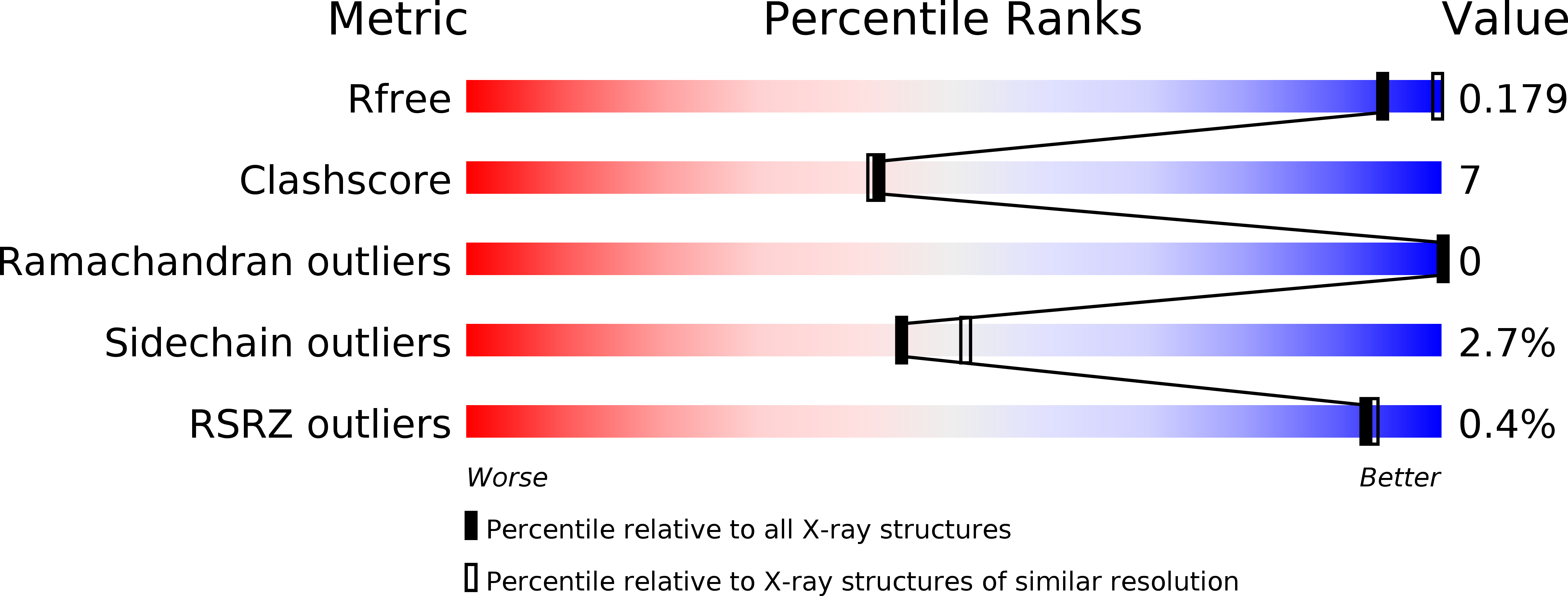
0.22
R-Value Work:
0.16
R-Value Observed:
0.17
Space Group:
P 61
Macromolecular Entities
Structures with similar UniProt ID
Protein Blast
Polymer Type:polypeptide(L)
Molecule:Defective in cullin neddylation protein 1
Gene (Uniprot):DCN1
Chain IDs:A
Chain Length:202
Number of Molecules:1
Biological Source:Saccharomyces cerevisiae
Structures with similar UniProt ID
Protein Blast
Polymer Type:polypeptide(L)
Molecule:Cell division control protein 53
Gene (Uniprot):CDC53
Chain IDs:B (auth: E)
Chain Length:88
Number of Molecules:1
Biological Source:Saccharomyces cerevisiae
Ligand Molecules
Primary Citation
A dual E3 mechanism for Rub1 ligation to Cdc53.
Mol.Cell 39 784 796 (2010)
PMID: 20832729 DOI: 10.1016/j.molcel.2010.08.030

Abstact

In ubiquitin-like protein (UBL) cascades, a thioester-linked E2∼UBL complex typically interacts with an E3 enzyme for UBL transfer to the target. Here we demonstrate a variant mechanism, whereby the E2 Ubc12 functions with two E3s, Hrt1 and Dcn1, for ligation of the UBL Rub1 to Cdc53's WHB subdomain. Hrt1 functions like a conventional RING E3, with its N terminus recruiting Cdc53 and C-terminal RING activating Ubc12∼Rub1. Dcn1's "potentiating neddylation" domain (Dcn1(P)) acts as an additional E3, reducing nonspecific Hrt1-mediated Ubc12∼Rub1 discharge and directing Ubc12's active site to Cdc53. Crystal structures of Dcn1(P)-Cdc53(WHB) and Ubc12 allow modeling of a catalytic complex, supported by mutational data. We propose that Dcn1's interactions with both Cdc53 and Ubc12 would restrict the otherwise flexible Hrt1 RING-bound Ubc12∼Rub1 to a catalytically competent orientation. Our data reveal mechanisms by which two E3s function synergistically to promote UBL transfer from one E2 to a target.

Legend

Protein

Chemical

Disease

Primary Citation of related structures
Feedback Form
Name
Email
Institute
Feedback