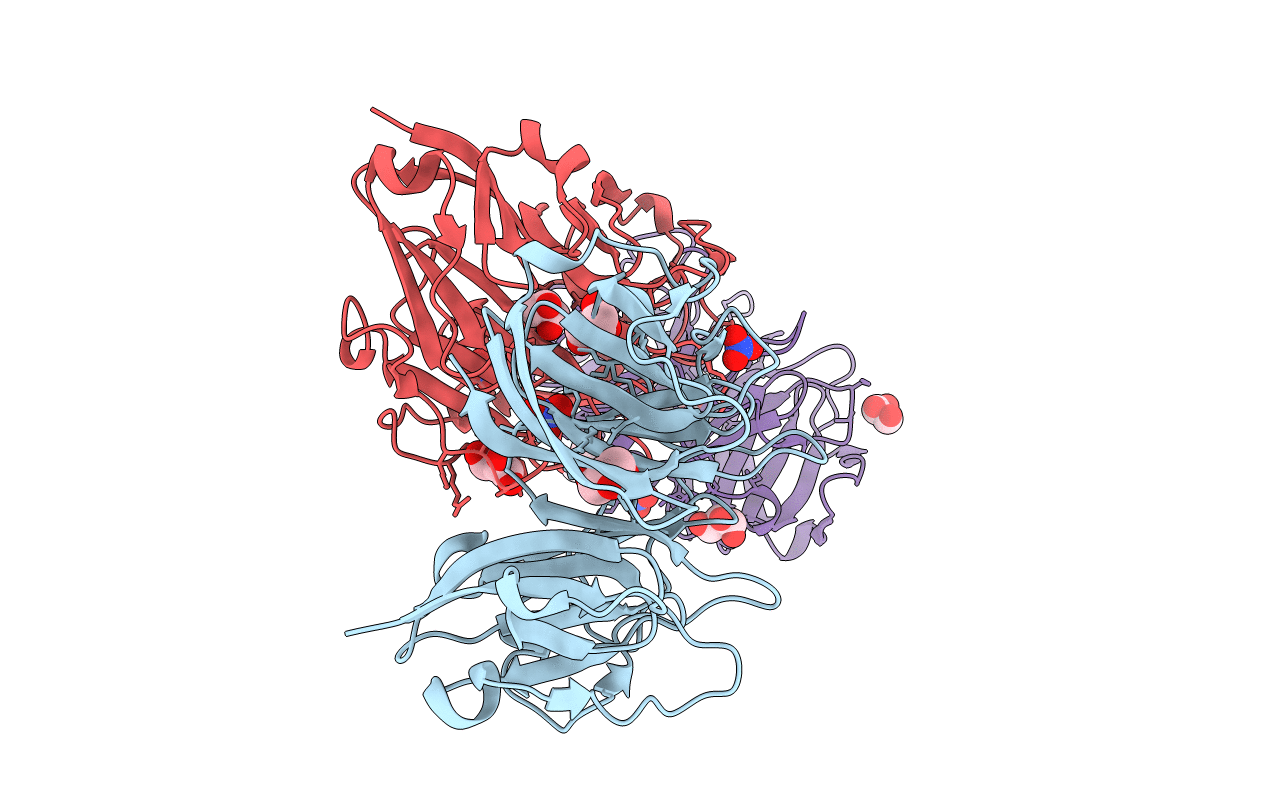
3NO0 image
Deposition Date 2010-06-24
Release Date 2010-12-01
Last Version Date 2023-12-27
Entry Detail
PDB ID:
3NO0
Keywords:
Title:
Aquifex aeolicus type IIA topoisomerase C-terminal domain
Biological Source:
Source Organism:
Host Organism:
Method Details:
Experimental Method:
Resolution:
1.30 Å
R-Value Free:
0.18
R-Value Work:
0.17
R-Value Observed:
0.17
Space Group:
P 1
Macromolecular Entities
Structures with similar UniProt ID
Protein Blast
Polymer Type:polypeptide(L)
Molecule:DNA gyrase subunit A
Gene (Uniprot):gyrA
Chain IDs:A, B, C
Chain Length:276
Number of Molecules:3
Biological Source:Aquifex aeolicus
Primary Citation
A naturally chimeric type IIA topoisomerase in Aquifex aeolicus highlights an evolutionary path for the emergence of functional paralogs.
Proc.Natl.Acad.Sci.USA 107 22055 22059 (2010)
PMID: 21076033 DOI: 10.1073/pnas.1012938107

Abstact

Bacteria frequently possess two type IIA DNA topoisomerases, gyrase and topo IV, which maintain chromosome topology by variously supercoiling, relaxing, and disentangling DNA. DNA recognition and functional output is thought to be controlled by the C-terminal domain (CTD) of the topoisomerase DNA binding subunit (GyrA/ParC). The deeply rooted organism Aquifex aeolicus encodes one type IIA topoisomerase conflictingly categorized as either DNA gyrase or topo IV. To resolve this enzyme's catalytic properties and heritage, we conducted a series of structural and biochemical studies on the isolated GyrA/ParC CTD and the holoenzyme. Whereas the CTD displays a global structure similar to that seen in bone fide GyrA and ParC paralogs, it lacks a key functional motif (the "GyrA-box") and fails to wrap DNA. Biochemical assays show that the A. aeolicus topoisomerase cannot supercoil DNA, but robustly removes supercoils and decatenates DNA, two hallmark activities of topo IV. Despite these properties, phylogenetic analyses place all functional domains except the CTD squarely within a gyrase lineage, and the A. aeolicus GyrB subunit is capable of supporting supercoiling with Escherichia coli GyrA, but not DNA relaxation with E. coli ParC. Moreover, swapping the A. aeolicus GyrA/ParC CTD with the GyrA CTD from Thermotoga maritima creates an enzyme that negatively supercoils DNA. These findings identify A. aeolicus as the first bacterial species yet found to exist without a functional gyrase, and suggest an evolutionary path for generation of bacterial type IIA paralogs.

Legend

Protein

Chemical

Disease

Primary Citation of related structures
Feedback Form
Name
Email
Institute
Feedback